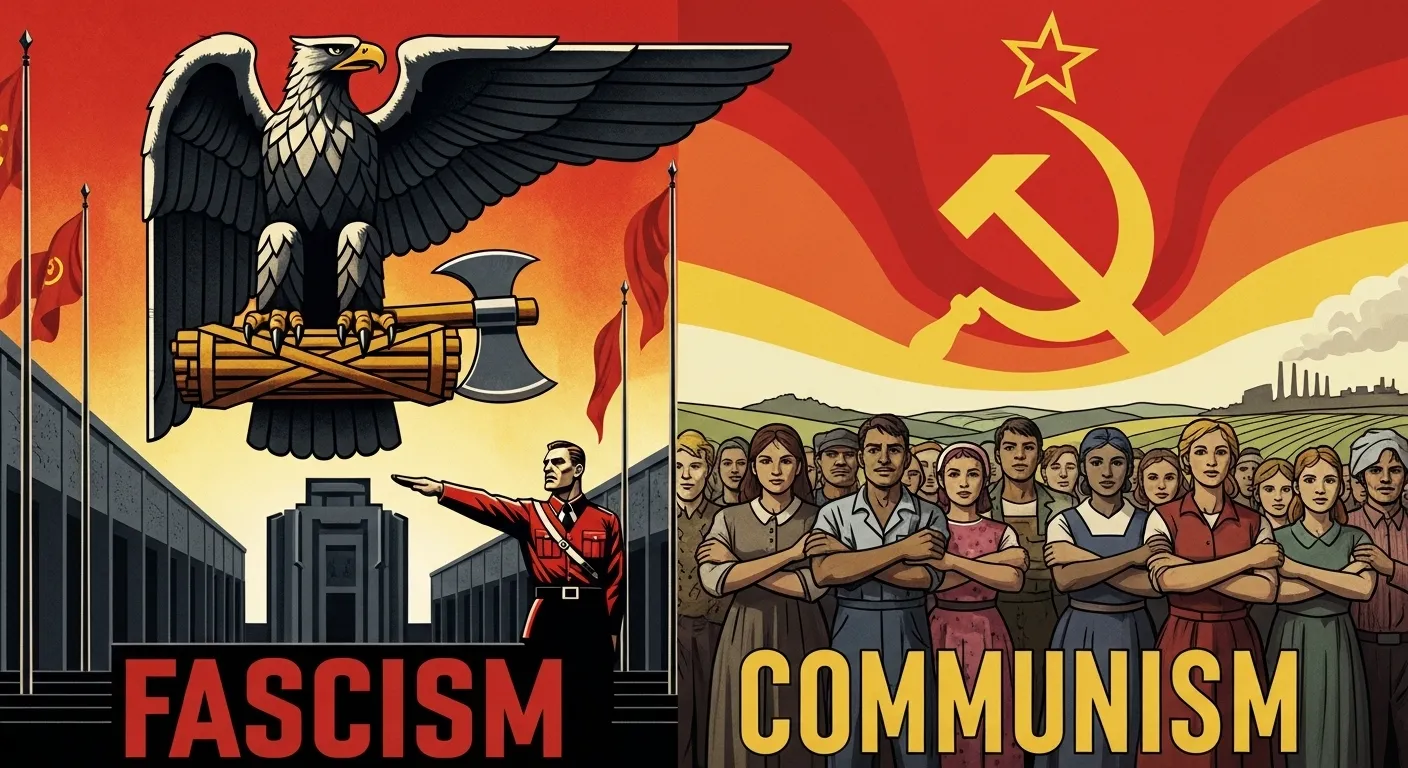
Imagine two countries facing economic crisis. In one, a powerful leader rises, promising unity, strict control, and national pride above everything else. In another, a revolutionary movement emerges, aiming to eliminate class differences and create a society where wealth is shared equally. These two paths reflect the difference between fascist and communist ideologies.
The difference between fascist and communist systems lies in their core beliefs about power, economy, and society. Fascism focuses on extreme nationalism, centralized authority, and often a single leader. Communism, on the other hand, is built on the idea of class equality, collective ownership, and a stateless society in theory.
Understanding the difference between fascist and communist is important because both ideologies have shaped major historical events and governments. While they may appear similar due to strong control, the difference between fascist and communist becomes clear when we examine their goals, structure, and values.
🔑 Key Difference Between Fascist and Communist
- Fascism: Authoritarian, nationalist system with centralized power under a leader
- Communism: Ideology aiming for classless society with shared ownership of resources
🌍 Why Is It Important to Know This Difference?
Knowing the difference between fascist and communist helps learners and citizens understand political systems and history. These ideologies have influenced wars, revolutions, and global politics. For experts, this knowledge is essential for analyzing governance, economics, and human rights issues. In society, understanding these systems promotes awareness and informed decision-making.
🔊 Pronunciation
- Fascist
- US: /ˈfæʃ.ɪst/
- UK: /ˈfæʃ.ɪst/
- Communist
- US: /ˈkɒm.jə.nɪst/
- UK: /ˈkɒm.jʊ.nɪst/
Now, let’s explore the difference between fascist and communist in detail.
🆚 Difference Between Fascist and Communist
1. Core Ideology
- Fascist: Focuses on nationalism and unity under authority
- Example: Loyalty to nation above all
- Example: Strong central leadership
- Communist: Focuses on class equality
- Example: Eliminating rich vs poor divide
- Example: Shared ownership
2. Leadership
- Fascist: Single powerful leader
- Example: Dictatorship
- Example: Cult of personality
- Communist: Party leadership (theoretically collective)
- Example: Communist party control
- Example: Central committee
3. Economic System
- Fascist: Allows private property but controlled by state
- Example: Businesses exist but regulated
- Example: State directs economy
- Communist: No private property
- Example: State owns industries
- Example: Collective farming
4. Social Structure
- Fascist: Supports hierarchy
- Example: Strong vs weak groups
- Example: Elite leadership
- Communist: Promotes equality
- Example: Classless society
- Example: Equal distribution
5. Nationalism
- Fascist: Extremely nationalist
- Example: National pride emphasized
- Example: Expansionist policies
- Communist: Internationalist
- Example: Workers of the world unite
- Example: Less focus on nation
6. Political Freedom
- Fascist: Limited freedoms
- Example: Censorship
- Example: Suppression of opposition
- Communist: Also limited in practice
- Example: One-party rule
- Example: Restricted speech
7. Role of State
- Fascist: Strong state controlling society
- Example: Military power
- Example: Strict laws
- Communist: State controls economy and aims to disappear eventually
- Example: State ownership
- Example: Theoretical stateless future
8. Historical Examples
- Fascist: Governments in Italy and Germany (20th century)
- Example: Authoritarian regimes
- Example: Nationalist movements
- Communist: USSR, China (historically)
- Example: Planned economies
- Example: Party rule
9. View on Individual
- Fascist: Individual serves the state
- Example: Obedience expected
- Example: Limited personal freedom
- Communist: Individual serves collective good
- Example: Community focus
- Example: Shared responsibility
10. Use of Propaganda
- Fascist: Heavy propaganda for nationalism
- Example: Media control
- Example: Leader glorification
- Communist: Propaganda for equality and ideology
- Example: Worker unity messages
- Example: State media
🔍 Nature and Behaviour
- Fascist: Authoritarian, nationalist, and hierarchical.
- Communist: Equality-focused, collective, but often centralized in practice.
🤔 Why Are People Confused?
People confuse fascism and communism because both systems often involve strong government control and limited political freedom. However, their goals and ideologies are fundamentally different.
📊 Comparison Table
| Feature | Fascist | Communist |
| Ideology | Nationalism | Class equality |
| Economy | Controlled capitalism | State ownership |
| Leadership | Single leader | Party rule |
| Freedom | Limited | Limited (in practice) |
| Nationalism | Strong | Weak |
| Similarity | Strong state control | One-party dominance |
⚖️ Which Is Better in What Situation?
From a modern democratic perspective, neither fascism nor authoritarian communism is considered ideal due to restrictions on freedom and human rights. However, communism’s goal of equality may appeal in contexts of extreme inequality, while fascism’s emphasis on order may attract those seeking stability though both come with significant risks.
🧠 Metaphors and Similes
- Fascism: “Like a strict army where everyone follows one commander.”
- Communism: “Like a shared kitchen where everyone contributes and eats equally.”
🎭 Connotative Meaning
- Fascist: Negative (oppression, control)
- Example: “A fascist regime limits freedom.”
- Communist: Mixed (equality vs control)
- Example: “Communism seeks fairness but may limit freedom.”
🗣️ Idioms & Expressions
- “Power corrupts” (applies to both systems)
- “All for one and one for all” (closer to communist ideal)
📚 Works in Literature
- The Communist Manifesto – Karl Marx & Friedrich Engels (Political theory, 1848)
- Mein Kampf – Adolf Hitler (Political ideology, 1925)
🎬 Movies
- The Great Dictator (1940, USA)
- Doctor Zhivago (1965, UK/USA)
❓ FAQs
1. Are fascism and communism the same?
No, they have different ideologies and goals.
2. Which supports equality?
Communism promotes equality.
3. Which supports nationalism?
Fascism strongly supports nationalism.
4. Do both limit freedom?
Yes, especially in practice.
5. Why are they controversial?
Due to historical misuse and human rights issues.
🌱 Usefulness in Society
Understanding these ideologies helps people analyze political systems, history, and global events more critically.
✨ Final Words
Fascism and communism are powerful ideologies with very different visions of society, yet both have shaped history in profound ways.
🧾 Conclusion
The difference between fascist and communist ideologies lies in their approach to power, economy, and society. Fascism emphasizes nationalism and centralized authority, while communism focuses on equality and shared ownership.
By understanding the difference between fascist and communist, individuals can better interpret historical events and political systems. In today’s world, this knowledge promotes awareness, critical thinking, and informed citizenship.