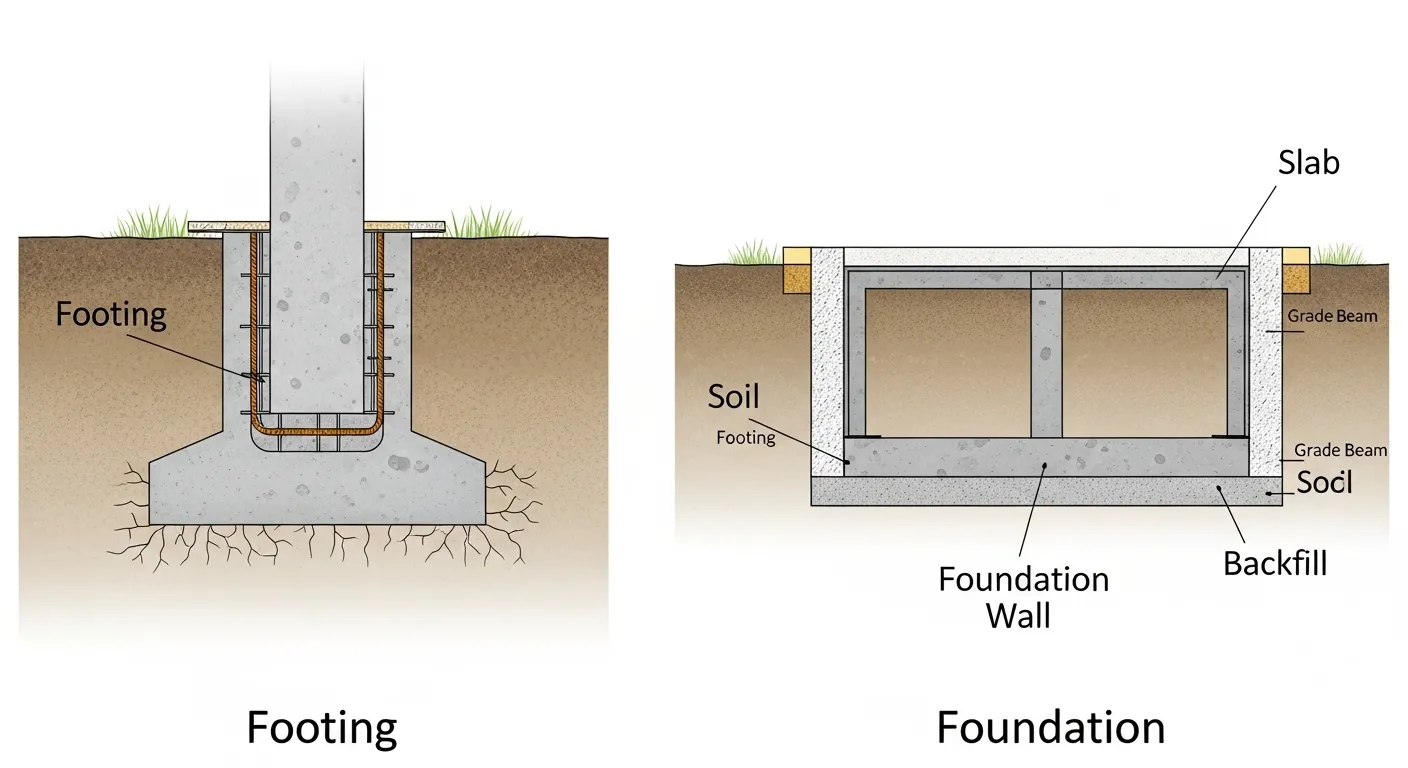
While visiting a construction site, Ahmed asked the engineer, “Why are we pouring concrete here before the walls?” The engineer replied, “This is the footing that supports the foundation.” Ahmed realized he had always confused the two terms.
In construction, footing and foundation are closely related, yet they serve different purposes. Understanding the difference between footing and foundation is essential for builders, civil engineers, and anyone involved in construction planning. Using the wrong type or misunderstanding their roles can affect the safety and stability of a structure.
Quick Answer
- Footing is the part of the foundation that transfers load directly to the soil.
- Foundation is the entire structural base of a building that supports the walls and distributes the weight.
In short: footing is part of the foundation, and the foundation supports the entire structure.
What is a Footing?
Footing is the lowermost part of a structure that directly touches the soil. It spreads the load from the columns or walls to prevent sinking or uneven settlement.
Key Features of Footing:
- Transfers structural load to soil
- Usually made of reinforced concrete
- Located below the ground level
- Can be of different types: strip, isolated, raft, or combined footing
Real-World Example:
For a small residential house, isolated footings are commonly used beneath columns to evenly distribute weight.
What is a Foundation?
Foundation is the entire base of a building, which may include footings, plinth beams, and slabs. Its main purpose is to transfer the load of the building to the ground safely and prevent settlement.
Key Features of Foundation:
- Supports the entire structure
- Can include footings, piles, raft, or mat foundations
- May extend deep into the soil for stability
- Ensures even distribution of load
Real-World Example:
High-rise buildings use pile foundations where deep foundations transfer heavy loads to stable soil layers.
Footing vs Foundation: Key Differences
| Feature | Footing | Foundation |
| Definition | Part of the structure that touches soil | Entire base that supports the building |
| Purpose | Distributes column/wall load to soil | Supports the structure and transfers load safely |
| Location | Below ground, directly under columns/walls | Below plinth level, can be shallow or deep |
| Material | Reinforced concrete commonly | Concrete, stone, brick, or combination |
| Types | Isolated, strip, combined, raft | Shallow, deep, pile, raft |
| Load Transfer | Directly to soil under the column | Through footings and structural elements |
| Size | Smaller and specific to columns/walls | Covers entire structure |
| Construction Stage | Constructed first | Built over footings or integrated |
Types of Footing
- Isolated Footing – For single columns
- Combined Footing – Supports two or more columns
- Strip Footing – Supports load-bearing walls
- Raft or Mat Footing – Supports entire building footprint
Types of Foundation
- Shallow Foundation – Near the surface (includes strip, spread, raft)
- Deep Foundation – Extends deep into soil (piles, caissons)
- Pile Foundation – Uses long, slender columns driven into soil
- Raft Foundation – Large slab supporting entire building
When to Use Footing vs Foundation
Footing:
- Use for individual columns or walls
- Suitable for lightweight structures
- Common in residential houses
Foundation:
- Use to support entire structure
- Required for heavy buildings or uneven soil
- Includes footings, plinth, and base slabs
Pros and Cons
Footing Pros:
- Directly transfers load to soil
- Simple and cost-effective for small buildings
- Easy to construct
Footing Cons:
- Only works for specific points (not whole building)
- Cannot support very heavy structures alone
Foundation Pros:
- Supports entire building safely
- Prevents uneven settlement
- Can be adapted for heavy or tall structures
Foundation Cons:
- More complex and expensive
- Requires careful planning and excavation
Real-Life Scenarios
Scenario 1: Single-Storey House
- Footing: Strip or isolated footing
- Foundation: Shallow foundation including footings and plinth
Scenario 2: High-Rise Building
- Footing: May use pile caps
- Foundation: Deep foundation with piles to transfer load
Scenario 3: Uneven Soil
- Footing: Reinforced raft footing
- Foundation: Raft or pile foundation depending on weight
Internal Linking Suggestions
For a construction or civil engineering blog, link this article to:
- “Difference Between Shallow and Deep Foundation”
- “Types of Footings in Building Construction”
- “What is Pile Foundation and When to Use It”
- “Building a Strong Foundation: Tips and Guidelines”
FAQs
1. Is footing the same as foundation?
No, footing is part of the foundation; the foundation is the complete base of a structure.
2. Can a building have foundation without footings?
Not typically. Footings are usually an integral part of most foundations.
3. Which is more important: footing or foundation?
Both are crucial; footings support individual loads, while the foundation ensures overall stability.
4. What materials are used for footing?
Reinforced concrete is most common, but stone or brick can be used in some cases.
5. What determines the type of foundation?
Factors include building weight, soil type, water table, and environmental conditions.
Conclusion
The difference between footing and foundation is simple: footing supports columns or walls directly, while foundation supports the entire building. Both are essential for stability and safety. Choosing the right type ensures longevity and prevents structural issues.