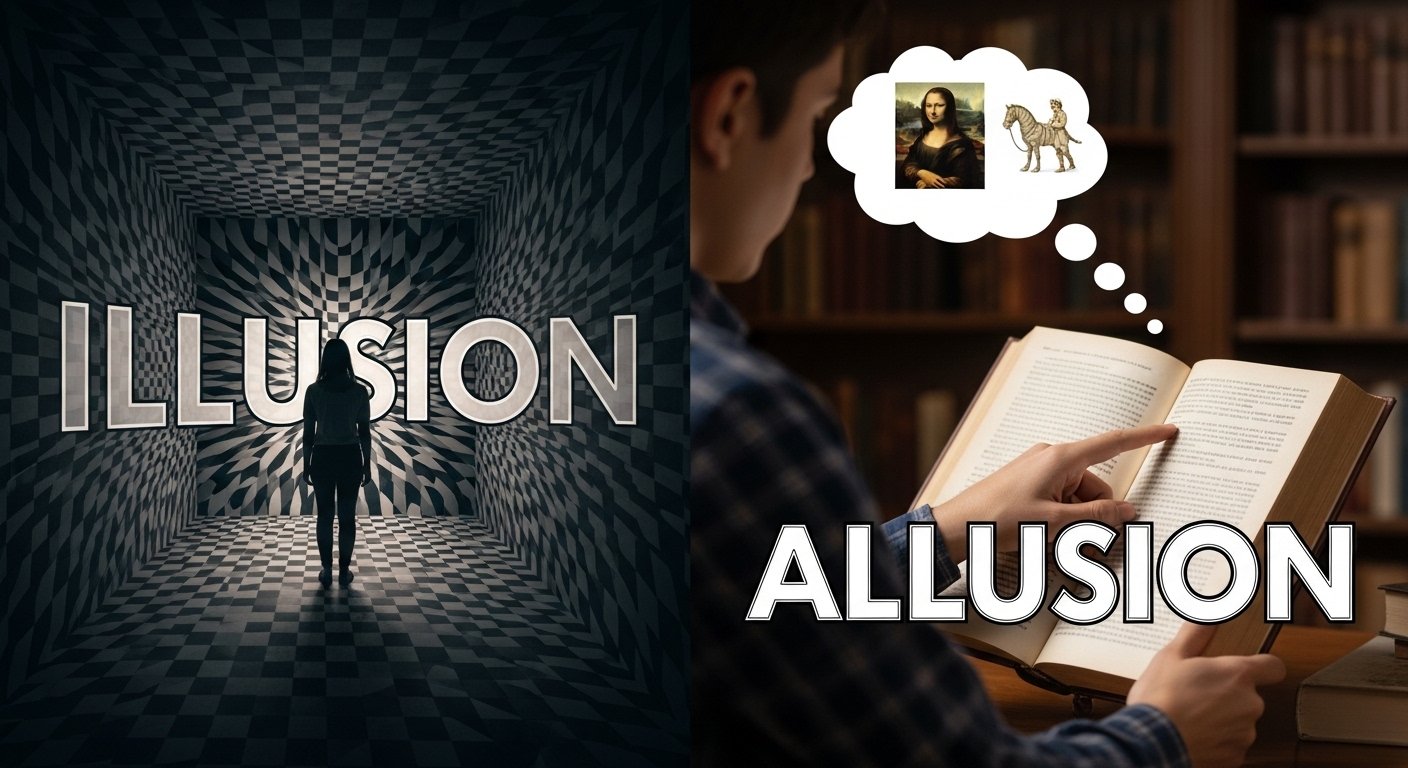
Imagine a magician performing on stage. He makes a coin disappear, and the audience is amazed. What they see is not real.it is only a trick of the eyes. This is called an illusion. Now imagine a writer telling a story and mentioning a famous hero like a legendary king or a popular movie character without explaining the whole story. That reference is called an allusion.
This simple situation helps explain the difference between illusion and allusion. Both words sound similar, but their meanings are completely different. An illusion deals with something that looks real but is not, while an allusion refers to an indirect reference to something well-known. Understanding the difference between illusion and allusion is important for students, writers, and readers. Many people confuse them because of their similar pronunciation. Learning the difference between illusion and allusion helps improve vocabulary, reading comprehension, and writing skills.
Key Difference Between the Both
The main difference between illusion and allusion is that illusion relates to a false appearance or deception, while allusion refers to an indirect reference to a person, event, or story.
Why Is Their Difference Necessary to Know for Learners and Experts?
Understanding the difference between illusion and allusion is important in education, literature, and communication. Students often encounter these words in English classes, poetry, novels, and essays. If they confuse them, the meaning of a sentence may change completely.
For learners, knowing this difference improves reading comprehension and vocabulary skills. For writers and teachers, it helps in clear expression and literary analysis. In society, clear language helps people communicate ideas effectively in books, speeches, journalism, and media. Therefore, recognizing the difference between illusion and allusion strengthens language skills and helps readers understand deeper meanings in literature and storytelling.
Pronunciation of the Keywords
Illusion
- US: /ɪˈluːʒən/
- UK: /ɪˈluːʒən/
Allusion
- US: /əˈluːʒən/
- UK: /əˈluːʒən/
Linking Hook
Now that we understand their meanings and importance, let us explore the difference between illusion and allusion in detail with clear explanations and examples.
Difference Between Illusion and Allusion
1. Meaning
Illusion refers to something that deceives the senses or mind.
Allusion refers to a brief or indirect reference to something famous.
Examples of illusion:
- The mirage in the desert was an illusion.
- The magician created the illusion of floating in the air.
Examples of allusion:
- The writer made an allusion to a famous king in the story.
- The speech included an allusion to a historical event.
2. Field of Use
Illusion is commonly used in psychology, magic, and visual perception.
Allusion is mainly used in literature, speeches, and writing.
Examples of illusion:
- Optical illusions confuse our eyes.
- Magic tricks create illusions for entertainment.
Examples of allusion:
- Poets often use allusions to ancient myths.
- A movie dialogue may include an allusion to a famous film.
3. Reality vs Reference
Illusion relates to false reality.
Allusion relates to reference or mention.
Examples of illusion:
- The painting created an illusion of depth.
- The mirror created an illusion of space.
Examples of allusion:
- The novel includes an allusion to a famous war.
- The teacher made an allusion to a famous scientist.
4. Purpose
Illusion aims to deceive or trick the senses.
Allusion aims to enrich meaning or connect ideas.
Examples of illusion:
- Stage performers use illusions to entertain audiences.
- Visual artists create illusions of movement.
Examples of allusion:
- Writers use allusions to add cultural meaning.
- Speakers use allusions to connect with listeners.
5. Nature
Illusion is sensory and visual.
Allusion is literary and linguistic.
Examples of illusion:
- A 3D painting creates a visual illusion.
- The desert mirage is an illusion caused by heat.
Examples of allusion:
- The poem includes an allusion to ancient mythology.
- The novel makes an allusion to a famous hero.
6. Understanding
Illusion can be understood by seeing or experiencing it.
Allusion requires knowledge of culture or history.
Examples of illusion:
- Anyone can see an optical illusion.
- A magic trick illusion amazes the audience.
Examples of allusion:
- Only readers who know the myth understand the allusion.
- The speech’s allusion to history was understood by educated listeners.
7. Form
Illusion is often physical or visual.
Allusion is verbal or written.
Examples of illusion:
- Mirrors create illusions in fun houses.
- Stage lighting creates illusions in theater.
Examples of allusion:
- The essay contains an allusion to a famous novel.
- The writer uses an allusion to mythology.
8. Impact
Illusion mainly affects perception.
Allusion mainly affects interpretation and meaning.
Examples of illusion:
- The optical illusion confused viewers.
- The magician’s illusion amazed the crowd.
Examples of allusion:
- The literary allusion deepened the story.
- The speech’s allusion inspired the audience.
9. Context
Illusion appears in science, art, and magic.
Allusion appears in literature, speeches, and education.
Examples of illusion:
- Psychology studies visual illusions.
- Artists create illusions using perspective.
Examples of allusion:
- Authors use allusions in novels.
- Teachers explain allusions in literature classes.
10. Core Idea
Illusion = False appearance
Allusion = Indirect reference
Examples of illusion:
- The ghostly figure was only an illusion.
- The desert water was an illusion.
Examples of allusion:
- The story contains an allusion to a famous legend.
- The article includes an allusion to a historical leader.
Nature and Behaviour of Both
Illusion is related to perception and the senses. It tricks the mind or eyes and creates something that appears real but is not.
Allusion is related to language and literature. It connects a text with another well-known story, person, or event to add deeper meaning.
Why People Are Confused About Their Use?
People confuse these words mainly because they sound very similar. Both words also appear frequently in English classes and literature discussions. Additionally, they share a similar spelling pattern, which leads to mistakes in writing and pronunciation. However, their meanings are entirely different—one relates to perception, while the other relates to references.
Table Showing Differences and Similarities
| Aspect | Illusion | Allusion | Similarity |
| Meaning | False appearance | Indirect reference | Both are English vocabulary words |
| Field | Psychology, art, magic | Literature, writing | Both appear in education |
| Nature | Sensory | Linguistic | Both affect interpretation |
| Purpose | Deceive senses | Enrich meaning | Both used creatively |
| Form | Visual or physical | Verbal or written | Both improve expression |
Which Is Better in What Situation?
Illusion is better in situations where visual effects or sensory experiences are needed. Magicians, artists, filmmakers, and psychologists often use illusions to create amazement or study perception. Illusions make entertainment more exciting and help scientists understand how the human brain interprets images and reality.
Allusion is better in writing and communication. Writers, poets, and speakers use allusions to connect ideas with famous stories, historical events, or cultural references. Allusions make writing more powerful and meaningful because they allow readers to understand deeper ideas without long explanations.
How the Keywords Are Used in Metaphors and Similes
Illusion metaphor
Example:
“His promise of easy success was only an illusion.”
Simile example:
“The dream vanished like an illusion.”
Allusion metaphor
Example:
“The speech was filled with allusions to ancient heroes.”
Simile example:
“Her story flowed like an allusion to a classic tale.”
Connotative Meaning
Illusion
Positive: imagination, creativity
Example: “Art often plays with illusion.”
Negative: deception or false hope
Example: “His belief in quick success was an illusion.”
Neutral: visual phenomenon
Example: “The painting creates an illusion of depth.”
Allusion
Positive: intelligence and literary richness
Example: “The writer used a clever allusion.”
Neutral: simple reference
Example: “The article contains an allusion to history.”
Idioms or Proverbs Related to the Words
“Smoke and mirrors” (related to illusion)
Example: “The magician’s trick was just smoke and mirrors.”
“A hint of something” (related to allusion)
Example: “The speech had a hint of an allusion to past struggles.”
Works in Literature Using the Keywords
- Illusions: The Adventures of a Reluctant Messiah — Philosophical Fiction, Richard Bach, 1977
- The Art of Allusion — Literary Criticism, various academic writers
Movies Related to the Theme
- The Illusionist — 2006, USA
- Now You See Me — 2013, USA (focused on magical illusions)
Frequently Asked Questions
1. What is the basic difference between illusion and allusion?
Illusion means a false appearance, while allusion means an indirect reference.
2. Why do people confuse illusion and allusion?
Because the words sound similar and have similar spelling.
3. Is illusion related to vision?
Yes, illusions often involve visual or sensory deception.
4. Is allusion used in literature?
Yes, writers frequently use allusions to refer to famous stories or events.
5. Can both words appear in the same text?
Yes. A story might describe an illusion and also contain an allusion.
How Both Are Useful for Surroundings
Illusions are useful in art, entertainment, and psychology to understand how people perceive reality. They are widely used in films, games, and visual design. Allusions are useful in literature, education, and communication because they connect ideas with history, culture, and shared knowledge.
Final Words for the Both
Illusion and allusion are two powerful English words that enrich language in different ways. Illusion deals with perception and visual deception, while allusion enriches writing through references to culture and history.
Conclusion
The difference between illusion and allusion lies mainly in their meanings and usage. Illusion refers to something that deceives the senses or creates a false appearance, often seen in magic, art, or visual perception. Allusion, on the other hand, is an indirect reference to a well-known person, story, event, or cultural idea, commonly used in literature and speech. Although the two words sound similar, their functions are very different. Understanding the difference between illusion and allusion helps students, writers, and readers communicate more clearly and appreciate deeper meanings in texts. By learning these distinctions, individuals can strengthen their vocabulary and improve their reading and writing skills.