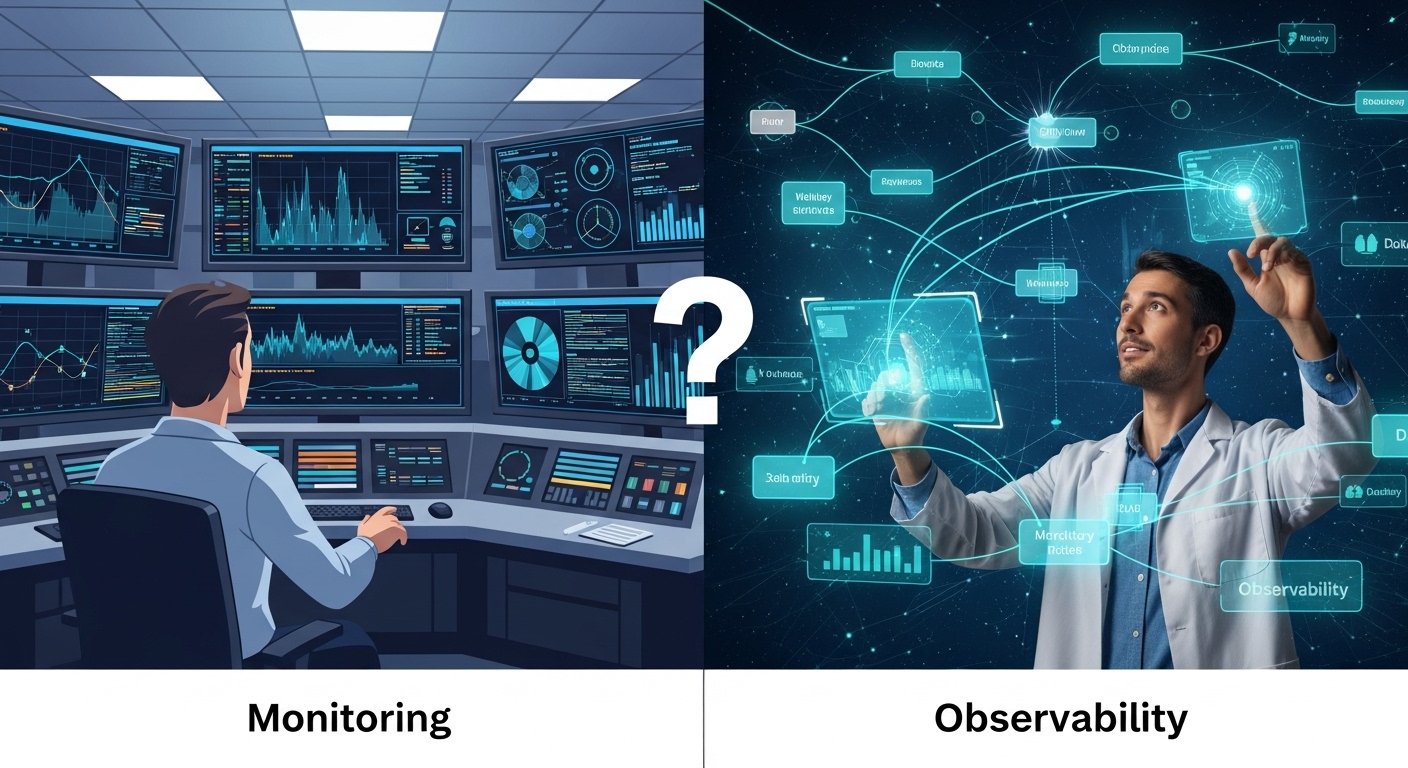
Imagine a busy online shopping website during a big sale. Suddenly, the website becomes slow, and customers start complaining. The technical team quickly checks their monitoring tools to see if something is wrong. Monitoring shows that the server’s CPU usage is high. But that is not enough to understand the whole problem. The engineers then use observability tools to analyze logs, metrics, and traces to find the exact cause.
This real-world situation clearly explains the difference between observability and monitoring. While monitoring helps detect when something goes wrong, observability helps explain why it went wrong. Understanding the difference between observability and monitoring is important for developers, IT teams, and technology learners. Many people use these terms together, but they serve different purposes. Learning the difference between observability and monitoring helps organizations build better systems and solve problems faster in today’s digital world.
Key Difference Between the Both
The main difference between observability and monitoring is that monitoring focuses on detecting known issues, while observability focuses on exploring and understanding unknown problems within a system.
Monitoring collects system data and alerts engineers when a threshold is crossed. Observability goes deeper by analyzing different data sources to explain the behavior of a system.
Why Is Their Difference Necessary to Know for Learners and Experts?
Understanding the difference between observability and monitoring is essential in the modern technology-driven society. Businesses rely heavily on software systems, cloud platforms, and digital services. If these systems fail, it can cause financial loss, security risks, and poor customer experiences.
For learners, knowing this difference helps build strong knowledge in IT, software engineering, and cloud computing. For experts and professionals, it improves troubleshooting skills and system reliability. In society, reliable digital systems support banking, healthcare, education, and communication services. Therefore, distinguishing between monitoring and observability helps organizations maintain stable and trustworthy technology infrastructure.
Pronunciation of the Keywords
Observability
- US: /əbˌzɝː.vəˈbɪl.ə.t̬i/
- UK: /əbˌzɜː.vəˈbɪl.ɪ.ti/
Monitoring
- US: /ˈmɑː.nə.tɚ.ɪŋ/
- UK: /ˈmɒn.ɪ.tər.ɪŋ/
Linking Hook
Now that we understand the basic idea and importance of these terms, let us explore the difference between observability and monitoring in detail through clear points and examples.
Difference Between Observability and Monitoring
1. Purpose
Monitoring is used to track system performance and detect issues.
Observability is used to deeply understand system behavior.
Examples:
- Monitoring alerts when server memory reaches 90%.
- Monitoring shows website downtime.
Examples for observability:
- Observability explains why memory usage increased.
- Observability traces a slow request through multiple services.
2. Type of Problems
Monitoring focuses on known problems.
Observability helps find unknown problems.
Examples:
Monitoring alerts when disk space becomes full.
Monitoring warns when CPU usage is too high.
Observability examples:
Observability helps find hidden software bugs.
Observability reveals unexpected system delays.
3. Data Sources
Monitoring mainly uses metrics.
Observability uses metrics, logs, and traces together.
Examples:
Monitoring shows the number of requests per minute.
Monitoring tracks server uptime.
Observability examples:
Observability reads application logs for error details.
Observability traces user requests across microservices.
4. Depth of Analysis
Monitoring provides surface-level information.
Observability provides deep system insights.
Examples:
Monitoring shows that response time increased.
Monitoring reports a database error.
Observability examples:
Observability explains which database query caused the delay.
Observability identifies the service responsible for the error.
5. Approach
Monitoring is reactive.
Observability is investigative and exploratory.
Examples:
Monitoring reacts when alerts are triggered.
Monitoring sends notifications when services fail.
Observability examples:
Observability explores system behavior before failures occur.
Observability investigates hidden performance issues.
6. System Complexity
Monitoring works well with simple systems.
Observability is designed for complex distributed systems.
Examples:
Monitoring checks a single server.
Monitoring tracks a simple application.
Observability examples:
Observability analyzes cloud infrastructure.
Observability tracks microservices communication.
7. Tools
Monitoring uses traditional monitoring tools.
Observability uses advanced analytics platforms.
Examples:
Monitoring tools show system dashboards.
Monitoring tools create performance alerts.
Observability examples:
Observability platforms analyze logs and traces.
Observability tools map system dependencies.
8. Troubleshooting
Monitoring helps identify that a problem exists.
Observability helps identify the cause of the problem.
Examples:
Monitoring detects that a website is slow.
Monitoring detects server crashes.
Observability examples:
Observability reveals the faulty microservice.
Observability identifies a problematic API call.
9. Visibility
Monitoring gives limited visibility.
Observability gives complete system visibility.
Examples:
Monitoring shows server health.
Monitoring shows network traffic levels.
Observability examples:
Observability shows full request paths.
Observability reveals interactions between services.
10. Goal
Monitoring aims to detect problems quickly.
Observability aims to understand and prevent problems.
Examples:
Monitoring quickly alerts engineers about downtime.
Monitoring tracks service availability.
Observability examples:
Observability predicts future failures.
Observability improves system design and stability.
Nature and Behaviour of Both
Monitoring is structured and rule-based. It depends on predefined metrics and thresholds. Its behavior is reactive because it waits for alerts before action is taken.
Observability is exploratory and analytical. It collects large amounts of system data and allows engineers to investigate patterns, anomalies, and root causes.
Why People Are Confused About Their Use?
People often confuse these terms because observability includes monitoring as one of its components. Both use similar tools and data sources such as metrics and dashboards. In many organizations, monitoring tools are labeled as observability platforms, which increases confusion. Additionally, both aim to improve system reliability, so beginners sometimes think they are the same concept.
Table Showing Differences and Similarities
| Aspect | Monitoring | Observability | Similarity |
| Purpose | Detect system problems | Understand system behavior | Both improve system reliability |
| Data | Metrics | Metrics, logs, traces | Both use system data |
| Focus | Known issues | Unknown issues | Both help troubleshooting |
| Depth | Surface-level insights | Deep analysis | Both analyze performance |
| Approach | Reactive | Exploratory | Both support IT operations |
Which Is Better in What Situation?
Monitoring is better when organizations need quick alerts and simple performance tracking. For example, monitoring tools are ideal for checking server uptime, CPU usage, and basic application performance. Small systems and websites benefit greatly from monitoring because it provides clear warnings before systems fail.
Observability is better in complex systems such as cloud platforms, microservices architectures, and large enterprise software. These environments have many interconnected components, and simple monitoring is not enough. Observability helps engineers understand system behavior, detect hidden issues, and improve overall system performance.
How the Keywords Are Used in Metaphors and Similes
Monitoring metaphor:
Monitoring is like a security guard watching cameras to detect suspicious activity.
Example:
“The monitoring system stood like a guard, watching every server.”
Observability metaphor:
Observability is like a doctor diagnosing a patient to find the root cause of illness.
Example:
“Observability acted like a doctor, analyzing every symptom of the system.”
Connotative Meaning
Monitoring
Positive: reliability, protection, control
Example: “Continuous monitoring keeps the network secure.”
Neutral: tracking or watching
Example: “The company uses monitoring to observe system health.”
Negative: surveillance or constant watching
Example: “Employees felt uncomfortable under strict monitoring.”
Observability
Positive: insight and understanding
Example: “Observability helped engineers solve the problem quickly.”
Neutral: system visibility
Example: “Observability provides data about system performance.”
Negative (rare): complexity
Example: “Some developers think observability tools are difficult to use.”
Idioms or Proverbs Related to the Words
“Keep an eye on” (related to monitoring)
Example: “The engineer kept an eye on the server performance.”
“Look beneath the surface” (related to observability)
Example: “To fix the issue, developers must look beneath the surface.”
Works in Literature Using the Keywords
- Observability Engineering — Technology/Non-fiction, Charity Majors, Liz Fong-Jones & George Miranda, 2022
- Monitoring with Prometheus — Technical Guide, James Turnbull, 2018
Movies Related to the Theme
- The Circle — 2017, USA (about surveillance and monitoring technology)
- Eagle Eye — 2008, USA (advanced monitoring and intelligence systems)
Frequently Asked Questions
1. Are observability and monitoring the same?
No. Monitoring detects problems, while observability helps explain and analyze them.
2. Can monitoring exist without observability?
Yes, many traditional systems use only monitoring tools.
3. Does observability replace monitoring?
No. Observability expands and improves monitoring rather than replacing it.
4. Why is observability important in cloud computing?
Because cloud systems are complex and require deeper insights into system behavior.
5. What data does observability use?
Observability uses metrics, logs, and traces to analyze systems.
How Both Are Useful for Surroundings
Monitoring and observability both help maintain reliable digital environments. Monitoring ensures systems run smoothly by detecting failures quickly. Observability helps engineers improve system design and performance by understanding complex interactions. Together, they support stable digital services used in banking, healthcare, education, and online communication.
Final Words for the Both
Monitoring is essential for detecting system issues quickly, while observability provides deeper understanding and insight into system behavior. Both concepts work together to maintain reliable and efficient technology systems.
Conclusion
The difference between observability and monitoring lies in their purpose and depth of analysis. Monitoring focuses on tracking system performance and detecting issues through predefined metrics and alerts. Observability, on the other hand, goes deeper by analyzing metrics, logs, and traces to understand the root cause of problems. In modern software environments, especially cloud and distributed systems, relying only on monitoring is not enough. Observability provides the insights needed to manage complex infrastructures effectively. By understanding the difference between observability and monitoring, learners and professionals can improve troubleshooting skills, maintain stable systems, and build more reliable digital services for businesses and society.