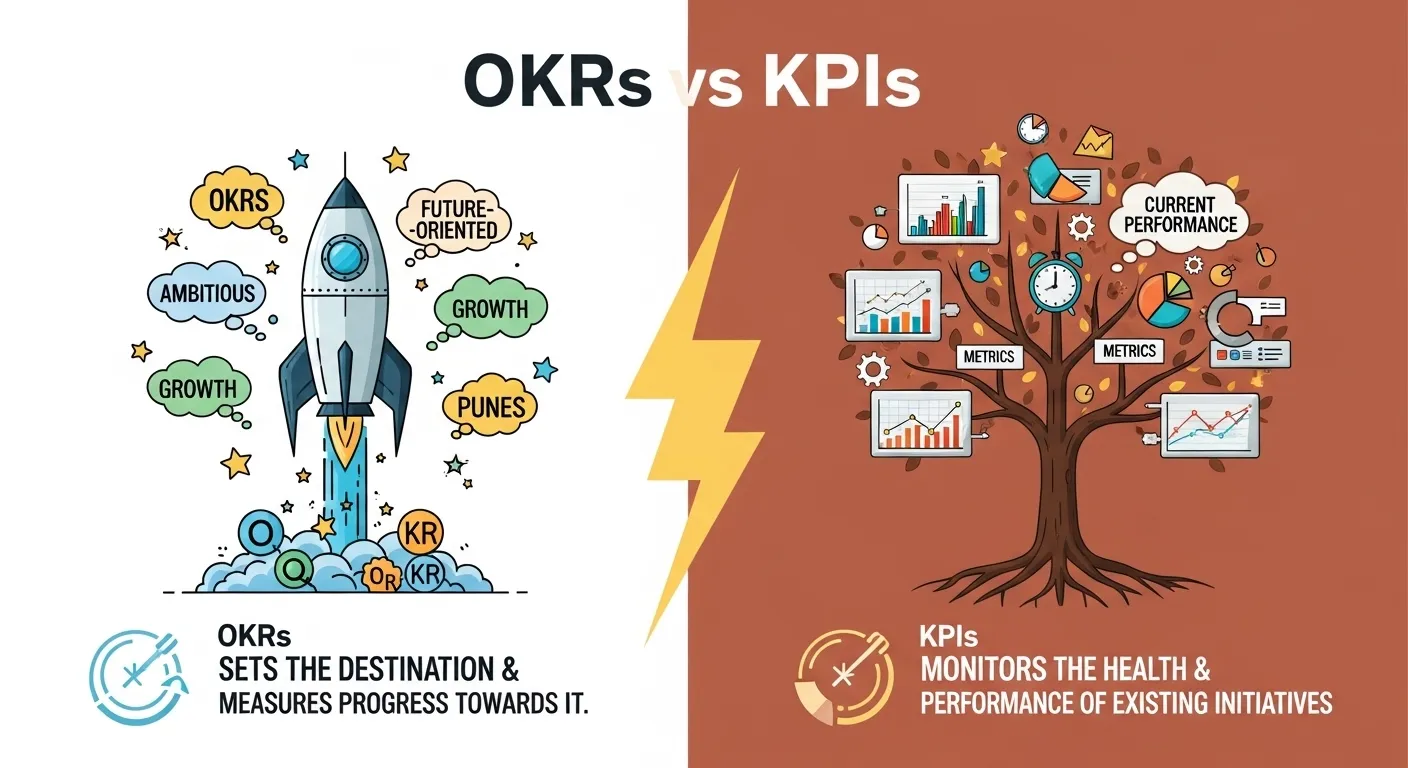
Difference Between OKRs and KPIs: Key Insights for Business Success. In today’s fast-paced business environment, measuring performance is essential. Two popular tools used by organizations are OKRs (Objectives and Key Results) and KPIs (Key Performance Indicators). Many professionals confuse these terms, but understanding the difference between OKRs and KPIs can make or break a company’s strategic goals. OKRs are goal-setting frameworks that define ambitious objectives and measurable results, while KPIs track ongoing performance to monitor progress. Businesses often use both together to ensure they are not only achieving targets but also staying aligned with their broader vision. Learning the difference between OKRs and KPIs is essential for managers, teams, and executives alike.
Pronunciation
- OKRs: US /oʊ-keɪ-ɑːrz/, UK /oʊ-keɪ-ɑːz/
- KPIs: US /ˌkeɪ-piː-ˈaɪz/, UK /ˌkeɪ-piː-ˈaɪz/
Linking Hook: Now that we understand their basic meanings, let’s dive into the key differences between OKRs and KPIs.
Difference Between OKRs and KPIs
1. Purpose
- OKRs: Focus on ambitious goals to drive change.
- Example 1: Increase customer engagement by 50% this quarter.
- Example 2: Launch a new product line by the end of the year.
- KPIs: Track performance metrics for ongoing operations.
- Example 1: Website traffic per month.
- Example 2: Monthly sales revenue.
2. Scope
- OKRs: Strategic and organization-wide.
- Example 1: Improve company culture across departments.
- Example 2: Expand market share internationally.
- KPIs: Operational and specific to teams or departments.
- Example 1: Customer support ticket resolution time.
- Example 2: Number of calls handled by the sales team.
3. Time Frame
- OKRs: Typically set quarterly or annually.
- Example 1: Q1 objective: Reduce churn by 20%.
- Example 2: Annual objective: Achieve market leader status.
- KPIs: Can be tracked daily, weekly, or monthly.
- Example 1: Daily website uptime percentage.
- Example 2: Weekly production output.
4. Ambition Level
- OKRs: Stretch goals designed to push boundaries.
- Example 1: Triple social media followers in six months.
- Example 2: Achieve zero product defects by next quarter.
- KPIs: Realistic, measurable, and achievable targets.
- Example 1: Maintain 95% on-time delivery rate.
- Example 2: Achieve 80% customer satisfaction.
5. Measurement
- OKRs: Measured by key results indicating progress.
- Example 1: Increase newsletter subscribers from 10k to 15k.
- Example 2: Reduce onboarding time from 10 days to 5 days.
- KPIs: Measured with metrics and dashboards.
- Example 1: Average revenue per user.
- Example 2: Employee turnover rate.
6. Flexibility
- OKRs: Can evolve during the period to align with strategy.
- Example 1: Adjust objectives based on market trends.
- Example 2: Change product launch goals if timelines shift.
- KPIs: Usually fixed for the measurement period.
- Example 1: Daily website uptime target remains constant.
- Example 2: Monthly sales quota stays unchanged.
7. Accountability
- OKRs: Encourages team alignment and collaboration.
- Example 1: Marketing and product teams jointly own a launch OKR.
- Example 2: HR and management share OKR to improve employee retention.
- KPIs: Assigned to individuals or teams.
- Example 1: Customer service team responsible for response time KPI.
- Example 2: Sales team accountable for monthly revenue KPI.
8. Outcome vs Process
- OKRs: Outcome-oriented, focusing on results.
- Example 1: Achieve top 3 ranking in app store by next quarter.
- Example 2: Increase annual recurring revenue by 25%.
- KPIs: Process-oriented, monitoring performance.
- Example 1: Number of calls made by sales team.
- Example 2: Average handling time per customer.
9. Motivation
- OKRs: Inspire teams with ambitious goals.
- Example 1: Push team to innovate product design.
- Example 2: Encourage cross-department collaboration.
- KPIs: Monitor efficiency without necessarily inspiring change.
- Example 1: Track daily production efficiency.
- Example 2: Maintain SLA compliance in IT support.
10. Review Frequency
- OKRs: Reviewed quarterly or during strategy meetings.
- Example 1: Quarterly check-in on market expansion OKR.
- Example 2: Adjust key results based on progress reviews.
- KPIs: Monitored continuously via dashboards.
- Example 1: Daily website performance reports.
- Example 2: Weekly sales performance reports.
Nature and Behaviour
- OKRs: Ambitious, strategic, motivating, result-focused.
- KPIs: Quantitative, operational, monitoring-focused, consistent.
Why People Are Confused
Both OKRs and KPIs involve measurement, but OKRs set goals while KPIs track performance. OKRs can include KPIs as metrics to measure success.
Table: Difference and Similarity
| Feature | OKRs | KPIs | Similarity |
| Purpose | Ambitious goals | Track performance metrics | Both track success |
| Scope | Strategic, company-wide | Operational, team-specific | Both used in management |
| Time Frame | Quarterly or yearly | Daily, weekly, or monthly | Both have measurable timelines |
| Ambition | Stretch goals | Realistic targets | Both define progress |
| Measurement | Key Results | Metrics/Dashboards | Both track performance |
Which is Better in What Situation?
OKRs are better for driving innovation, aligning teams, and achieving strategic objectives. KPIs are better for monitoring daily operations, efficiency, and business health. Using both together gives a complete picture of performance and growth.
Use in Metaphors and Similes
- OKRs: “OKRs are the compass guiding your company through uncharted waters.”
- KPIs: “KPIs are the speedometer, showing how fast you are moving toward the target.”
Connotative Meaning
- OKRs: Positive, motivating, growth-oriented.
- Example: OKRs inspire employees to achieve ambitious goals.
- KPIs: Neutral, factual, performance-oriented.
- Example: KPIs help monitor company efficiency.
Idioms or Proverbs
- “Aim for the stars, even if you miss” – related to OKRs.
- “What gets measured gets managed” – relates to KPIs.
Literature Featuring the Keywords
- Measure What Matters (Business/Management, John Doerr, 2018) – OKRs.
- The Balanced Scorecard (Business, Robert Kaplan & David Norton, 1996) – KPIs.
Movies About the Keywords
- Moneyball (2011, USA) – shows data-driven KPIs in sports.
- The Social Network (2010, USA) – OKRs implicit in company growth strategies.
FAQs
1. Are OKRs and KPIs the same?
No, OKRs set ambitious goals; KPIs track performance.
2. Can KPIs be part of OKRs?
Yes, KPIs can be metrics used to measure key results.
3. Which one motivates employees more?
OKRs motivate with ambitious, inspiring goals.
4. How often should OKRs be reviewed?
Typically quarterly or annually.
5. Can a company use both simultaneously?
Yes, combining OKRs and KPIs ensures strategic alignment and operational tracking.
How Both Are Useful for Surroundings
OKRs encourage innovation and strategic alignment across teams. KPIs monitor efficiency and maintain operational health. Together, they enhance productivity and drive sustainable growth.
Final Words
OKRs and KPIs are complementary tools. OKRs inspire change and growth, while KPIs ensure accountability and operational efficiency. Understanding their differences is key to effective business management.
Conclusion
OKRs and KPIs are essential tools for modern businesses. OKRs focus on ambitious goals and outcomes, inspiring teams to achieve strategic objectives, while KPIs monitor ongoing performance for operational efficiency. Using both together provides a balanced approach to growth, accountability, and progress tracking. Proper understanding of OKRs and KPIs ensures businesses not only measure success accurately but also align their teams with long-term visions. By mastering these frameworks, companies can boost performance, drive results, and maintain sustainable growth.