Ayesha had always dreamed of teaching English abroad. While searching online, she came across two popular terms: TEFL and TESOL. At first glance, they seemed identical. Both promised exciting teaching opportunities, travel, and career growth. But as she dug deeper, she realized there was a subtle yet important difference between TEFL and TESOL.
Understanding the difference between TEFL and TESOL is essential for anyone planning to teach English professionally. These terms are often used interchangeably, which adds to the confusion. However, the difference between TEFL and TESOL lies in context, teaching environment, and sometimes certification usage.
If you’re a student, aspiring teacher, or professional looking to expand your career, knowing the difference between TEFL and TESOL can guide your decisions. It helps you choose the right certification, teaching location, and job opportunities that match your goals.
🔑 Key Difference Between TEFL and TESOL
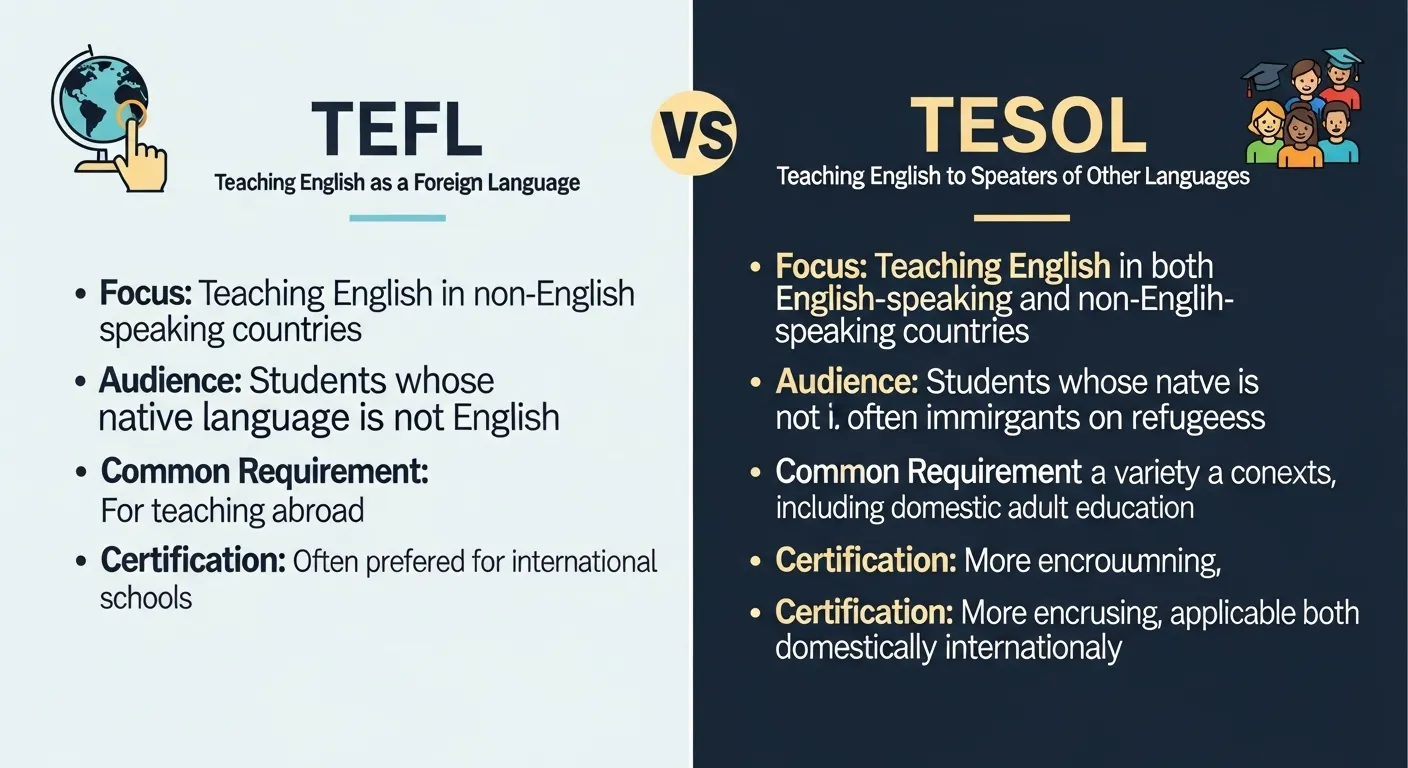
- TEFL (Teaching English as a Foreign Language): Teaching English in countries where English is not the primary language
- TESOL (Teaching English to Speakers of Other Languages): A broader term that includes both foreign and second language teaching
🌍 Why Is It Important to Know This Difference?
Knowing the difference between TEFL and TESOL helps learners and professionals select the right career path. TEFL is ideal for teaching abroad, while TESOL opens doors to both local and international opportunities. This knowledge is valuable for job applications, certifications, and long-term career planning in the global education system.
🔊 Pronunciation
- TEFL
- US: /ˈtɛf.əl/
- UK: /ˈtɛf.əl/
- TESOL
- US: /ˈtiː.sɒl/
- UK: /ˈtiː.sɒl/
Before we dive deeper, let’s explore the detailed difference between TEFL and TESOL.
🆚 Difference Between TEFL and TESOL
1. Full Form
- TEFL: Teaching English as a Foreign Language
- Example: Teaching English in Japan
- Example: Teaching in Saudi Arabia
- TESOL: Teaching English to Speakers of Other Languages
- Example: Teaching immigrants in the USA
- Example: Teaching international students
2. Scope
- TEFL: Narrower scope
- Example: Focuses on non-English-speaking countries
- Example: Classroom abroad
- TESOL: Broader scope
- Example: Includes TEFL and TESL
- Example: Covers global and local teaching
3. Teaching Context
- TEFL: English not used in daily life
- Example: China classrooms
- Example: Korea schools
- TESOL: English may be used in daily life
- Example: USA ESL classes
- Example: UK language centers
4. Usage of Term
- TEFL: Common in job ads abroad
- Example: “TEFL teacher needed”
- Example: Language schools overseas
- TESOL: Academic and professional term
- Example: University programs
- Example: Research field
5. Certification
- TEFL: Certificate for teaching abroad
- Example: 120-hour TEFL course
- Example: Online TEFL certification
- TESOL: Certification or degree
- Example: TESOL diploma
- Example: Master’s in TESOL
6. Career Opportunities
- TEFL: Mainly international jobs
- Example: Teaching in Asia
- Example: Language institutes abroad
- TESOL: Wider opportunities
- Example: Schools, colleges, NGOs
- Example: Teaching locally and abroad
7. Target Students
- TEFL: Foreign learners in their own country
- Example: School children in Spain
- Example: Adults in Thailand
- TESOL: Mixed learners
- Example: Immigrants
- Example: International students
8. Academic Recognition
- TEFL: Less academic focus
- Example: Short-term certification
- Example: Practical training
- TESOL: More academic
- Example: University degrees
- Example: Research-based learning
9. Flexibility
- TEFL: Location-specific
- Example: Must go abroad
- Example: Travel required
- TESOL: Flexible
- Example: Teach locally or abroad
- Example: Online teaching
10. Popularity
- TEFL: Popular among travelers
- Example: Gap year teachers
- Example: Short-term careers
- TESOL: Popular among professionals
- Example: Career educators
- Example: Academic experts
🔍 Nature and Behaviour
- TEFL: Practical, travel-focused, and job-oriented.
- TESOL: Comprehensive, academic, and career-focused.
🤔 Why Are People Confused?
People are confused because TEFL and TESOL are often used interchangeably by employers and training institutes. Many courses overlap in content, making the distinction less clear.
📊 Comparison Table
| Feature | TEFL | TESOL |
| Scope | Narrow | Broad |
| Focus | Teaching abroad | Teaching globally |
| Certification | Short-term | Academic/degree-based |
| Flexibility | Limited | High |
| Similarity | Both teach English learners | Both require training |
⚖️ Which Is Better in What Situation?
TEFL is better if you want to travel and teach English in non-English-speaking countries. It’s ideal for beginners, gap-year students, or those seeking adventure and short-term teaching jobs.
TESOL is better if you want a long-term teaching career with flexibility. It suits professionals who want to teach both locally and internationally, including academic institutions.
🧠 Metaphors and Similes
- TEFL: “Like a passport to teaching abroad.”
- TESOL: “Like a master key to global teaching opportunities.”
🎭 Connotative Meaning
- TEFL: Positive (adventure, travel, opportunity)
- TESOL: Positive (professional, academic, versatile)
🗣️ Idioms & Expressions
- “The world is your classroom” (TEFL)
- “Knowledge is power” (TESOL)
📚 Works in Literature
- TESOL discussed in academic journals (Applied Linguistics, 1990s–present)
🎬 Movies
- No major films specifically based on TEFL/TESOL, but themes appear in education documentaries.
❓ FAQs
1. Is TEFL the same as TESOL?
No, TESOL is broader and includes TEFL.
2. Which is better for teaching abroad?
TEFL is commonly used for overseas jobs.
3. Can TESOL be used internationally?
Yes, TESOL works both locally and globally.
4. Do employers accept both?
Yes, many accept either certification.
5. Which is more professional?
TESOL is generally more academic and career-focused.
🌱 Usefulness in Daily Life
Both TEFL and TESOL help people communicate globally, improve education systems, and connect cultures through language learning.
✨ Final Words
TEFL is your gateway to teaching abroad, while TESOL offers a broader and more professional teaching career path.
🧾 Conclusion
The difference between TEFL and TESOL lies mainly in scope and application. TEFL focuses on teaching English in foreign countries, while TESOL covers a wider range of teaching contexts, including both foreign and second language environments.
Understanding the difference between TEFL and TESOL helps you align your goals with the right certification and career path. Whether you want to explore the world or build a long-term teaching profession, both options offer valuable opportunities.