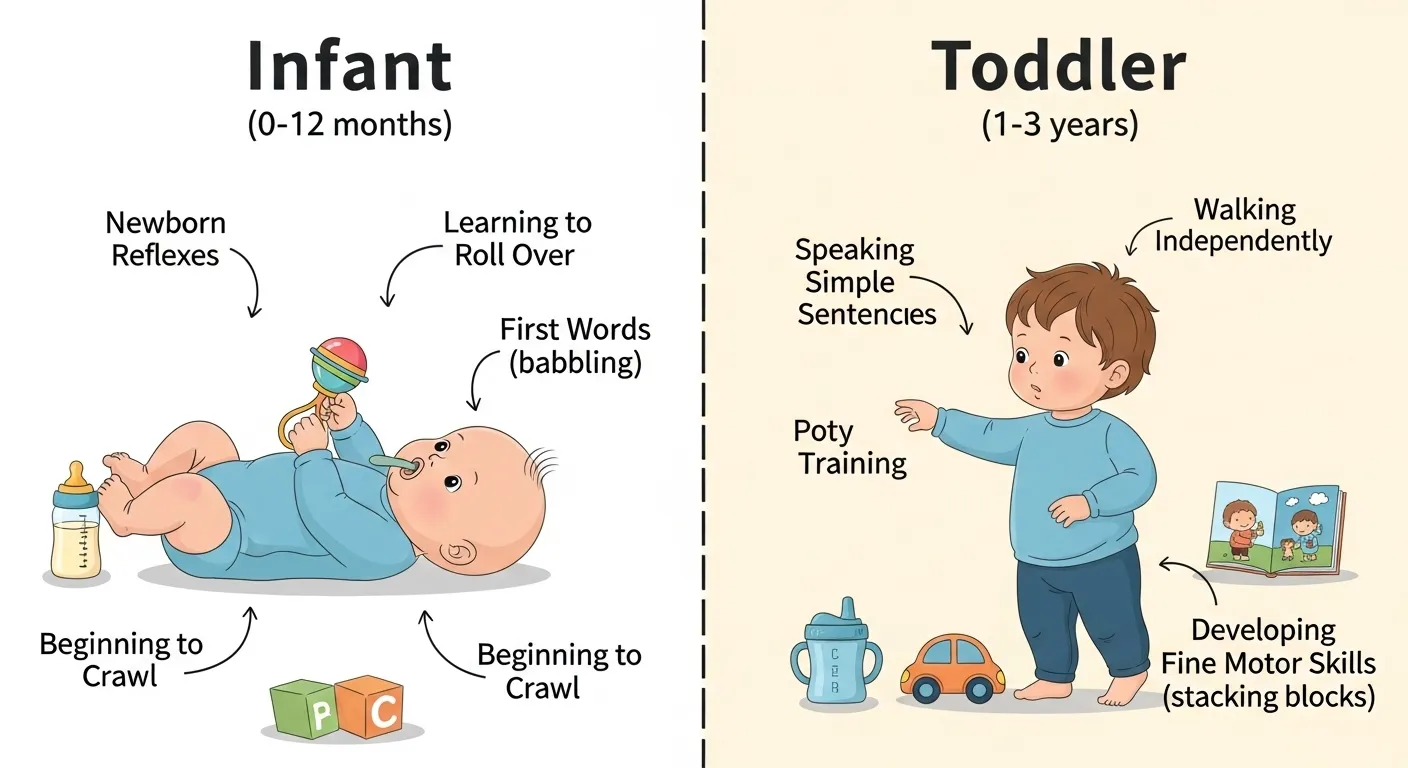
Imagine a young couple visiting their relatives with their baby. The grandmother lovingly calls the baby an infant, while the older cousin refers to a slightly older child in the family as a toddler. Although both terms describe very young children, there is a clear difference between infant and toddler based on age and development.
An infant is a baby in the earliest stage of life, usually from birth to about one year old. A toddler, on the other hand, is a young child who has begun walking and exploring the world, typically between one and three years of age. Understanding the difference between infant and toddler helps parents, educators, healthcare professionals, and students describe early childhood stages accurately. The difference between infant and toddler is important in childcare, medicine, and education because each stage involves different physical, emotional, and cognitive development.
Key Difference Between the Both
The main difference lies in age and developmental abilities.
An infant is a baby from birth to about 12 months who is mostly dependent on caregivers, while a toddler is a child aged about 1 to 3 years who begins walking, talking, and exploring independently.
Why Their Difference Is Necessary to Know
Understanding this difference is important for parents, pediatricians, teachers, and childcare providers. Each stage of childhood requires different types of care, nutrition, and learning support. For example, infants need constant supervision and basic nurturing, while toddlers require guidance as they begin to walk, speak, and interact with their environment. Knowing the difference between infant and toddler also helps in planning healthcare, early education programs, and parenting strategies that support healthy development.
Pronunciation (US & UK)
Infant
- US: /ˈɪn.fənt/
- UK: /ˈɪn.fənt/
Toddler
- US: /ˈtɑːd.lɚ/
- UK: /ˈtɒd.lə/
Before exploring further, let’s examine the detailed difference between infant and toddler.
Difference Between Infant and Toddler
1. Age Range
Infants are usually from birth to 12 months.
Toddlers are generally 1 to 3 years old.
Infant Examples
- A newborn baby in the hospital.
- A six-month-old baby learning to sit.
Toddler Examples
- A one-year-old child taking first steps.
- A two-year-old child learning new words.
2. Physical Development
Infants are developing basic motor skills.
Toddlers develop stronger movement abilities.
Infant Examples
- Learning to roll over.
- Beginning to crawl.
Toddler Examples
- Walking around the house.
- Climbing small furniture.
3. Mobility
Infants have limited movement and rely on caregivers.
Toddlers move independently.
Infant Examples
- Lying in a crib or stroller.
- Crawling slowly on the floor.
Toddler Examples
- Walking and running.
- Exploring rooms independently.
4. Communication Skills
Infants communicate mainly through crying or simple sounds.
Toddlers begin forming words and short sentences.
Infant Examples
- Crying for food or comfort.
- Babbling sounds like “ba” or “ma”.
Toddler Examples
- Saying simple words like “mama”.
- Using short phrases such as “want milk”.
5. Cognitive Development
Infants learn through observation and basic interaction.
Toddlers begin problem-solving and imitation.
Infant Examples
- Recognizing familiar faces.
- Responding to voices.
Toddler Examples
- Copying actions of adults.
- Solving simple puzzles.
6. Feeding Habits
Infants mainly consume milk.
Toddlers begin eating solid foods regularly.
Infant Examples
- Breast milk feeding.
- Formula feeding.
Toddler Examples
- Eating fruits and vegetables.
- Using a spoon to eat.
7. Emotional Development
Infants show basic emotional responses.
Toddlers show stronger emotions and independence.
Infant Examples
- Smiling at caregivers.
- Crying when uncomfortable.
Toddler Examples
- Showing excitement while playing.
- Expressing frustration or tantrums.
8. Learning Environment
Infants require nurturing and sensory stimulation.
Toddlers benefit from interactive learning and play.
Infant Examples
- Listening to lullabies.
- Playing with soft toys.
Toddler Examples
- Playing educational games.
- Learning colors and shapes.
9. Dependency Level
Infants are completely dependent on caregivers.
Toddlers begin developing independence.
Infant Examples
- Being carried most of the time.
- Needing help for all activities.
Toddler Examples
- Walking independently.
- Attempting to dress themselves.
10. Social Interaction
Infants interact mainly with parents.
Toddlers start interacting with other children.
Infant Examples
- Smiling at parents.
- Responding to voices.
Toddler Examples
- Playing with other children.
- Learning sharing and cooperation.
Nature and Behaviour
Infant: Gentle, highly dependent, and focused on basic survival and bonding with caregivers.
Toddler: Curious, energetic, and eager to explore the environment while learning independence.
Why People Are Confused About Their Use
People sometimes use the terms interchangeably because both refer to very young children. However, each word describes a different stage of early childhood development.
Table: Difference and Similarity Between Infant and Toddler
| Feature | Infant | Toddler | Similarity |
| Age | Birth to 12 months | 1 to 3 years | Early childhood stages |
| Movement | Limited movement | Walking and running | Growing development |
| Communication | Crying and babbling | Words and phrases | Learning to communicate |
| Independence | Fully dependent | Some independence | Need parental care |
| Learning | Sensory exploration | Active learning through play | Rapid development |
Which Is Better in What Situation?
Infant
The infant stage is essential for building the foundation of life. During this period, babies develop trust, bonding, and basic sensory awareness. Caregivers focus on providing nutrition, comfort, and safety. Infants require gentle interaction, such as singing, talking, and holding, which supports emotional and brain development. This stage is important because it lays the groundwork for later learning and relationships.
Toddler)
The toddler stage is a time of rapid growth and exploration. Children begin walking, speaking, and interacting with their surroundings. Parents and caregivers focus on teaching basic skills such as communication, social behavior, and problem-solving. Toddlers benefit from play-based learning activities that encourage curiosity and creativity. This stage helps children develop independence and confidence.
Use in Metaphors and Similes
- “The new project was like an infant, needing care and attention.”
- “The young company was a toddler in the industry, learning to walk.”
Connotative Meaning
Infant
- Positive: Innocence and new beginnings
- Neutral: Very young child
Toddler
- Positive: Growth and curiosity
- Neutral: Young developing child
Idioms or Proverbs
Although direct idioms are rare, related expressions include:
“Out of the mouths of babes.”
Example: The toddler’s simple words revealed an honest truth.
“Baby steps.”
Example: The company is taking baby steps toward success.
Works in Literature
- “The Common Sense Book of Baby and Child Care” – Parenting book, Benjamin Spock, 1946
- “Your Baby and Child” – Parenting guide, Penelope Leach, 1977
Movies Related to Infants or Toddlers
- Look Who’s Talking – 1989, USA
- Boss Baby – 2017, USA
Frequently Asked Questions
1. At what age does an infant become a toddler?
Usually around the first birthday when the child begins walking.
2. Do toddlers still need naps?
Yes, most toddlers need one or two naps daily.
3. Are infants able to talk?
Infants usually babble but do not speak clear words.
4. Why are toddlers called toddlers?
Because they “toddle,” meaning they walk unsteadily while learning to walk.
5. Do infants and toddlers need different nutrition?
Yes, infants mainly need milk while toddlers eat solid foods.
How Both Are Useful for Surroundings
Infants and toddlers represent the earliest stages of human life and development. Their growth reminds families and communities of the importance of care, education, and nurturing environments.
Final Words
Infants and toddlers are two important stages of early childhood development. Each stage involves unique growth patterns and care requirements.
Conclusion
Understanding the difference between infant and toddler helps parents, educators, and healthcare professionals support children during early development. Infants represent the earliest stage of life, characterized by rapid physical growth and total dependence on caregivers. Toddlers, on the other hand, begin to walk, talk, and explore the world with growing independence. Although both stages are part of early childhood, they involve different developmental milestones and care needs. Recognizing the difference between infant and toddler allows families and communities to provide appropriate guidance, nutrition, and learning opportunities that support healthy development.