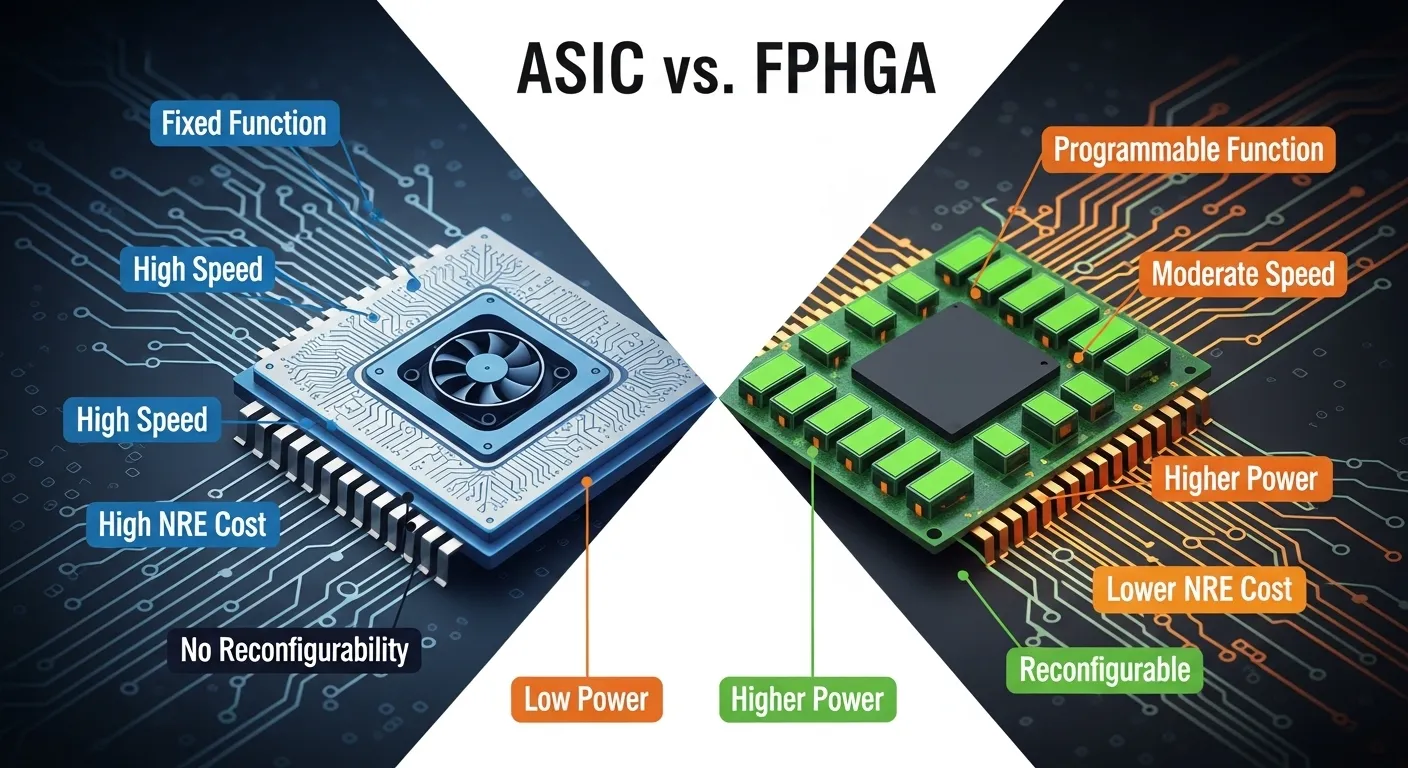
In the world of electronics and computing, ASIC and FPGA are two important types of hardware used for specific tasks. ASIC, or Application-Specific Integrated Circuit, is designed for a single purpose, providing high performance and efficiency. FPGA, or Field-Programmable Gate Array, is a flexible hardware platform that can be programmed and reprogrammed for multiple tasks. Understanding the difference between ASIC and FPGA is essential for engineers, students, and tech enthusiasts who want to choose the right technology for projects, mining cryptocurrencies, or industrial applications. This article explores their structure, use cases, advantages, and limitations.
Pronunciation
- ASIC: US /ˈeɪsɪk/, UK /ˈeɪsɪk/
- FPGA: US /ˌɛf.piː.dʒiːˈeɪ/, UK /ˌɛf.piː.dʒiːˈeɪ/
Linking Hook: Let’s dive deeper into the key differences between ASIC and FPGA to understand which is suitable for your technology needs.
Difference Between ASIC and FPGA
1. Definition
- ASIC: Customized chip designed for a specific task.
- Example 1: A Bitcoin mining ASIC performs only mining efficiently.
- Example 2: Graphics chips in consoles are designed as ASICs.
- FPGA: A programmable chip that can be configured for multiple applications.
- Example 1: FPGA used for prototyping new hardware designs.
- Example 2: Reconfigurable FPGA used in telecom signal processing.
2. Customization
- ASIC: Fixed design; cannot be reprogrammed after manufacturing.
- Example 1: ASIC for encryption cannot change its function.
- Example 2: Camera sensor ASIC performs specific imaging tasks.
- FPGA: Fully programmable; can change functions multiple times.
- Example 1: An FPGA can switch from image processing to network routing.
- Example 2: Lab testing of hardware algorithms using an FPGA.
3. Cost
- ASIC: High initial design and manufacturing cost, but cheaper per unit at large scale.
- Example 1: Manufacturing custom ASIC for millions of units in telecom.
- Example 2: Bitcoin ASIC miners have a high upfront cost.
- FPGA: Moderate cost per unit; higher for large-scale production.
- Example 1: FPGA boards for prototyping small projects.
- Example 2: Aerospace FPGA used in small batch development.
4. Speed and Performance
- ASIC: High performance and efficiency for its specific function.
- Example 1: ASIC miner processes hashes faster than an FPGA or a GPU.
- Example 2: Graphics ASIC renders frames faster in consoles.
- FPGA: Lower performance compared to ASIC for the same task.
- Example 1: An FPGA can run slower in hashing than an ASIC.
- Example 2: FPGA-based video processing may be slower than a custom ASIC.
5. Flexibility
- ASIC: No flexibility; limited to the designed function.
- Example 1: ASIC cannot be updated for a new protocol.
- Example 2: A dedicated AI ASIC cannot perform general computing.
- FPGA: High flexibility; can be reprogrammed anytime.
- Example 1: Modify the FPGA for a new communication protocol.
- Example 2: Adapt the FPGA to experiment with new algorithms.
6. Development Time
- ASIC: Long development cycle due to custom design.
- Example 1: Designing an ASIC for crypto mining can take months.
- Example 2: A custom ASIC for smartphones may take over a year.
- FPGA: Shorter development cycle; ideal for testing and prototyping.
- Example 1: Rapid FPGA prototyping in universities.
- Example 2: FPGA for proof-of-concept hardware.
7. Power Efficiency
- ASIC: More power-efficient because it is optimized for a single task.
- Example 1: ASIC miner consumes less power than an FPGA for the same mining.
- Example 2: ASIC in mobile devices extends battery life.
- FPGA: Less power-efficient due to general-purpose programmability.
- Example 1: FPGA consumes more energy for repetitive computations.
- Example 2: FPGA-based networks draw higher power than ASICs.
8. Lifespan and Obsolescence
- ASIC: Longer lifespan for intended purpose; becomes obsolete if requirements change.
- Example 1: ASIC designed for old crypto algorithm becomes obsolete.
- Example 2: Graphics ASIC in old consoles remains functional for years.
- FPGA: Can adapt to new requirements; extends functional lifespan.
- Example 1: FPGA can be reprogrammed for new tasks in a lab setting.
- Example 2: Telecom FPGA upgraded for new protocols without new hardware.
9. Learning and Experimentation
- ASIC: Not suitable for educational experimentation due to fixed design.
- Example 1: Cannot test different algorithms on ASIC.
- Example 2: Students cannot modify ASIC for learning.
- FPGA: Excellent for learning, experimentation, and prototyping.
- Example 1: Engineering students program FPGA to test logic designs.
- Example 2: FPGA allows hands-on hardware experimentation.
10. Industry Use Cases
- ASIC: Consumer electronics, cryptocurrency mining, AI accelerators.
- Example 1: Bitcoin mining ASIC miners.
- Example 2: Apple Neural Engine ASIC for AI tasks.
- FPGA: Telecommunications, defense, automotive, prototyping.
- Example 1: FPGA in 5G base stations.
- Example 2: Automotive ADAS systems using FPGA.
Nature and Behaviour
- ASIC: Fixed, high-performance, energy-efficient, purpose-built.
- FPGA: Flexible, programmable, adaptable, slightly slower and less energy-efficient.
Why People Are Confused
Both are types of integrated circuits used in hardware design. The confusion arises because FPGA can be used for similar applications as ASIC but with lower efficiency and higher flexibility.
Table: Difference and Similarity
| Feature | ASIC | FPGA | Similarity |
| Flexibility | Low; single-purpose | High; reprogrammable | Both are integrated circuits |
| Performance | High for specific task | Moderate; depends on configuration | Both execute digital logic |
| Cost | High initial, low per unit | Moderate per unit, high in scale | Both require design and programming |
| Power Efficiency | High | Lower | Both consume power |
| Development Time | Long | Short | Both need technical expertise |
Which is Better in What Situation?
- ASIC: Best when a task is repetitive, high-volume, or requires maximum performance and efficiency, such as cryptocurrency mining or consumer electronics.
- FPGA: Best for prototyping, low-to-medium volume production, or applications needing adaptability and frequent updates, like research, defense, or telecommunications.
Use in Metaphors and Similes
- ASIC: “ASIC is like a race car built for a single track—fast, efficient, but limited.”
- FPGA: “FPGA is like a Swiss army knife—adaptable, versatile, but not specialized for one task.”
Connotative Meaning
- ASIC: Positive for efficiency and performance, neutral for flexibility.
- FPGA: Positive for adaptability and learning, neutral for raw performance.
Idioms or Proverbs
- “Jack of all trades, master of none” – aligns with FPGA’s versatility.
- “Made to measure” – aligns with ASIC’s purpose-built efficiency.
Literature & Movies
- Digital Design and FPGA Prototyping (Textbook, 2020) – focuses on FPGA applications.
- ASICs: From Concept to Chip (Technical Guide, 2018) – detailed ASIC insights.
- Tron: Legacy (2010, USA) – fictional portrayal of custom computing systems.
FAQs
1. Can FPGA replace ASIC?
Only in low-volume or prototyping; ASIC is better for high-volume, high-efficiency tasks.
2. Are ASIC and FPGA interchangeable?
No; ASIC is fixed, FPGA is programmable.
3. Which is faster?
ASIC is faster and more energy-efficient for specific tasks.
4. Can FPGA be used for cryptocurrency mining?
Yes, but less efficient than ASIC miners.
5. Which is better for learning and experimentation?
FPGA is ideal for students and prototyping.
How Both Are Useful for the Surroundings
ASIC improves efficiency and performance in consumer electronics, AI, and mining, saving power and resources. FPGA promotes innovation, experimentation, and adaptability, especially in research and industrial prototyping.
Final Words
ASIC and FPGA serve complementary roles in technology. Understanding their differences helps engineers, hobbyists, and industries select the right solution for performance, flexibility, and cost.
Conclusion
ASIC is a purpose-built, high-performance, energy-efficient integrated circuit for specific tasks. FPGA is a reprogrammable, adaptable chip suitable for prototyping, experimentation, and flexible applications. Both are essential in electronics, computing, and industrial design, each excelling in different scenarios. Choosing the right technology depends on performance requirements, cost, flexibility, and production scale. Knowledge of ASIC vs FPGA enables informed decisions for engineers, students, and tech enthusiasts.