When you join a school or course, you often hear two words: curriculum and syllabus. Many students think they mean the same thing. Even some parents feel confused. But they are not the same.
Imagine your school year. You have subjects, activities, exams, and goals. All of this is planned. But how is it planned? What tells teachers what to teach? What tells students what to study?
This is where curriculum and syllabus come in. Both are important parts of education. But they have different roles.
In this article, you will learn the difference between curriculum and syllabus in very simple English. You will see clear meanings, examples, and a comparison table. By the end, you will understand both clearly.
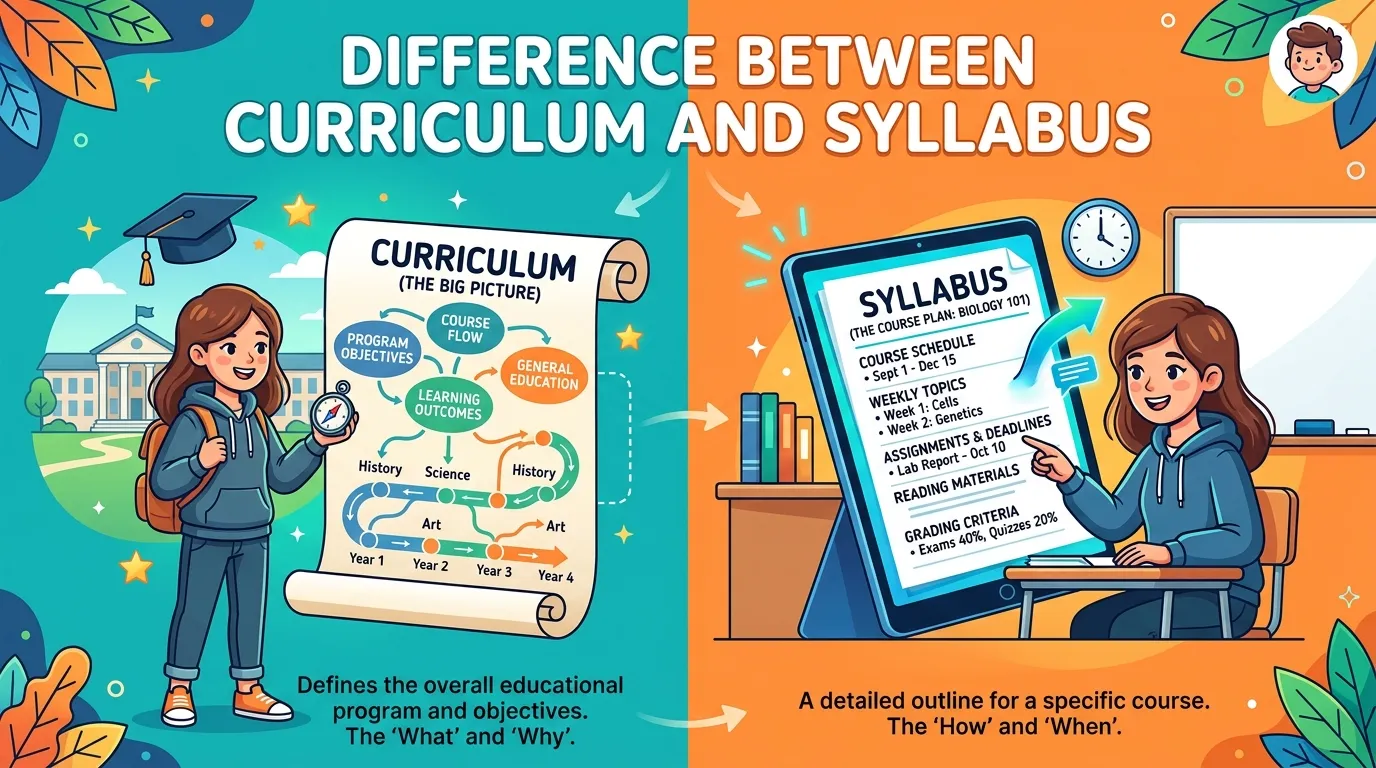
The difference between curriculum and syllabus is simple. A curriculum is the full plan of education, including subjects, goals, and activities. A syllabus is a detailed outline of topics for a specific subject or course.
What Is Curriculum?
A curriculum is the complete plan of education.
It includes everything a student learns in a school or program.
Simple Features:
- Covers all subjects
- Includes goals and activities
- Long-term plan
What It Includes:
- Subjects (Math, English, Science)
- Learning goals
- Teaching methods
- Exams and assessments
Real-Life Example:
A school curriculum includes all classes, sports, projects, and learning goals for the whole year.
What is a syllabus?
A syllabus is a detailed list of topics for one subject.
It tells what to study in that subject.
Simple Features:
- Subject-specific
- Short-term plan
- Focus on topics
What It Includes:
- Chapter names
- Topics to study
- Schedule
- Assignments
Real-Life Example:
The English syllabus lists grammar topics, essays, and reading lessons for the term.
Difference Between Curriculum and Syllabus
Here is a simple table to understand the difference between curriculum and syllabus:
| Feature | Curriculum | Syllabus |
| Meaning | Full education plan | Topics of one subject |
| Scope | Broad | Narrow |
| Level | Whole program | Single course |
| Focus | Goals and activities | Content and topics |
| Time | Long-term | Short-term |
| Created By | Education boards | Teachers or schools |
| Example | School year plan | Math chapter list |
Key Differences Explained
Scope
Curriculum is big.
It covers the whole education system.
The syllabus is small.
It covers only one subject.
Purpose
Curriculum sets goals.
It decides what students should learn overall.
Syllabus gives details.
It tells what to study in each subject.
Planning Level
The curriculum is made at a higher level.
It is often created by education boards.
The syllabus is made at a lower level.
Teachers or schools prepare it.
Time Frame
Curriculum is for a long time.
It may cover a full year or more.
The syllabus is for a shorter time.
It may cover a term or semester.
Content vs Strategy
Curriculum includes strategy and activities.
The syllabus focuses on content only.
Examples
Example 1: School Year
- Curriculum: All subjects, sports, and goals
- Syllabus: Topics for each subject
Example 2: English Subject
- Curriculum: Improve reading and writing skills
- Syllabus: Grammar, essays, stories
Example 3: College Course
- Curriculum: Full degree program
- Syllabus: Topics for one subject
Example 4: Exam Preparation
- Curriculum: Overall exam structure
- Syllabus: Specific chapters to study
Importance of Knowing the Difference
Understanding the difference between curriculum and syllabus is very important.
It helps you:
- Plan your studies
- Focus on the right topics
- Understand your learning path
Students can study smarter.
Teachers can teach better.
Benefits of Understanding Curriculum vs Syllabus
- Helps in better study planning
- Reduces confusion
- Improves time management
- Supports better learning
- Helps in exam preparation
- Makes goals clear
- Builds strong academic skills
Common Mistakes People Make
Mistake 1: Thinking They Are the Same
They are different but connected.
Mistake 2: Ignoring the Curriculum
Some focus only on the syllabus and miss the bigger goals.
Mistake 3: Not Following the Syllabus
Students may study topics not needed for exams.
Mistake 4: Confusing Scope
Curriculum is broad, syllabus is specific.
Real-Life Use
Where Curriculum Is Used:
- Schools
- Colleges
- Education systems
Where Syllabus Is Used:
- Classrooms
- Subjects
- Courses
Who Uses Them:
- Teachers
- Students
- Education boards
Easy Trick to Remember the Difference
Here is a simple trick:
Curriculum = Complete plan
Syllabus = Subject plan
Think like this:
- Curriculum = Big picture
- Syllabus = Small details
Which One Is Better?
This is not about better or worse.
Both are important.
Curriculum:
- Guides the whole system
Syllabus:
- Guides daily learning
You need both for a good education.
FAQs
1. What is the main difference between a curriculum and a syllabus?
Curriculum is the full education plan. A syllabus is the list of topics for one subject.
2. Which is broader, curriculum or syllabus?
The curriculum is broader. The syllabus is more specific.
3. Who creates the curriculum?
Education boards or institutions usually create it.
4. Who creates the syllabus?
Teachers or schools often prepare the syllabus.
5. Can syllabus change often?
Yes, it can change based on course needs.
6. Is the syllabus part of the curriculum?
Yes, the syllabus is a part of the curriculum.
7. Why is curriculum important?
It sets goals and guides the whole education system.
Conclusion
The difference between curriculum and syllabus is easy to understand when you look closely. A curriculum is the full plan of education. It includes subjects, goals, and activities. A syllabus is a detailed list of topics for one subject.
Curriculum gives the big picture. The syllabus gives the small details. Both work together to guide students and teachers.
When you understand this difference, you can study better and plan your learning more clearly. Just remember: curriculum is the full journey, and syllabus is the path for each subject.