When you read a story or watch a movie, you may notice ideas that repeat. You may also feel a deeper message behind the story. But many learners get confused here. Is that a theme or a motif?
These two words are common in literature and storytelling. They sound similar and often appear together. That is why people mix them up. But they are not the same.
In this article, you will learn the difference between theme and motif in very simple English. You will see clear meanings, easy examples, and a simple comparison table. By the end, you will understand both and use them correctly.
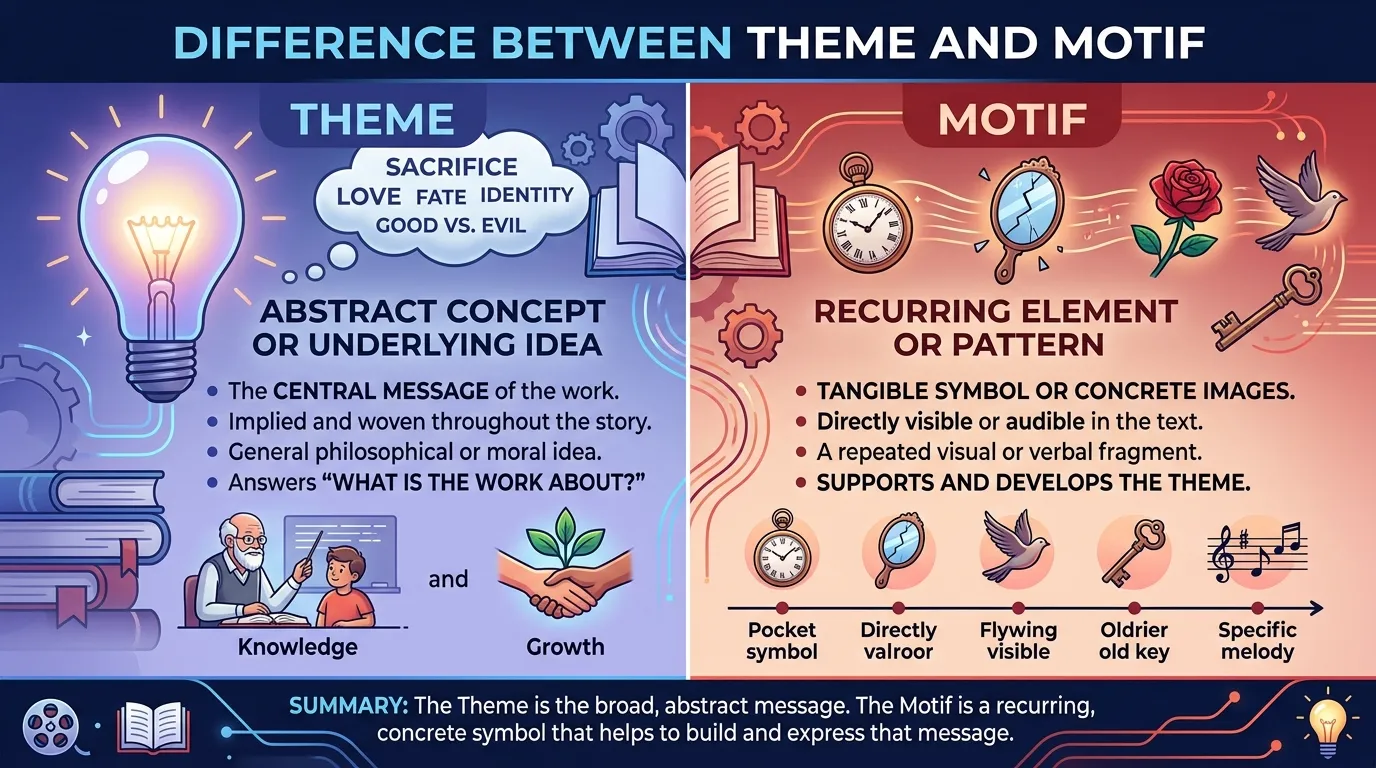
The difference between theme and motif is simple. A theme is the main message or idea of a story. A motif is a repeated element, like an image, word, or symbol, that helps show the theme.
What Is Theme?
A theme is the main idea or message of a story.
It tells what the story is really about.
Simple Features:
- Big idea of the story
- Hidden message
- Not always directly said
Common Themes:
- Love
- Friendship
- Good vs evil
- Courage
Real-Life Example:
In a story about helping others, the theme may be kindness.
What Is Motif?
A motif is something that repeats again and again in a story.
It can be:
- A word
- A symbol
- An image
- An idea
Simple Features:
- Repeats often
- Helps explain the theme
- Easy to notice
Real-Life Example:
If a story shows a broken mirror many times, it may be a motif.
Difference Between Theme and Motif
Here is a simple table to understand the difference between theme and motif:
| Feature | Theme | Motif |
| Meaning | Main message | Repeated element |
| Role | Shows big idea | Supports the theme |
| Type | Idea or lesson | Symbol, word, or image |
| Frequency | Not repeated | Repeated often |
| Visibility | Can be hidden | Easy to see |
| Example | Love, courage | Heart symbol, repeated words |
Key Differences Explained
Main Idea vs Repeated Element
A theme is the main idea.
It tells what the story teaches.
A motif is a repeated detail.
It helps show that idea.
Hidden vs Visible
Themes are sometimes hidden.
You may need to think to find them.
Motifs are easy to see.
They appear again and again.
Big Picture vs Small Detail
The theme is the big picture.
Motif is a small part.
But that small part helps explain the big idea.
Role in Story
Theme gives meaning.
Motif gives clues.
Both work together.
Examples
Example 1: Love Story
- Theme: Love is powerful
- Motif: Hearts, flowers, romantic words
Example 2: War Story
- Theme: War causes pain
- Motif: Broken homes, dark skies
Example 3: Friendship Story
- Theme: True friends help each other
- Motif: Helping hands, shared moments
Example 4: Movie Example
In many movies:
- Theme: Good wins over evil
- Motif: Light vs dark scenes
Importance of Knowing the Difference
Understanding the difference between theme and motif helps you enjoy stories more.
It helps you:
- Understand the deeper meaning
- Analyze stories better
- Do well in exams
If you know motifs, you can find themes easily.
Benefits of Understanding Theme vs Motif
- Improves reading skills
- Helps in literature studies
- Makes story analysis easy
- Builds critical thinking
- Helps in writing stories
- Reduces confusion
- Makes learning fun
Common Mistakes People Make
Mistake 1: Thinking They Are the Same
Theme and motif are connected but not the same.
Mistake 2: Calling Motif a Theme
A repeated symbol is not the main message.
Mistake 3: Ignoring Motifs
Motifs help you understand the theme.
Mistake 4: Missing the Theme
People see repeated things but miss the deeper idea.
Real-Life Use
Where Theme Is Used:
- Stories
- Movies
- Poems
Where Motif Is Used:
- Literature
- Films
- Art
Who Uses Them:
- Writers
- Students
- Teachers
Easy Trick to Remember the Difference
Here is a simple trick:
Theme = Message
Motif = Repeat
Think like this:
- Theme = What story says
- Motif = What repeats
Which One Is Better?
Neither is better.
They are different but connected.
Theme:
- Gives meaning
Motif:
- Supports meaning
You need both to understand a story fully.
FAQs
1. What is the main difference between theme and motif?
A theme is the main idea. A motif is a repeated element.
2. Can a story have more than one theme?
Yes, a story can have many themes.
3. Can a motif appear many times?
Yes, motifs repeat throughout the story.
4. Are theme and motif the same?
No, they are different but related.
5. Why are motifs important?
They help explain and support the theme.
6. What is an example of a motif?
A repeated symbol, like a rose or a color.
7. How can I find the theme?
Look at the message the story gives.
Conclusion
The difference between theme and motif is easy when you break it down. A theme is the main message or idea of a story. A motif is a repeated element that helps show that message.
Themes are big and sometimes hidden. Motifs are small but easy to see. Both work together to make a story meaningful and powerful.
If you remember one simple idea, theme is the message, and motif is the repeat, you will understand stories better. This will help you in reading, writing, and learning literature with confidence.