
T&M most often means “time and materials.” It is a way of billing where you pay for the hours people work plus the cost of the supplies they use. That is the T&m meaning you will see on contracts, quotes, and invoices. But the letters can mean other things in other fields, so context matters.
Many people run into T&M when they hire a contractor, read a job offer, or review a bill. The term sounds technical, yet the idea is simple. In this guide, you will learn what T&M means in plain words, how a T&M contract works, and how it compares with other pricing styles. You will also see real examples, other meanings of the letters, common mistakes, and easy tips for staying safe. By the end, you will know exactly what to look for the next time you see “T&M” on a page.
Quick Answer: The T&M Meaning in Simple Words
In business, T&M stands for “time and materials.” Think of it as paying for two things: the time workers spend on your job and the materials they need to finish it.
Here is a simple way to picture it. Say you hire a plumber to fix a leaking pipe. The plumber charges $90 per hour. The job takes three hours, so the labor is $270. The plumber also buys $60 worth of pipe and fittings. Your bill is 330.Youpaidfortime(270) and materials ($60). That is a T&M job.
The key point is that the final price is not set in advance. It depends on how long the work takes and how much material is used. This is the biggest difference between T&M and other pricing styles, and it is why people care so much about the details.
You will see T&M in construction, home repair, software development, consulting, auto repair, and many other trades. Wherever work is hard to predict, T&M tends to show up.
Time and Materials Explained: The Two Parts of the Price
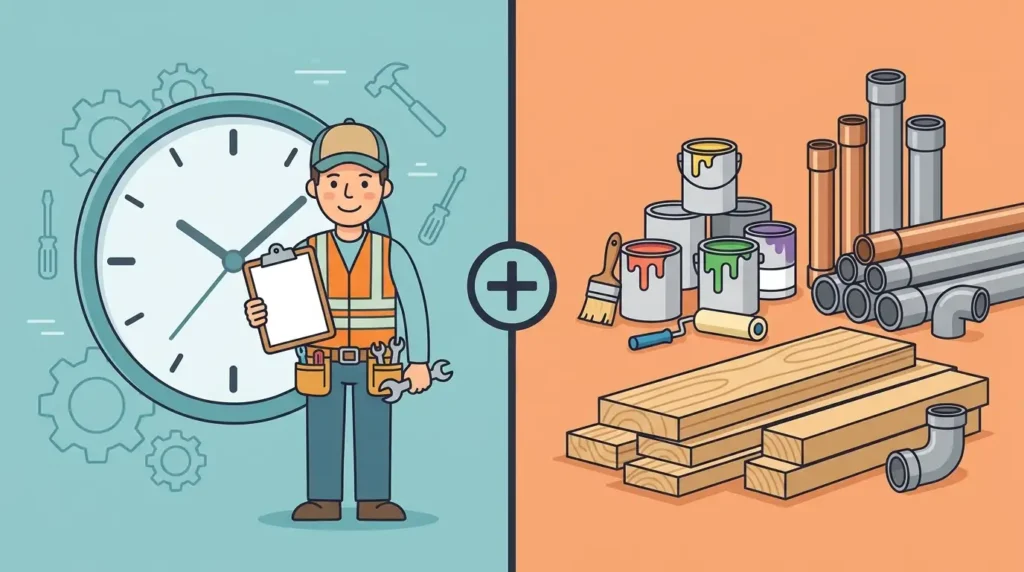
To really understand the t&m meaning, it helps to look at each half of the term.
The “time” part is the labor. Workers record the hours they spend on your project, and you pay an agreed hourly rate. That rate often covers more than just a paycheck. It usually includes the worker’s wages, the company’s overhead (things like insurance, tools, and office costs), and a profit margin. So an hourly rate of $90 does not mean the worker takes home $90. It means the company charges $90 for each hour of that worker’s time.
The “materials” part covers the physical or digital items needed for the job. In construction, that could be lumber, nails, paint, or concrete. In software work, it might be licenses, hosting fees, or tools. In auto repair, it is the parts. Companies often bill materials at their cost, or at cost plus a small markup, such as 10 or 15 percent. The markup helps cover the time spent buying, storing, and handling the items.
Some T&M contracts also list extra costs, such as travel, permits, or equipment rental. A good contract spells out every one of these ahead of time. If something is not listed, ask about it before work starts. A clear list protects both sides and keeps the final bill from becoming a surprise.
How a T&M Contract Works Step by Step
A T&M contract is not complicated, but it does follow a pattern. Understanding the steps makes it easier to spot problems early.
First, both sides agree on the scope of work. This is a short description of what needs to be done. Because T&M is flexible, the scope can be looser than in other contracts, but it should still be clear enough that everyone knows the goal.
Next, the hourly rates are set. A job may have one flat rate for everyone, or different rates for different roles. For example, a senior engineer might cost more per hour than a junior helper. The contract should list each rate in writing.
Then the rules for materials are decided. The contract should say how materials are priced, if a markup applies, and if receipts will be shared. Asking for receipts is perfectly normal.
After that, the work begins. Workers track their hours, usually with timesheets or a time-tracking app. The contractor then sends invoices on a set schedule, such as weekly or monthly. Each invoice should show hours worked, who worked them, and what materials were bought.
Finally, many contracts include a “not-to-exceed” limit, also called a cap. This is a maximum amount the contractor cannot go beyond without asking you first. If the work is heading toward the cap, the contractor must stop and get your approval. A cap is one of the best tools for keeping a T&M project under control.
T&M vs Fixed Price vs Cost Plus
People often wonder how T&M compares with other ways of pricing a job. The table below shows the three most common styles side by side.
| Feature | Time and Materials (T&M) | Fixed Price | Cost Plus |
| How you pay | Hourly rate plus materials | One agreed total price | Actual costs plus a set fee or percentage |
| Final cost known upfront? | No, it can change | Yes | No, it can change |
| Who carries the risk? | Mostly the client | Mostly the contractor | Mostly the client |
| Best for | Unclear or changing work | Clear, well-defined work | Large projects with unknown costs |
| Flexibility | High | Low | High |
| Typical example | Home repair, software support | Building a fence from a set plan | Government or large construction jobs |
The main difference comes down to risk. With a fixed price, the contractor takes on the risk of going over budget. With T&M, the client takes on more of that risk, because more hours means a bigger bill. Cost plus is similar to T&M, but it usually bills actual costs for everything, then adds a fee on top, instead of using set hourly rates.
Neither style is better in every case. Fixed price works well when the job is clear and unlikely to change. T&M works well when the job is uncertain, when you expect changes along the way, or when you need to start quickly without a full plan.
Pros and Cons of T&M Contracts
Every pricing style has strengths and weaknesses. Here is a quick look at how T&M stacks up.
| Pros | Cons |
| Flexible when plans change | Final cost is hard to predict |
| Work can start quickly | Client carries more budget risk |
| You pay only for actual work done | Slow work can mean higher bills |
| Easy to add or remove tasks | Needs careful tracking of hours |
| Fair when the job is unclear | Less motivation for speed unless managed well |
The biggest benefit is flexibility. If you discover halfway through a project that you want something different, you can adjust without rewriting the whole contract. The biggest drawback is uncertainty. Since you pay for time, a slow or messy job can cost far more than you planned.
Trust plays a large role here. A T&M arrangement works best when you know and trust the people doing the work, or when you have strong ways to check their hours and costs. That is why caps, regular updates, and detailed invoices matter so much.
Other Meanings of T&M
While “time and materials” is the most common answer, it is not the only one. The letters T&M can stand for several other things depending on the field. Here are the main ones.
| Field | What T&M Stands For | Quick Meaning |
| Business and construction | Time and Materials | A billing method based on hours and supplies |
| Engineering and electronics | Test and Measurement | Tools and methods for checking how equipment performs |
| Industrial engineering | Time and Motion | A study of how long tasks take and how workers move |
| Company names | Varies | Often initials of founders or a brand name |
In engineering and electronics, “test and measurement” refers to the instruments and processes used to check how a device works. Think of tools like multimeters and oscilloscopes. Companies that make or sell this equipment often say they work in the “T&M industry.”
“Time and motion” comes from the early study of work efficiency. Researchers such as Frederick Taylor and the husband-and-wife team of Frank and Lillian Gilbreth studied how long tasks took and how workers moved, hoping to find better ways to do them. A “time and motion study” is still a known term in factories, hospitals, and offices, though people often shorten it in casual speech.
You may also see T&M as part of a company name, where the letters are just initials. In that case, the meaning depends on the business itself. If you spot T&M in a text message or on social media, there is no widely agreed slang meaning that I can point to with confidence. When in doubt, look at the surrounding words or ask the person who used it.
Real-Life Examples of T&M in Action
Examples make any idea easier to understand, so here are a few common ones.
Imagine a homeowner who wants to remodel a bathroom. When the contractor opens the wall, they find old water damage nobody could see before. A fixed price would be hard to set, because no one knows how bad the damage is. So they agree on T&M: $75 per hour for labor, plus materials at cost with a 10 percent markup, and a cap of $8,000. If the repairs are small, the homeowner pays less. If they are big, the cap keeps the bill from running away.
Now think of a small business that hires a freelance web developer. The owner is not sure exactly what the website needs. They agree to pay $60 per hour, plus the cost of any paid tools. Each week, the developer sends a report showing hours and tasks. As ideas change, the work changes too, and the owner pays only for what is done.
Here is one from auto repair. You bring in a car that makes a strange noise. The mechanic cannot know the cause until they look. They charge shop time to find the problem, then bill for the parts used in the fix. Again, time and materials.
In each case, T&M fits because the exact amount of work was unknown at the start. That is the heart of when this pricing style makes sense.
Common Mistakes to Avoid
T&M is useful, but people stumble on the same problems again and again. Knowing them in advance can save you real money.
One common mistake is skipping the written agreement. A handshake deal feels friendly, but if a dispute comes up later, there is nothing to point to. Always put rates, materials rules, and limits in writing.
Another mistake is not setting a cap. Without a limit, a project can quietly grow far beyond what you planned. Even a rough cap gives you a checkpoint where you can pause and decide.
People also forget to ask for detailed invoices. A bill that says only “labor and materials: $4,200” tells you nothing. A good invoice lists dates, hours, names, tasks, and receipts. If an invoice is vague, ask for more detail.
Some clients make the opposite error and micromanage every minute. Trust and good communication work better than constant checking. Regular updates, such as a short weekly call, usually keep things on track without creating tension.
Finally, many people do not define the scope clearly enough. Even in a flexible contract, a short written description of the goal helps everyone stay focused. Vague goals lead to extra hours.
Tips and Best Practices for Using T&M
If you decide a T&M arrangement is right for you, a few habits will help it go smoothly.
Start by agreeing on a not-to-exceed amount and a rule that the contractor must ask before going past it. This one step prevents most bad surprises.
Ask for regular progress reports. Weekly summaries of hours, tasks finished, and money spent make it easy to spot trouble early. If something looks off, you can talk about it right away instead of after the bill arrives.
Compare rates before you sign. Get at least two or three quotes if you can. Remember that the lowest hourly rate is not always the cheapest job. A skilled worker at a higher rate may finish in half the time.
Be clear about how materials will be billed. Ask if there is a markup, and if you can see receipts. Honest contractors are usually happy to share them.
If you are the one providing the service, track your time carefully and honestly. Use a simple app or timesheet, and write short notes about what you did each day. Clear records build trust and make invoices easy to approve.
Last, break big projects into smaller phases. You can review progress at the end of each phase and decide if to continue. This keeps control in your hands and limits risk.
FAQs
What does T&M stand for?
In most business settings, T&M stands for “time and materials.” It describes a pricing method where you pay for the hours worked and the supplies used. In technical fields, it can also mean “test and measurement” or “time and motion.”
Is a T&M contract a good idea?
It can be, especially when the work is unclear or likely to change. It is less ideal when you need a fixed budget. Adding a not-to-exceed cap and asking for regular updates makes it much safer.
What is the difference between T&M and fixed price?
With T&M, you pay for actual hours and materials, so the total can change. With a fixed price, you agree on one total in advance. Fixed price gives more certainty, while T&M gives more flexibility.
Can a contractor add a markup on materials?
Yes, many T&M contracts allow a markup, often around 10 to 15 percent. The key is that it must be agreed on in writing before work begins. If you do not see it in the contract, ask.
How do I keep a T&M project from going over budget?
Set a cap, ask for weekly reports, and review invoices carefully. Breaking the job into phases also helps, since you can check costs at each step before moving on.
What does T&M mean in electronics?
In electronics and engineering, T&M usually means “test and measurement.” It refers to the equipment and methods used to check how devices perform, such as tools that measure voltage or signals.
Conclusion
The t&m meaning is easy to remember once you break it down. In most cases, it stands for “time and materials,” a way of paying for the hours someone works plus the supplies they use. It is flexible, fair for unclear jobs, and common in building, repair, consulting, and software work. Its main weakness is that the final price can change, so the client needs good tracking and clear limits.
Remember that T&M can also mean “test and measurement” or “time and motion” in other fields, so always check the context. If you plan to use a T&M agreement, put everything in writing, agree on a cap, and ask for detailed invoices. A little preparation at the start can save you a lot of stress and money later.