
Have you ever met someone who promised big things but never followed through? Then you already understand why people love the phrase “acta non verba.” It is a short Latin saying that packs a big lesson into three words.
If you landed here, you probably saw the phrase on a poster, a coin, a tattoo, or a speech. Maybe you just want to know what it means and how to use it. That is a smart thing to look up.
In this guide, you will learn the acta non verba meaning in plain words. You will see how to say it, where it comes from, and how people use it today. We will also cover common mistakes, real-life examples, and a few simple tips for living by the phrase. By the end, you will be able to explain it to anyone with confidence.
Quick Answer
The acta non verba meaning is “deeds, not words” or “actions, not words.” It tells us that what a person does matters more than what a person says. Talk is easy, but real actions show who someone truly is.
The phrase comes from Latin. People use it as a motto, a life rule, and a reminder to keep promises. When someone says “acta non verba,” they are saying, “Show me, don’t just tell me.”
Meaning and Definition
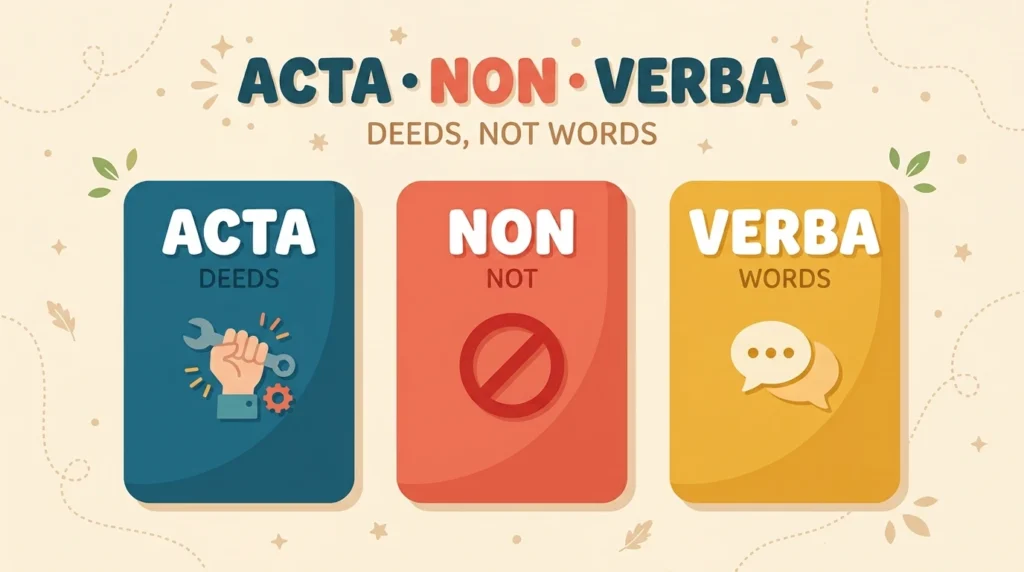
Let’s break the phrase into parts. In Latin, “acta” means “deeds” or “things that were done.” The word “non” means “not.” The word “verba” means “words.” Put them together, and you get “deeds, not words.”
Think about a friend who says, “I’ll help you move this weekend.” Then the weekend comes, and your friend never shows up. Their words sounded nice, but their actions told a different story. Now think about another friend who says nothing but arrives with a truck and boxes. That second friend lives by “acta non verba.”
The phrase is not saying that words are bad. Words matter. We use them to share ideas, make plans, and show love. The point is that words alone are not enough. They must be backed up by action. A promise without action is like a car with no engine. It looks fine, but it goes nowhere.
Here is a simple table to help you remember the pieces.
| Latin Word | English Meaning | Simple Note |
| Acta | Deeds, actions | What you do |
| Non | Not | Used to compare |
| Verba | Words | What you say |
You can also think of it as a quick test. When you want to know if someone is honest, look at what they do over time. That is the heart of the phrase.
How to Say It Correctly
Many people want to say the phrase out loud but feel unsure. Do not worry. It is easier than it looks.
In classical Latin, it sounds like “AHK-tah nohn WEHR-bah.” Many English speakers say it a bit differently, such as “AK-tuh non VER-buh.” Both are common, and people will understand you either way.
There is one grammar note worth knowing. The phrase has no verb. Latin often drops verbs when the meaning is clear, just as we do in English when we say “Safety first.” You do not need to add any extra words. You can write it as “Acta non verba” with a capital A at the start. If it sits in the middle of a sentence, many writers use lowercase and put it in quotes or italics.
Here is how it might look in a sentence: “Our coach lives by the motto ‘acta non verba,’ so he never makes empty promises.”
Origin and History
The exact origin of the phrase is a little hard to pin down. Ideas like “actions over words” have been around for thousands of years in many cultures. The Latin form, though, became well known in Europe and later in English-speaking countries.
The idea behind the saying is old. Ancient writers often praised leaders who proved themselves through action. Roman culture respected duty, courage, and people who got things done. So a short Latin motto about deeds fit that way of thinking well.
It is also worth being careful here. You may see websites that credit the phrase to one specific famous person or one exact date. Reliable proof for those claims is often missing. It is more honest to say that the phrase grew out of a long tradition of valuing action, and that no single clear inventor is firmly proven.
What we do know is that the phrase has been used as a motto by schools, military groups, clubs, and organizations around the world. Many of them chose it because it is short, strong, and easy to remember. A motto like this works as a promise: “We will be judged by what we do.”
One famous modern example is the women’s suffrage movement in Britain. Campaigners used the slogan “Deeds, not words” to show they were tired of waiting and ready to act. This is the English version of the same idea, and it shows how powerful the message can be.
Acta Non Verba in the Real World
You will find this motto in many places. Here is a table with a few common ones.
| Where You May See It | Why They Use It |
| Schools and colleges | To teach students that effort matters more than big talk |
| Military and service groups | To show that duty and results come first |
| Sports teams | To remind players to prove themselves on the field |
| Businesses | To promise customers real results, not just ads |
| Personal tattoos and jewelry | To act as a daily reminder to follow through |
Many people also choose the phrase as a personal motto. A student might put it on a notebook to stay focused. A new manager might hang it on an office wall to remind the team that talk is cheap. Some people wear it on a ring or bracelet.
The phrase is popular because it fits almost any part of life. It works at home, at work, in school, and in friendships. Anywhere trust matters, “acta non verba” has something to say.
Real-Life Examples
Examples make an idea easier to grasp. Let’s look at a few simple ones.
At work. Imagine two coworkers. One says, “I’ll finish that report soon,” but keeps putting it off. The other quietly finishes the report and sends it early. Who would you trust with the next big job? The second coworker lives by “acta non verba.”
In friendship. A friend who tells you “I’m always here for you” is kind. But a friend who shows up with soup when you are sick is better. Their action proves their words.
In parenting. Parents often learn this one fast. A parent can tell a child to be kind a hundred times. But if the child sees the parent being rude to others, the child will copy the action, not the speech. Kids learn more from what we do than from what we say.
In leadership. A good leader does not just give orders. A good leader rolls up their sleeves and works beside the team. When people see the leader doing the hard work, they trust the leader more.
In health goals. Many people say, “I’m going to start exercising on Monday.” Then Monday comes and goes. The person who simply puts on their shoes and walks for ten minutes has already done more than the person who made a grand speech.
Each of these stories shows the same truth. People remember what you do far longer than what you say.
Common Mistakes
Even a simple phrase can be misused. Here are some mistakes to avoid.
The first mistake is thinking the phrase means “never speak.” That is not true. Clear words are very useful. The phrase simply says that words must be matched by action.
The second mistake is mixing up the spelling. Some people write “acta non verbs” or “acto non verba.” The correct form is “acta non verba.” Double-check before you print it on a shirt or get it inked on your skin.
The third mistake is using the phrase to look smart while not living it. If someone posts “acta non verba” online but never keeps their promises, the phrase becomes a joke. A motto only has power when the person behind it follows it.
The fourth mistake is believing every story you read about its history. As we said earlier, some claims about who first said it are not well proven. It is better to share only what we can trust.
Finally, some people use the phrase to put others down. They say it in an angry way to shame someone. A better use is to inspire yourself and encourage others, not to attack them.
Similar Sayings in English
English has many sayings that carry the same message. Knowing them can help you understand the Latin phrase even better.
| English Saying | Meaning |
| Actions speak louder than words | What you do is more convincing than what you say |
| Talk is cheap | Speaking costs nothing, so it proves little |
| Walk the walk | Do what you claim you can do |
| Practice what you preach | Follow your own advice |
| Put your money where your mouth is | Back up your claims with real effort |
All of these say, in different ways, what “acta non verba” says in just three words. The Latin version feels stronger and more formal. That is one reason people love it as a motto. It sounds timeless.
Tips for Living by Acta Non Verba
Knowing the meaning is one thing. Living it is another. Here are some practical ways to bring the phrase into your daily life.
Start small. You do not need to change your whole life overnight. Pick one promise you made and finish it today. Small wins build trust, both with others and with yourself.
Make fewer promises, but keep them. It is better to say, “I’ll try my best,” than to say “I’ll definitely do it” and then fail. Honest, careful words lead to stronger trust.
Let your results do the talking. Instead of announcing your plans to everyone, quietly work on them. When you finish, the results speak for themselves.
Write your goals down and track your progress. A simple checklist can turn a wish into a plan. Each checked box is proof of action.
Be patient with yourself. Everyone fails to follow through sometimes. The goal is not to be perfect. The goal is to keep showing up and keep trying.
Finally, notice what others do, not just what they say. This helps you choose better friends, partners, and leaders. Trust is built over time, one action at a time.
FAQs
What does acta non verba mean in simple words?
It means “deeds, not words” or “actions, not words.” It tells us that what we do is more important than what we say.
What language is acta non verba?
It is Latin. Latin was the language of ancient Rome, and many mottos, laws, and science terms still use it today.
How do you pronounce acta non verba?
A common English way is “AK-tuh non VER-buh.” The classical Latin sound is closer to “AHK-tah nohn WEHR-bah.” Both are widely understood.
Who said acta non verba first?
There is no firmly proven single person. The idea is very old, and the phrase grew out of a long tradition of valuing action. Be careful with websites that name one exact person without clear proof.
Is acta non verba a good tattoo or motto?
Many people choose it because it is short, strong, and meaningful. Just make sure the spelling is correct, and that the message reflects how you truly want to live.
What is the opposite of acta non verba?
The opposite idea would be “all talk and no action.” It describes someone who makes big claims but does not follow through.
Conclusion
The acta non verba meaning is simple and powerful: “deeds, not words.” It reminds us that trust is earned through action, not through speeches or promises alone. If you see it on a school crest, a sports locker room wall, or a friend’s wrist, the message stays the same. Do what you say you will do.
You do not need to be perfect to live by this phrase. You only need to start. Keep your promises, finish what you begin, and let your results speak for you. Over time, people will notice. They will trust you more, and you will trust yourself more too.
So the next time you feel tempted to just talk about a goal, take one small step instead. That one step is worth more than a hundred words. Acta non verba.