Think about this sentence: “The happy boy runs fast.”
Here, some words tell action, and some describe things. But which is which? Many learners feel confused between verbs and adjectives. They look simple, but they do very different jobs.
This confusion is common, especially for beginners learning English. If you mix them up, your sentences may sound wrong or unclear.
. You will see simple meanings, clear examples, and a helpful comparison table. By the end, you will know exactly how to use both correctly.
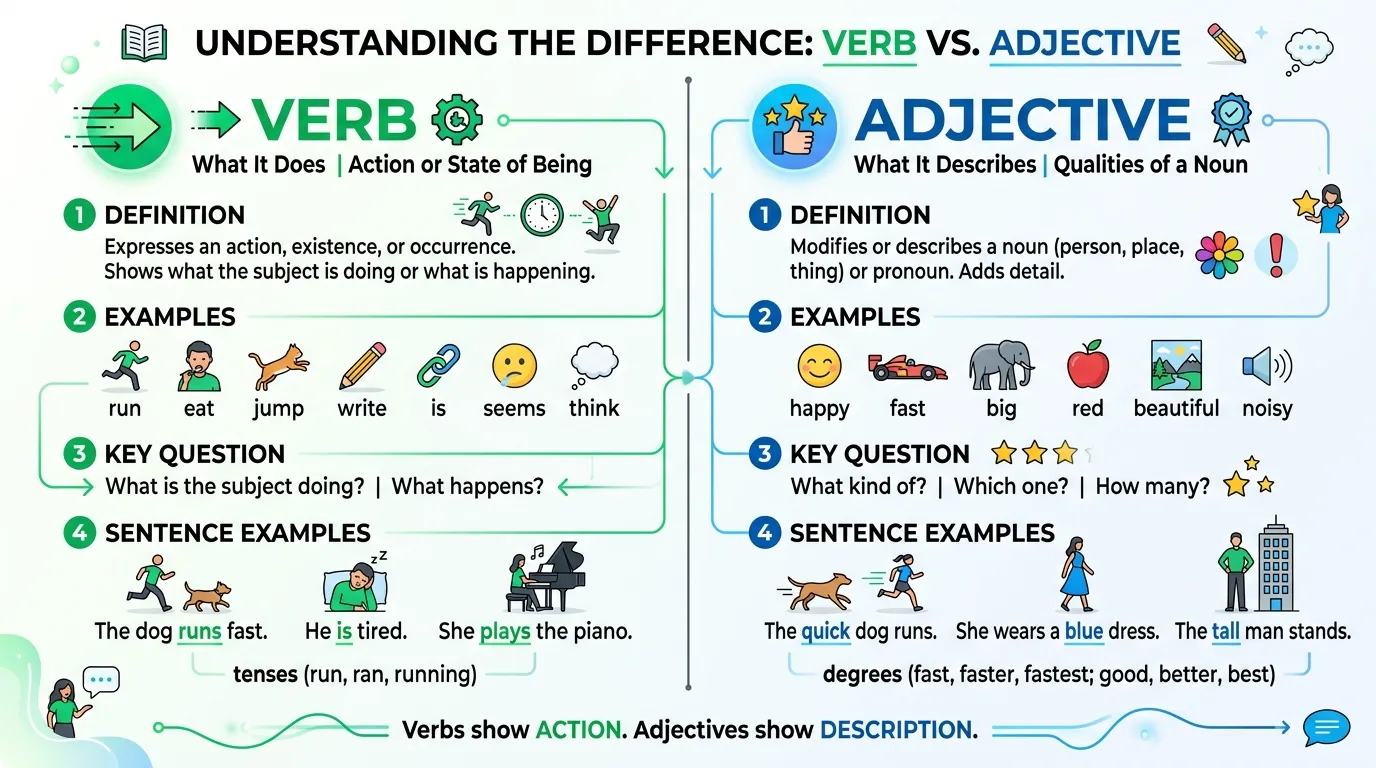
The difference between verb and adjective is simple. A verb shows an action or state, like “run” or “is.” An adjective describes a noun, like “happy” or “big.” Verbs tell what happens, while adjectives tell what something is like.
What Is Verb?
A verb is a word that shows action or a state.
It tells what someone or something does.
Simple Features:
- Shows action or happening
- Can show time (past, present, future)
- Very important in a sentence
Examples of Verbs:
- run
- eat
- play
- is
- are
Real-Life Example:
“She runs every day.”
Here, runs is the verb. It shows action.
What is an adjective?
An adjective is a word that describes a noun.
It tells more about a person, place, or thing.
Simple Features:
- Describes something
- Gives more detail
- Comes before a noun or after “is/are”
Examples of Adjectives:
- happy
- big
- red
- fast
- tall
Real-Life Example:
“She is happy.”
Here, happy is the adjective. It describes how she feels.
Difference Between Verb and Adjective
Here is a simple table to understand the difference between a verb and an adjective:
| Feature | Verb | Adjective |
| Meaning | Shows action or state | Describes a noun |
| Role | Tells what happens | Tells what something is like |
| Example | run, eat, is | happy, big, red |
| Position | After subject | Main part of the sentence |
| Function | Main part of sentence | Adds detail |
| Time | Can show tense | Does not show tense |
Key Differences Explained
Action vs Description
A verb shows action.
Example:
“He plays.” → plays is action.
An adjective describes something.
Example:
“He is smart.” → Smart gives detail.
Sentence Role
A verb is needed in most sentences.
Without a verb, the sentence feels incomplete.
Example:
“She is happy.” (wrong)
“She is happy.” (correct)
An adjective adds detail but is not always required.
Position in Sentence
Verbs usually come after the subject.
Example:
“They eat food.”
Adjectives come before nouns or after linking verbs.
Example:
“A big house”
“The house is big”
Tense (Time)
Verbs can change with time.
Example:
run → ran → running
Adjectives do not change with time.
Example:
big stays big
Examples
Example 1: Simple Sentence
- Verb: “He runs fast.”
- Adjective: “He is fast.”
Example 2: With Noun
- Verb: “She sings a song.”
- Adjective: “She has a sweet voice.”
Example 3: Daily Life
- Verb: “They play cricket.”
- Adjective: “They are good players.”
Example 4: School Example
- Verb: “The student studies.”
- Adjective: “The student is smart.”
Importance of Knowing the Difference
Understanding the difference between verb and adjective is very important.
It helps you:
- Make correct sentences
- Speak clearly
- Write better English
If you mix them up, your message may be wrong or confusing.
This knowledge is useful for:
- Students
- Writers
- English learners
Benefits of Understanding Verb vs Adjective
- Improves grammar skills
- Makes sentences clear
- Helps in exams
- Builds confidence in speaking
- Reduces mistakes
- Helps in writing better
- Makes communication easy
Common Mistakes People Make
Mistake 1: Using Adjective as Verb
Wrong: “He is happy.”
Correct: “He is happy.”
Mistake 2: Missing Verb
A sentence needs a verb.
Wrong: “She very kind.”
Correct: “She is very kind.”
Mistake 3: Confusing Forms
Some words look similar.
Example:
“running” (verb form)
“fast” (adjective)
Mistake 4: Wrong Placement
Adjectives must be placed correctly.
Wrong: “House big.”
Correct: “Big house.”
Real-Life Use
Where Verbs Are Used:
- Talking
- Writing
- Giving instructions
Where Adjectives Are Used:
- Describing people
- Describing things
- Adding details
Who Uses Them:
- Students
- Teachers
- Writers
- Everyone who speaks English
Easy Trick to Remember the Difference
Here is a simple trick:
Verb = Action
Adjective = Description
Think like this:
- Verb = Do
- Adjective = Describe
Which One Is Better?
This is not a “better” question.
Both are important.
Use Verb When:
- You show action
- You complete a sentence
Use Adjective When:
- You add detail
- You describe something
You need both to make strong sentences.
FAQs
1. What is the main difference between verb and adjective?
A verb shows action or a state. An adjective describes a noun.
2. Can a sentence work without a verb?
No, most sentences need a verb to be complete.
3. Can an adjective act like a verb?
No, but it can follow a linking verb like “is.”
4. What are examples of verbs?
5. What are examples of adjectives?
Big, happy, red, tall, fast.
6. Why do people confuse verb and adjective?
Both are common words in sentences, but they have different roles.
7. Which comes first, verb or adjective?
It depends. Verbs follow the subject. Adjectives usually come before nouns.
Conclusion
The difference between verb and adjective is easy once you understand their roles. A verb shows action or state, like “run” or “is.” An adjective describes a noun, like “happy” or “big.”
Verbs are the heart of a sentence. They show what is happening. Adjectives make sentences richer by adding detail. Both work together to create clear and meaningful sentences.
If you remember one simple idea, a verb is action, an adjective is description, you will never feel confused again. Keep practicing, and your English will improve step by step.