Imagine driving at night on a foggy road. Your car lights up the path, keeping you safe. But have you ever wondered why some cars use HID lights while others use LED lights? Understanding the difference between HID and LED is not just for car enthusiasts; it matters for daily safety, energy use, and efficiency.
HID stands for High-Intensity Discharge, a type of lighting known for brightness and long-range visibility. LED means Light Emitting Diode, which gives bright light using less energy and lasting longer. Many people get confused between HID and LED, especially when buying cars or home lights. Knowing the difference between HID and LED helps learners, drivers, and lighting experts make smart decisions.
Pronunciation:
- HID – US: /ˌeɪtʃ.aɪˈdiː/ | UK: /ˌeɪtʃ.aɪˈdiː/
- LED – US: /ˌɛl.iːˈdiː/ | UK: /ˌɛl.iːˈdiː/
Let’s dive deeper to understand the difference between HID and LED in detail.
H2: Key Differences Between HID and LED
1. Technology
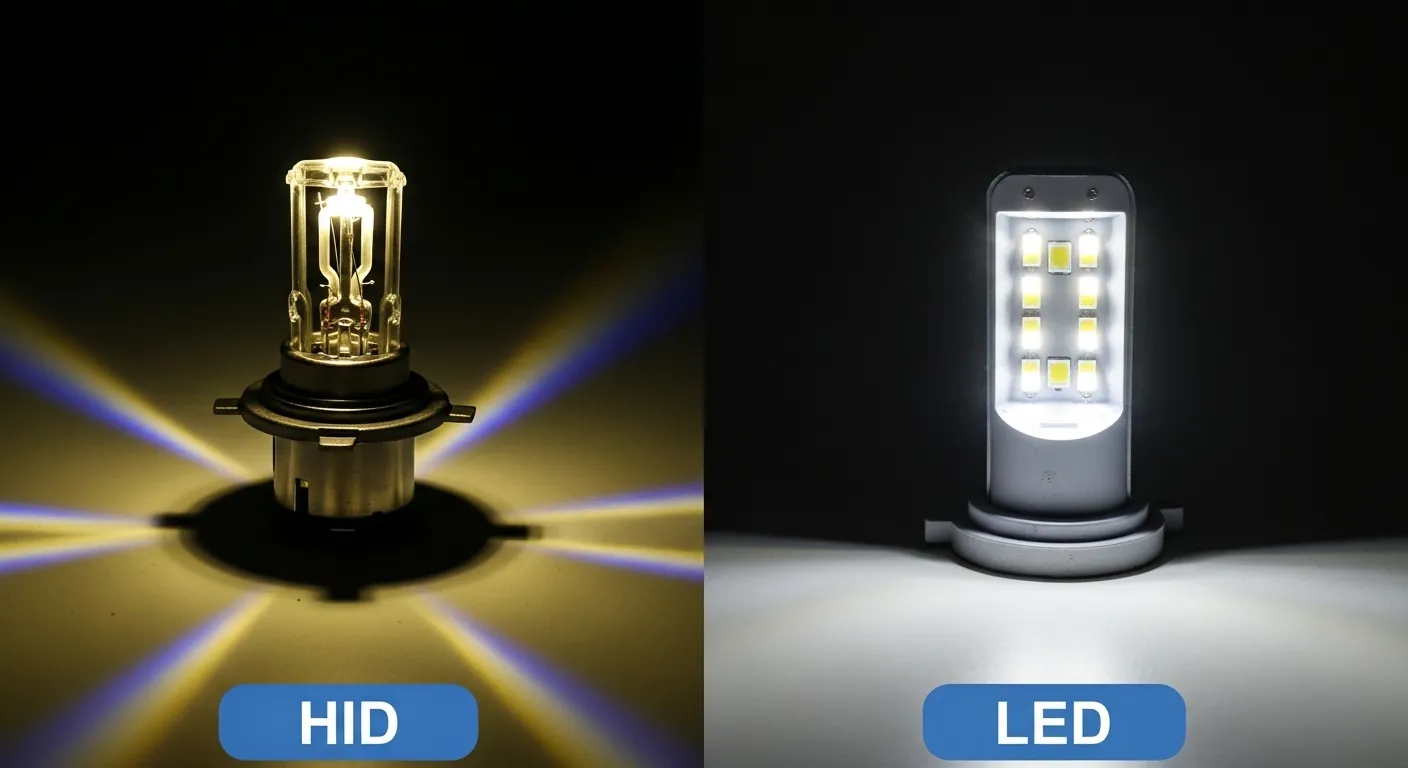
Meaning: HID uses gas and electric discharge, LED uses semiconductors.
Examples:
- HID bulbs create light through xenon gas and high voltage.
- LED bulbs emit light when electricity passes through a chip.
2. Brightness
Meaning: HID lights are extremely bright; LED lights are bright but more focused.
Examples:
- HID headlights can illuminate a long highway.
- LED lights focus well on streets without blinding other drivers.
3. Energy Efficiency
Meaning: LEDs consume less energy than HIDs.
Examples:
- A car with LED lights uses less battery.
- HID lights drain more power in older vehicles.
4. Lifespan
Meaning: LED bulbs last longer than HID bulbs.
Examples:
- LED lights can work 50,000 hours.
- HID lights usually last 2,000–3,000 hours.
5. Cost
Meaning: HID lights are usually more expensive to maintain; LEDs are cost-effective over time.
Examples:
- Replacing an HID bulb costs more.
- LED lights save money on electricity and replacements.
6. Warm-up Time
Meaning: HID lights take a few seconds to reach full brightness; LED lights turn on instantly.
Examples:
- HID headlights take 2–3 seconds to glow fully.
- LED lights glow immediately when switched on.
7. Durability
Meaning: LED lights are more resistant to vibrations and shocks.
Examples:
- LED lights survive rough roads.
- HID lights are more fragile in off-road vehicles.
8. Color Temperature
Meaning: HIDs usually produce bluish light; LEDs can produce various colors.
Examples:
- HID lights have a cold white-blue hue.
- LEDs can glow in warm white, cool white, or amber.
9. Environmental Impact
Meaning: LEDs are eco-friendly; HIDs use more energy and produce more heat.
Examples:
- LED lights reduce carbon footprint.
- HID lights generate extra heat, affecting efficiency.
10. Application
Meaning: HIDs are common in cars and stadiums; LEDs are widely used in homes, streetlights, and cars.
Examples:
- HIDs light up highways and stadiums.
- LEDs illuminate offices, streets, and vehicles efficiently.
Nature and Behaviour of HID and LED
- HID: Produces intense, broad light; takes time to reach full brightness; high energy usage; fragile.
- LED: Produces focused light instantly; energy-efficient; long-lasting; highly durable.
Why People Are Confused
Many people confuse HID and LED because both produce bright light. However, their technology, efficiency, lifespan, and cost differ significantly.
Table: Difference and Similarity
| Feature | HID | LED | Similarity |
| Technology | Gas discharge | Semiconductor | Both produce artificial light |
| Brightness | Very high, wide | Bright, focused | Both illuminate effectively |
| Energy Usage | Higher | Lower | Both need electricity |
| Lifespan | Short (~3,000 hrs) | Long (~50,000 hrs) | Both need replacement eventually |
| Warm-up Time | Few seconds | Instant | Both serve lighting purpose |
| Cost | Expensive | Affordable long-term | Both vary by brand |
| Durability | Fragile | Very durable | Both can fail |
| Color Temperature | Cool white/blue | Various colors | Both can produce white light |
| Application | Cars, stadiums | Cars, streets, homes | Both used for illumination |
| Environmental Impact | More heat, energy-intensive | Eco-friendly, energy-saving | Both help in visibility |
Which Is Better in What Situation?
- HID: Better for long-distance visibility on highways and large areas due to intense brightness. Ideal for drivers needing wide light coverage.
- LED: Better for energy savings, home lighting, and urban streets. Perfect for eco-conscious users and long-term cost-effectiveness.
How HID and LED Are Used in Metaphors and Similes
- HID: “Like HID lights cutting through darkness, his words illuminated the problem.”
- LED: “Her smile was like an LED glow, bright and lasting.”
Connotative Meaning
- HID: Neutral to positive; implies brightness and power.
- LED: Positive; implies efficiency, modernity, and durability.
Examples:
- HID: “The HID projector lit the stage like a spotlight.”
- LED: “LED technology is the future of eco-friendly lighting.”
Idioms/Proverbs Related to Light
- “Light at the end of the tunnel” – hope after difficulty.
- “See the light” – understand or realize something.
- Example: HID lights show the road, giving drivers hope at night. LED bulbs help see the light in every dark corner.
Works in Literature
- “The Light Brigade” – Poetry, Alfred Lord Tennyson, 1854 (metaphorical use of light).
- “LED Dreams” – Modern fiction, Alex Carter, 2019 (science/tech theme).
Movies on HID and LED
- “LED Revolution” – 2020, USA (technology documentary)
- “HID Lights” – 2018, UK (tech innovation short film)
Frequently Asked Questions
- Which is brighter, HID or LED?
- HID is brighter over long distances; LED is more focused.
- Do LEDs use less energy than HIDs?
- Yes, LEDs are highly energy-efficient.
- Which lasts longer?
- LEDs typically last 50,000 hours, while HIDs last 2,000–3,000 hours.
- Can HID be replaced with LED?
- Yes, but requires compatible fittings and voltage.
- Are HIDs safer at night?
- HIDs are brighter and visible, but LEDs reduce glare and energy waste.
How Both Are Useful for the Surroundings
- HID: Lights highways, stadiums, and outdoor events efficiently.
- LED: Reduces electricity consumption, provides eco-friendly home and street lighting.
Final Words
Understanding the difference between HID and LED helps in making informed choices for vehicles, homes, and streets. Both have their unique advantages, and knowing them improves safety, efficiency, and sustainability.
Conclusion
HID and LED lights serve the same basic purpose: illumination. However, their technology, brightness, energy efficiency, lifespan, and cost differ greatly. HID lights are ideal for long-distance visibility and large areas, while LED lights shine in energy-saving applications, durability, and eco-friendliness. Knowing the difference between HID and LED is essential for drivers, lighting experts, students, and everyday users to make informed and safe choices. Both types of lights enhance our surroundings and daily life in unique ways.