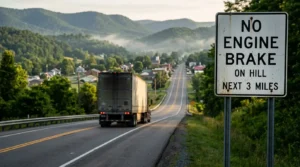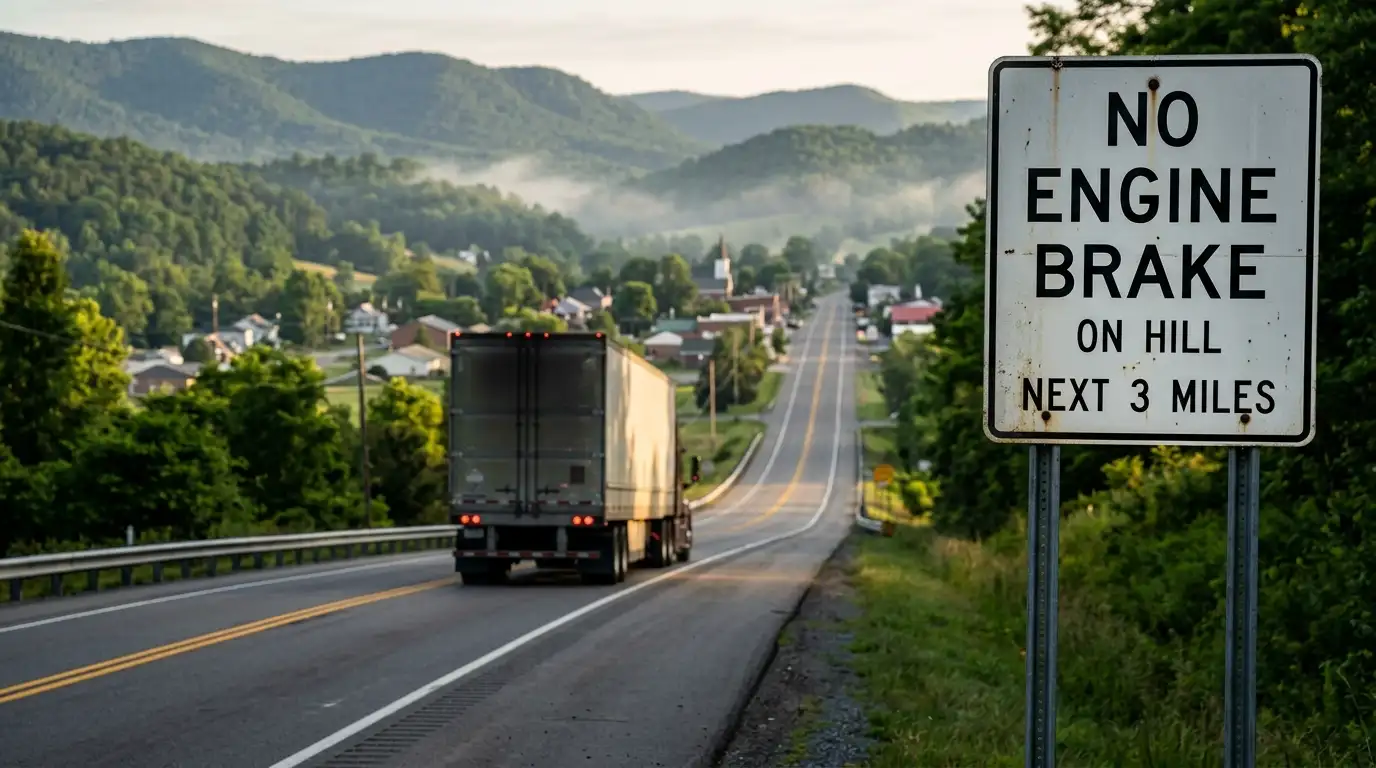
The no engine brake meaning is simple. A “No Engine Brake” sign tells truck drivers not to use their engine brake, which makes a loud, rattling noise, in that area. Towns post these signs to keep neighborhoods quiet. The sign does not ban the truck’s normal brakes, and drivers can still stop.
If you saw one of these signs and wondered what it meant, you are not alone. Many people search for it after hearing a truck roar down a hill at night. Others are new drivers who want to follow the rules. In this article, you will learn what an engine brake is, why some places ban it, and how truck drivers slow down safely when they can’t use it.
Quick Answer
A “No Engine Brake” sign means that drivers of large trucks must not use the engine’s compression brake in that zone. Some signs say “Jake Brake Prohibited” or “Engine Brakes Prohibited.” They all mean the same thing.
The rule is about noise. An engine brake makes a sudden, loud, machine-gun sound. That sound can wake people up and bother families who live near the road. So the town asks drivers to slow down in other ways.
The sign is not about safety in the way a stop sign is. It is a noise rule. Still, it is a real traffic rule, and drivers can be ticketed for ignoring it. Rules and penalties differ by place, so a driver should always follow the posted sign.
What Is an Engine Brake?
An engine brake is a tool that helps a big truck slow down without using the regular brake pedal. It uses the engine itself to create drag. That drag works like a hand held against the wheel of a bike.
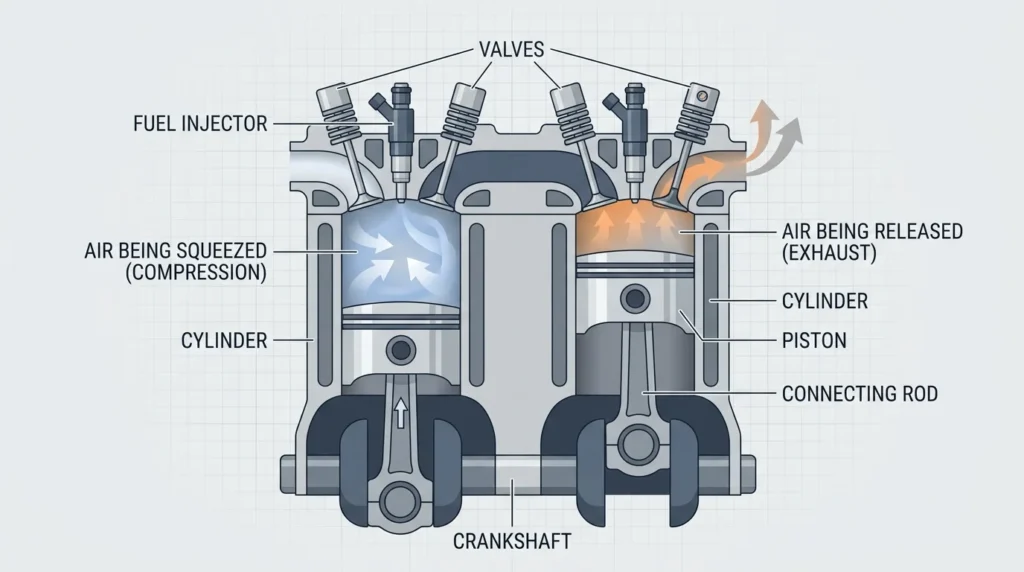
To understand it, think about how an engine works. In a diesel engine, each piston pushes up and squeezes air. This squeezing takes energy. Normally, the squeezed air then pushes the piston back down, which gives the energy back. That is why the truck keeps rolling.
A compression-release engine brake changes this. Near the top of the squeeze, it opens a valve and lets the squeezed air rush out. Now the air cannot push the piston back down. The engine has to take in energy and give none back. This slows the truck.
That sudden burst of air leaving the engine is what makes the loud sound. It is a series of sharp bangs, one after another, so fast that they sound like a buzz or rattle.
Many people call this a “Jake brake.” That name comes from Jacobs Vehicle Systems, a company that made popular versions of this device. “Jake brake” is a brand name that people now use for the whole idea. Other names include compression brake, engine retarder, and “Jake.”
Heavy trucks need this tool for a good reason. A loaded truck can weigh up to 80,000 pounds. Going down a long hill, the regular brakes can get very hot. Hot brakes lose power, and that is dangerous. The engine brake takes some of the work so the regular brakes stay cool.
Why Towns Put Up No Engine Brake Signs
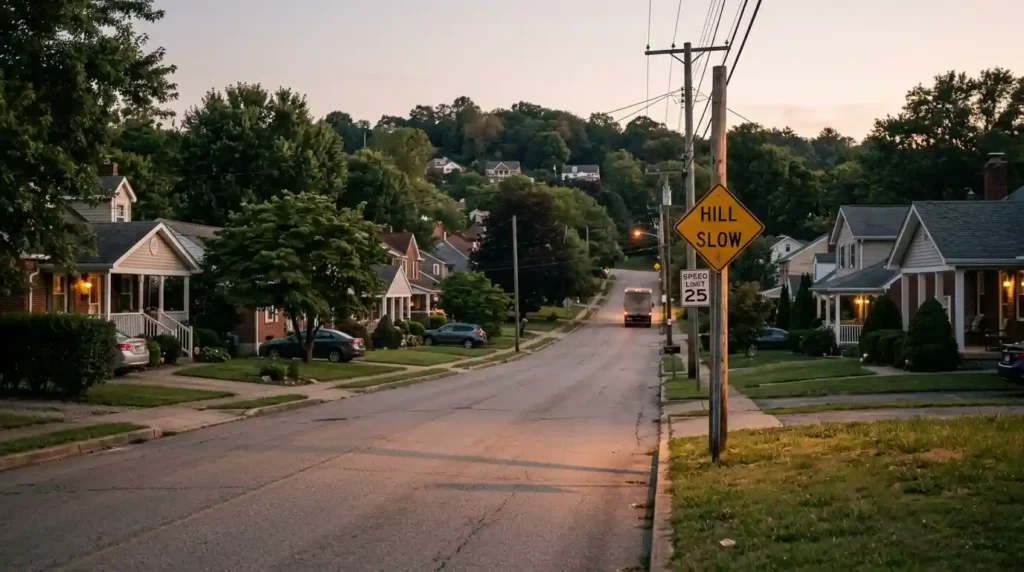
Noise is the main reason. An engine brake can be much louder than the same truck rolling along normally. When a truck uses one near homes, schools, or hospitals, the sound can carry a long way.
Think about a family living near a long downhill road. Trucks may pass at all hours. Each time a driver uses the engine brake, the home shakes with sound. A baby wakes up. A night-shift worker cannot sleep. After many complaints, the town may decide to post signs.
Here are some places where you often see these signs. Roads near neighborhoods are common. So are roads close to hospitals, schools, and quiet towns that sit at the bottom of a hill. Some signs appear at the edge of a town, so drivers know the rule before they enter.
Local leaders also want to be fair. Truck drivers are doing their jobs, and the goods they carry reach stores in every town. The signs are a way to balance two needs: keeping roads working and keeping neighborhoods livable.
How the Signs Look and What They Say
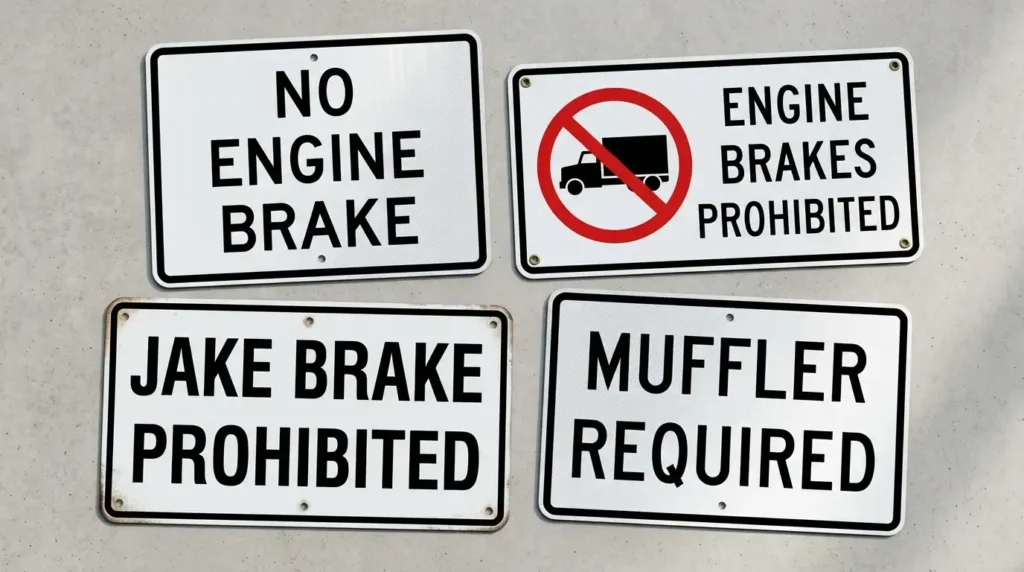
Not every sign uses the same words. Different states, cities, and countries use different wording. The table below shows common ones and what they usually mean.
| Sign Wording | What It Usually Means |
| No Engine Brake | Do not use the engine brake in this area |
| Engine Brakes Prohibited | Same as above, using stronger wording |
| Jake Brake Use Prohibited | Same rule, using the common brand name |
| Compression Brake Limited to Emergencies | Use only if you must, to avoid a crash |
| Muffler Required for Engine Brake Use | Allowed only if the truck has a working muffler on the brake |
Most of these signs are white or yellow with black letters, and some show a picture of a truck with a line across it. Always read the whole sign. A small difference in the words can change the rule.
Also note where the rule starts and stops. Some signs mark the beginning of a quiet zone. Others mark the end. If you are not sure, treat the rule as active until you see a sign that says it is over.
Engine Brake vs. Exhaust Brake vs. Service Brakes
Drivers hear several brake words, and it is easy to mix them up. This table sets them side by side.
| Type of Brake | How It Works | How Loud Is It? | Usually Banned by “No Engine Brake” Signs? |
| Compression-release engine brake (Jake brake) | Releases squeezed air to slow the engine | Very loud | Yes |
| Exhaust brake | Partly blocks the exhaust pipe to build back pressure | Much quieter | Often no, but check the sign |
| Service brakes (regular brakes) | Friction pads press against the wheels | Quiet | No, always allowed |
| Downshifting | Using a lower gear so the engine holds the truck back | Moderate | No, usually allowed |
The most important point is that the sign does not take away the truck’s ability to stop. The regular brakes always work. The rule only asks the driver not to use one loud tool.
Some signs name the type of brake they mean. If the wording is not clear, a driver should follow the stricter reading while in the zone, or choose a quiet method such as a lower gear.
What Truck Drivers Should Do on a Steep Hill
A “No Engine Brake” sign does not mean “just use your brake pedal and hope for the best.” Smart drivers plan ahead. Here is how experienced drivers handle a long downhill in a quiet zone.
First, slow down before the hill begins. A truck that enters a downgrade too fast has little room to fix mistakes. It is much easier to stay in control when you start slow.
Second, pick a lower gear before you start downhill. The engine itself holds the truck back when it is in a low gear, even without the loud brake. Pick the gear early, because shifting on a steep hill can be hard.
Third, use the service brakes in short, firm presses. Many safety guides explain a method where the driver brakes hard for a moment, then lets go, instead of dragging the brakes the whole way. This keeps the brakes from getting too hot. Drivers should learn the method taught in their training and follow their company’s rules.
Fourth, watch for signs about runaway truck ramps. These are special lanes beside steep roads where a truck can steer if its brakes fail. They are built to stop a truck safely. A good driver always knows where the next one is.
Last, remember that safety comes first. Many rules allow the engine brake in a real emergency. If a driver must use it to avoid a crash, saving lives matters more than noise. Even so, a driver should not use an emergency as an excuse.
Does the Sign Apply to Cars?
Most of the time, no. These signs are aimed at large trucks with compression-release engine brakes. A regular car does not have one, so there is nothing for the driver to turn off.
However, some people use the phrase “engine braking” for something else. In a car, engine braking means letting off the gas, or shifting to a lower gear, so the engine slows the car. This is normal driving. It is quiet, and it is not what the sign talks about.
If you drive a pickup or a small truck, you probably do not have a Jake brake. Some larger pickups with special exhaust systems may have a brake that is different from the loud type. If you are unsure, check the owner’s manual or ask a dealer. When in doubt, a lower gear is a safe and quiet choice.
Electric vehicles are different again. Many slow down when you lift your foot, using a system called regenerative braking. It makes almost no sound. So the idea of a loud engine brake does not apply to them.
Other Meanings of “No Engine Brake”
Sometimes the phrase is not about a road sign at all. This is worth knowing, because it can confuse readers.
A driver might say a vehicle has “no engine brake” when it does not have an engine brake system installed. Many smaller trucks and nearly all passenger cars fall into this group. They rely on regular brakes and normal engine drag.
The phrase can also come up when someone talks about coasting in neutral. When a car is in neutral, the engine is not connected to the wheels. That means there is no engine braking at all. Experts warn against this on hills, because the driver loses a helpful way to control speed.
Finally, some people mix it up with a condition where the engine brake does not work. If a truck’s engine brake stops working, the driver must rely more on the service brakes and gears. A good driver tells the shop right away, since the tool is important on long descents.
In most searches, though, people want the road sign meaning, and that is the one we covered above.
A Short History of the Engine Brake
The engine brake has been around for decades. Clessie Cummins, a well-known engine builder, developed the compression-release brake in the 1950s. Jacobs later helped bring it to many trucks, which is why the name “Jake brake” stuck.
At first, the device was welcomed. It made long downhill drives safer, and it let drivers keep their regular brakes cool. Over time, more trucks used them, and so did the noise. By the 1970s and 1980s, people in many places began to complain.
Mufflers and better designs now help, and some engine brakes are quieter than the old ones. Still, they can be loud, so many towns choose to ban them. This is why the signs exist today.
Fines and Rules: What to Know
There is no single rule for the whole country or world. Each state, province, county, or town can set its own rules. Some places have signs only on certain roads. Others have wider noise laws.
Because of this, the fine for breaking the rule is not the same everywhere. I do not want to guess at a number. A driver should check the rules for the state or city where they drive, and read the posted sign carefully.
In the United States, a good place to start is the state’s transportation department. Many also share local noise rules. If you work for a trucking company, your dispatcher or safety manager should also know the local rules on regular routes.
Remember that the sign is the law in that spot. If you ignore it, you may get a ticket, even if you did not know the exact reason.
Common Mistakes People Make
Even skilled drivers can slip up. Here are the mistakes that come up most often.
The first mistake is thinking the sign bans all braking. It does not. It only bans one type of loud engine brake. The truck can still stop, and the driver can still use the regular brakes.
The second mistake is waiting too long to slow down. A driver who enters a hill too fast may feel forced to use the engine brake. Planning ahead avoids this problem.
The third mistake is mixing up the names. People say “Jake brake,” “engine brake,” and “exhaust brake” as if they were the same. They are not. The rule may cover one but not the others, so reading the exact wording matters.
The fourth mistake is ignoring a faint or hidden sign. Signs can be blocked by trees or snow. A driver should stay alert near towns and hill bottoms, where these signs are common.
The fifth mistake is thinking that noise rules do not matter. To the people who live there, they matter a lot. Following the rules is also good for the image of the trucking business.
Real-Life Examples
Here are a few simple examples that show how this works.
Imagine a driver named Mark who hauls lumber. He comes down a long hill into a small town. A sign at the top says “No Engine Brake.” Mark slows early, shifts to a low gear, and uses short presses on the pedal. He rolls into town quietly. No one is woken up, and Mark stays safe.
Now picture a different case. A driver sees a car stop suddenly ahead on a downhill road. The brakes feel weak, and the truck is gaining speed. The sign says engine brakes are banned, but it also says emergencies are allowed. The driver uses every tool to stop safely. Here, safety comes first.
Last, think about Sara, who lives beside a steep road. For years, trucks rattled her windows at night. After neighbors asked the town for help, signs went up. Trucks still pass, but the nights are quieter. This is what the signs are meant to do.
FAQs
What does “no engine brake” mean on a sign?
It means truck drivers must not use the loud compression-release engine brake in that area. The rule is meant to cut noise for nearby homes and businesses.
Is a Jake brake the same as an engine brake?
Mostly, yes. “Jake brake” comes from a brand name, but people use it for any compression-release brake. Some signs use that name directly.
Can truck drivers still stop if engine brakes are banned?
Yes. The regular service brakes work as always. Drivers can also use lower gears to control speed on hills.
Is the engine brake allowed in an emergency?
Some signs and local rules allow it when needed to avoid a crash. Others do not say. A driver should read the sign and know the local rules.
Do these signs apply to regular cars?
Usually not. Cars do not have compression-release engine brakes. Normal engine braking, like lifting your foot off the gas, is not what the sign means.
What happens if a driver ignores the sign?
The driver can be ticketed. Fines and rules vary by place, so it is best to check with the local transportation department.
Conclusion
The no engine brake meaning comes down to this: a loud tool is not allowed in that zone, and the driver must slow the truck in a quieter way. The sign does not stop a driver from braking. It just asks them to plan ahead, use lower gears, and use the regular brakes with care.
For nearby residents, these signs mean calmer nights. For drivers, they are a reminder to respect the communities they pass through. Safe driving and good manners can go together.
If you are a driver, always read each sign closely. Slow down before steep hills, pick the right gear early, and know where emergency ramps are. If you are just curious, you now know why that sign is on the road, and what the loud rattle is all about.