Imagine you need money. You go to a bank and ask for help. The bank gives you money, and you promise to pay it back later with extra money. This is a common situation. But sometimes, instead of taking money from a bank, companies and governments raise money from many people. This is where confusion starts.
Many people mix up loans and bonds. They both involve borrowing money. But they are not the same. The way they work is different. The people involved are different. Even the risks and uses are different.
In this article, you will learn the difference between loan and bond in very simple English. You will see clear meanings, easy examples, and a side-by-side comparison. By the end, you will know exactly how both work.
Featured Snippet
The difference between loan and bond is simple. A loan is money borrowed from one lender, like a bank. A bond is money raised from many investors. Loans are private agreements, while bonds are public and can be bought or sold.
What Is Loan?
A loan is money you borrow from one person or one bank.
You agree to:
- Pay back the money
- Pay extra money called interest
- Follow a time plan
Simple Features:
- One lender (like a bank)
- Fixed payment plan
- Private agreement
Real-Life Example:
You take a car loan from a bank. The bank gives you money. You pay it back every month with interest.
What Is Bond?
A bond is a way to borrow money from many people.
Companies or governments issue bonds.
People buy these bonds and become lenders.
Simple Features:
- Many investors
- Can be bought and sold
- Public investment tool
Real-Life Example:
A government needs money to build roads. It issues bonds. Many people buy these bonds and earn interest over time.
Difference Between Loan and Bond
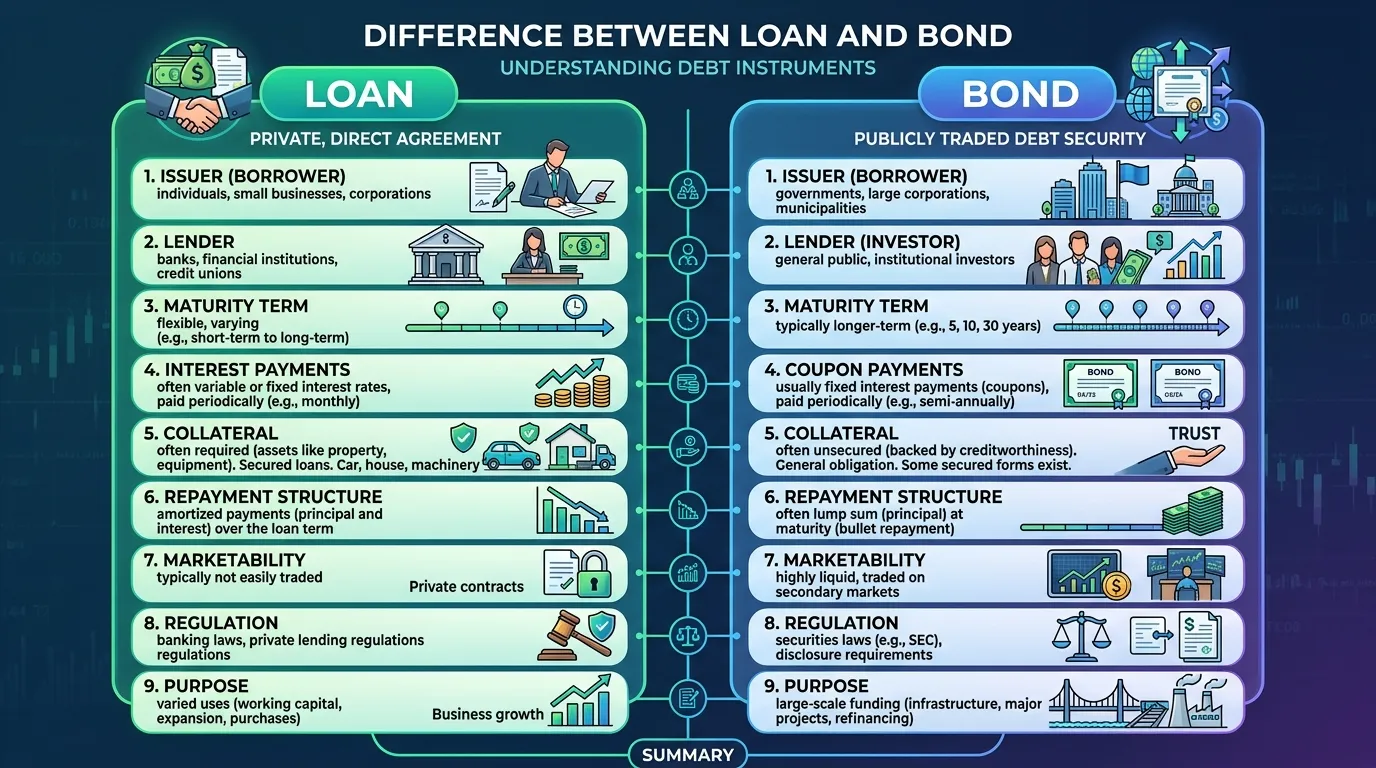
Here is a simple table to understand the difference between loan and bond:
| Feature | Loan | Bond |
| Meaning | Money borrowed from one lender | Money raised from many investors |
| Lender | Bank or individual | Public investors |
| Type | Private agreement | Public investment |
| Transfer | Cannot be sold easily | Can be bought and sold |
| Use | Personal or business needs | Large projects |
| Risk | Lower for lender | Depends on issuer |
| Interest | Fixed or variable | Fixed mostly |
| Example | Car loan, home loan | Government bond |
Key Differences Explained
Source of Money
A loan comes from one place.
Usually a bank or a person gives the money.
A bond comes from many people.
Thousands of investors may give small amounts.
Ownership and Access
Loans are private.
Only you and the lender are involved.
Bonds are public.
Anyone can buy them.
Flexibility
Loans are fixed.
You follow strict rules.
Bonds are flexible.
They can be traded in markets.
Use of Money
Loans are often used for:
- Buying a house
- Buying a car
- Starting a small business
Bonds are used for:
- Big company projects
- Government work
- Infrastructure
Risk Level
Loans are safer for lenders.
They deal with one borrower.
Bonds carry more risk.
The value may change in the market.
Examples
Example 1: Personal Loan
Ali takes a loan from a bank to buy a bike. He pays monthly.
Example 2: Home Loan
A family takes a loan to buy a house. They pay over many years.
Example 3: Government Bond
A government issues bonds to build a bridge. People invest and earn interest.
Example 4: Company Bond
A company needs money to expand. It sells bonds to investors.
Importance of Knowing the Difference
Understanding the difference between loan and bond is very useful.
It helps you:
- Make smart money decisions
- Understand finance basics
- Avoid confusion
If you want to borrow money, you choose a loan.
If you want to invest money, you may choose bonds.
Benefits of Understanding Loan vs Bond
- Helps in smart investing
- Improves financial knowledge
- Reduces confusion
- Helps choose the right option
- Useful for students and beginners
- Builds confidence in money decisions
- Helps understand markets
Common Mistakes People Make
Mistake 1: Thinking They Are the Same
Both involve borrowing money, but they work differently.
Mistake 2: Ignoring Risk
People think bonds are always safe. Some bonds carry risk.
Mistake 3: Not Knowing Who Lends
Loans have one lender. Bonds have many.
Mistake 4: Thinking Bonds Are Only for Experts
Anyone can invest in bonds, not just experts.
Real-Life Use
Where Loans Are Used:
- Buying cars
- Buying homes
- Paying for education
Where Bonds Are Used:
- Government projects
- Company growth
- Investment plans
Who Uses Them:
- Individuals use loans
- Investors buy bonds
- Governments issue bonds
Easy Trick to Remember the Difference
Here is a simple trick:
Loan = One lender
Bond = Many lenders
Think like this:
- Loan = One-to-one
- Bond = One-to-many
Which One Is Better?
It depends on your need.
Choose Loan When:
- You need money
- You want simple borrowing
- You deal with a bank
Choose Bond When:
- You want to invest
- You want steady income
- You trust the issuer
Loans are for borrowers.
Bonds are for investors.
FAQs
1. What is the main difference between loan and bond?
A loan is from one lender. A bond is from many investors.
2. Which is better, loan or bond?
It depends. Loans are for borrowing. Bonds are for investing.
3. Can a bond be sold?
Yes, bonds can be bought and sold in markets.
4. Are loans safer than bonds?
Loans are safer for lenders, but bonds can vary in risk.
5. Who can take a loan?
Anyone who qualifies, like individuals or businesses.
6. Who can buy bonds?
Anyone with money to invest can buy bonds.
7. Do both have interest?
Yes, both loans and bonds include interest payments.
Conclusion
The difference between loan and bond is easy to understand when you break it down. A loan is money borrowed from one lender, usually a bank, with a clear plan to pay it back. A bond is money raised from many investors, often used by companies or governments for large projects.
Loans are simple and direct. Bonds are more flexible and can be traded. Loans are best for people who need money. Bonds are best for people who want to invest money and earn interest.
By learning this difference, you can make better financial choices. Just remember: loans are for borrowing, and bonds are for investing.