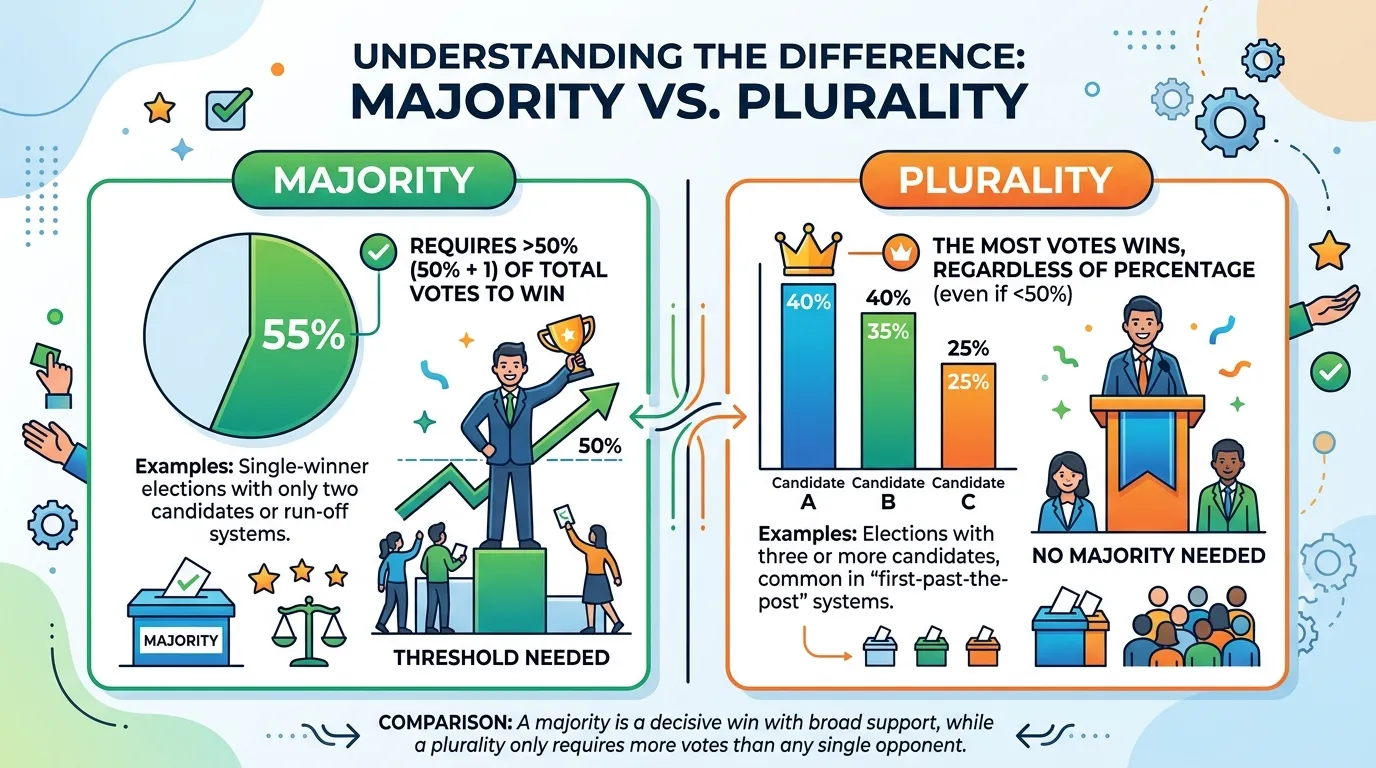
Imagine a school election. Three students run for class leader. One gets 40 votes, one gets 35, and one gets 25. Who wins? Many people feel confused here. Is 40 enough to win? This is where the difference between majority and plurality becomes important.
Many people mix these two terms. They sound similar, but they are not the same. You may see them in elections, voting, or even simple group decisions. If you do not understand them, you may make wrong assumptions.
In this article, you will learn both terms in very simple English. You will see clear definitions, easy examples, and a side-by-side comparison. By the end, you will know exactly what each term means and when to use it.
Featured Snippet
The difference between majority and plurality is simple. A majority means more than half of all votes. A plurality means the highest number of votes, but not more than half. The majority needs over 50%, while the plurality just needs more votes than others.
What is the majority?
A majority means more than half.
This is the key idea.
If there are 100 votes, a majority means at least 51 votes.
Simple Features:
- More than 50%
- Shows strong support
- Often used in final decisions
Real-Life Example:
In a class of 20 students:
- 11 students chose pizza
- 9 students choose burgers
Pizza has the majority because 11 is more than half of 20.
What Is Plurality?
A plurality means the highest number of votes, but not more than half.
It wins, even if it is less than 50%.
Simple Features:
- Not more than half
- Just more than others
- Common in elections with many choices
Real-Life Example:
In a class of 30 students:
- 12 choose pizza
- 10 choose burgers
- 8 choose pasta
Pizza wins by plurality. But 12 is not more than half of 30, so it is not a majority.
Difference Between Majority and Plurality
Here is a simple table to understand the difference between majority and plurality:
| Feature | Majority | Plurality |
| Meaning | More than half of votes | Highest number of votes |
| Percentage | Over 50% | Less than or more than 50% |
| Strength | Strong support | Weak or split support |
| Use | Final decisions | Multi-option voting |
| Example | 60 out of 100 votes | 40 out of 100 votes (if others have less) |
| Requirement | Needs majority mark | Just needs more than others |
| Common Use | Laws, approvals | Elections with many candidates |
Key Differences Explained
The majority needs more than half
A majority must cross the 50% mark.
If total votes are 100, you need 51 or more.
This shows strong support.
Example:
If 70 people agree, it is a clear majority.
Plurality Only Needs the Highest Votes
Plurality does not need 50%.
It only needs more votes than the others.
Example:
If the votes are 40, 35, and 25, then 40 wins.
But 40 is not more than half, so it is not a majority.
The majority shows strong agreement
The majority means most people agree.
It is a clear decision.
Example:
In a team, if most people pick one option, it feels fair.
Plurality Shows Split Choices
Plurality means people are divided.
No option has full support.
Example:
In elections with many candidates, votes get split.
Use in Voting Systems
The majority is used when strong approval is needed.
Plurality is used when many choices are present.
Example:
Some countries use plurality voting in elections.
Examples
Let’s look at simple, real-life examples.
Example 1: School Election
- Ali: 45 votes
- Ahmed: 35 votes
- Sara: 20 votes
Ali wins by plurality, not majority.
Example 2: Food Choice
- Pizza: 60 votes
- Burger: 25 votes
- Pasta: 15 votes
Pizza wins by a majority.
Example 3: Group Decision
In a group of 10:
- 6 choose movie A
- 4 choose movie B
Movie A has a majority.
Example 4: Election in a City
- Candidate A: 48%
- Candidate B: 32%
- Candidate C: 20%
Candidate A wins by plurality.
Importance of Knowing the Difference
Understanding the difference between majority and plurality is very important.
It helps you:
- Understand election results
- Make fair decisions
- Avoid confusion
If you think plurality is majority, you may think people strongly support something when they do not.
This knowledge is useful in:
- School voting
- Group decisions
- National elections
It helps you see the truth behind numbers.
Benefits of Understanding Majority vs Plurality
- Helps you make better decisions
- Clears confusion in voting results
- Improves your general knowledge
- Helps in exams and studies
- Makes you smarter in discussions
- Helps you understand elections
- Builds strong thinking skills
Common Mistakes People Make
Mistake 1: Thinking Plurality Means Majority
Many people think the winner always has more than half.
This is wrong.
Plurality can win with less than 50%.
Mistake 2: Ignoring Total Votes
People forget to check the total votes.
Without total votes, you cannot know the majority.
Mistake 3: Mixing Both Terms
Some people use both words interchangeably.
But they have different meanings.
Mistake 4: Assuming Strong Support
Plurality does not mean strong support.
It may just mean others got fewer votes.
Real-Life Use
Where Majority Is Used:
- Final decisions
- Passing laws
- Team agreements
Example: A law may need majority approval to pass.
Where Plurality Is Used:
- Elections with many candidates
- Competitions
- Polls
Example: A leader may win even without 50% votes.
Who Uses Them:
- Students in schools
- Governments in elections
- Groups in decisions
Easy Trick to Remember the Difference
Here is a simple trick:
Majority = More than half
Plurality = Most, but not half
Think like this:
- Majority = Big win
- Plurality = Just a win
Which One Is Better?
There is no single answer.
It depends on the situation.
Choose Majority When:
- You need strong support
- Decisions must be fair
- Agreement is important
Choose Plurality When:
- Many choices are present
- A quick decision is needed
- Voting has many options
Plurality is easier, but the majority is stronger.
FAQs
1. What is the main difference between majority and plurality?
A majority means more than half of the votes. A plurality means the highest votes, but not more than half.
2. Which is better, majority or plurality?
It depends. The majority shows strong support. Plurality is useful when there are many choices.
3. Can someone win with fewer than 50% votes?
Yes. That is called a plurality win.
4. Why do people confuse majority and plurality?
Because both involve winning votes, but their rules are different.
5. Is plurality always fair?
Not always. It may not show full support from most people.
6. Does the majority always mean everyone agrees?
No. It just means more than half agree.
7. Where are these terms commonly used?
They are used in elections, voting, schools, and group decisions.
Conclusion
The difference between majority and plurality is simple once you understand it clearly. A majority means more than half of the total votes. It shows strong support and clear agreement. A plurality means having the highest number of votes, even if it is less than half. It often happens when there are many choices.
Both terms are important in voting and decision-making. The majority gives stronger confidence, while plurality helps when choices are many and time is short. By knowing this difference, you can better understand elections, group decisions, and daily choices.
Keep the simple trick in mind: the majority is more than half, and the plurality is just the most votes. This will help you never mix them up again.