Imagine standing under a clear night sky centuries ago, just like ancient astronomers did. Everything you saw, the stars, the Sun, the Moon, appeared to revolve around Earth. It felt obvious: we must be at the center of everything.
For a long time, this belief shaped how humans understood the universe. Scholars built entire systems around this idea, teaching that Earth was fixed and everything else moved around it. But then came bold thinkers who challenged this view. Observations improved, questions deepened, and eventually, a revolutionary idea emerged: what if the Sun, not Earth, was at the center?
This shift didn’t just change astronomy; it transformed science, philosophy, and our understanding of reality. Let’s explore the difference between geocentric and heliocentric models in a simple, engaging way.
Quick Answer
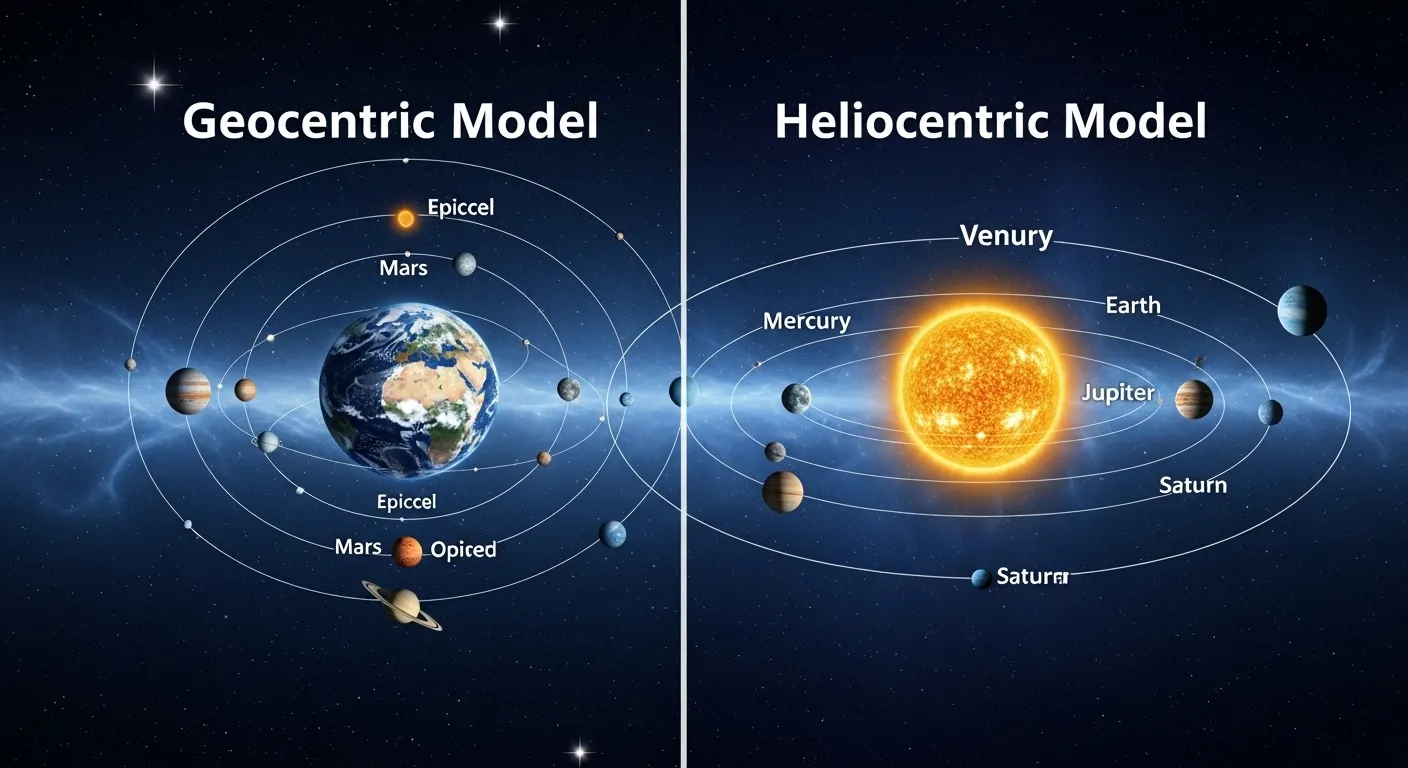
- The geocentric model places Earth at the center of the universe, with the Sun, Moon, and planets orbiting it.
- The heliocentric model places the Sun at the center, with Earth and other planets orbiting the Sun.
What is the Geocentric Model?
The geocentric model is an ancient theory that describes Earth as the center of the universe.
Key Idea:
Everything Sun, Moon, planets, and stars, revolves around Earth.
Who Supported It?
- Aristotle
- Claudius Ptolemy
How It Worked:
- Earth is stationary at the center
- Celestial bodies move in circular orbits
- Complex loops (called epicycles) were added to explain unusual planetary motion
Real-World Perspective:
If you observe the sky casually, the Sun appears to rise and set, reinforcing the idea that it moves around Earth. This visual illusion made the geocentric model believable for centuries.
What is the Heliocentric Model?
The heliocentric model is the modern scientific understanding of our solar system.
Key Idea:
The Sun is at the center, and Earth revolves around it.
Who Introduced It?
- Nicolaus Copernicus
- Supported later by Galileo Galilei and Johannes Kepler
How It Works:
- The Sun is stationary at the center (of the solar system)
- Earth rotates on its axis (causing day and night)
- Earth revolves around the Sun (causing seasons)
Real-World Perspective:
Modern space missions, satellite data, and telescopes confirm that Earth is just one of many planets orbiting the Sun.
Geocentric vs Heliocentric: Key Differences
| Feature | Geocentric Model | Heliocentric Model |
| Center of System | Earth | Sun |
| Movement of Earth | Stationary | Rotates and revolves |
| Movement of Sun | Orbits Earth | Movement of the Sun |
| Planetary Motion | Complex loops (epicycles) | Simple elliptical orbits |
| Accuracy | Less accurate | Highly accurate |
| Scientific Acceptance | Historical belief | Modern scientific fact |
| Key Supporters | Aristotle, Ptolemy | Copernicus, Galileo, Kepler |
Why the Geocentric Model Was Accepted for So Long
1. Human Observation
From Earth, everything appears to move around us.
2. Lack of Technology
Ancient astronomers didn’t have telescopes to observe planetary details.
3. Philosophical Beliefs
Many believed humans were central to the universe, reinforcing Earth-centered ideas.
What Changed the View?
The transition from geocentric to heliocentric didn’t happen overnight.
Key Developments:
- Better observations using early telescopes
- Discovery of moons orbiting Jupiter (by Galileo)
- Mathematical models by Kepler showing elliptical orbits
These discoveries made the heliocentric model more accurate and reliable.
Real-World Example
Example 1: Day and Night
- Geocentric View: The Sun moves around Earth daily
- Heliocentric View: Earth rotates on its axis
Example 2: Seasons
- Geocentric View: Hard to explain clearly
- Heliocentric View: Caused by Earth’s tilt and orbit around the Sun
Example 3: Planet Motion
- Geocentric: Requires complex loops
- Heliocentric: Explained naturally through orbital paths
When to Use Geocentric vs Heliocentric
Use the Geocentric Model When:
- Studying the history of science
- Understanding ancient beliefs
- Learning how early astronomy evolved
Use the Heliocentric Model When:
- Studying modern astronomy
- Explaining planetary motion
- Understanding space science and physics
Pros and Cons of Each Model
Geocentric Model
Pros:
- Matches basic human observation
- Simple to understand at first glance
Cons:
- Inaccurate
- Requires complicated adjustments
- Cannot explain many phenomena correctly
Heliocentric Model
Pros:
- Scientifically accurate
- Explains seasons, orbits, and motion clearly
- Supported by modern evidence
Cons:
- Initially harder to accept historically
- Challenged long-held beliefs
Why This Difference Matters Today
Understanding the difference between geocentric and heliocentric models is more than just a science lesson. It teaches us:
- The importance of questioning assumptions
- How scientific knowledge evolves
- Why evidence matters more than appearances
This shift is often called one of the greatest revolutions in human thinking.
Internal Linking Suggestions
If you’re creating educational content, consider linking this topic to:
- “Difference Between Rotation and Revolution”
- “What is the Solar System?”
- “Difference Between Astronomy and Astrology”
- “Who Was Galileo and Why Is He Important?”
FAQs
1. Is the geocentric model completely wrong?
Yes, scientifically it is incorrect, but it is important historically.
2. Why did people believe in the geocentric model?
Because it matched what they observed and lacked better tools for measurement.
3. Who proved the heliocentric model?
Nicolaus Copernicus proposed it, and Galileo Galilei and Johannes Kepler provided supporting evidence.
4. Is the Sun the center of the universe?
No, the Sun is only the center of our solar system, not the universe.
5. What evidence supports the heliocentric model?
Planetary motion, telescope observations, satellite data, and space exploration.
Conclusion
The difference between geocentric and heliocentric models highlights a powerful shift in human understanding. What once seemed obvious, that Earth was the center, was replaced by a more accurate, evidence-based view of the solar system.
This transformation reminds us that knowledge evolves. What matters most is not what we believe at first glance, but what we can prove through observation and reasoning.