
The radius meaning in math is simple: it is the distance from the center of a circle to any point on its edge. Picture a bicycle wheel. The spoke that runs from the middle of the wheel to the rim is a radius, and every spoke has the same length. That equal length is what makes a circle a circle.
Maybe you are a student, a parent helping with homework, or just someone who saw the letter r in a formula and wondered what it means. You are in the right place. In this guide, you will learn what a radius is, how it is different from a diameter, and how to find it using easy steps. You will also see real-life examples, helpful tables, common mistakes, and clear answers to the questions people ask most.
Quick Answer: Radius Meaning in Math
In math, the radius is a straight line segment that goes from the center of a circle to any point on the circle. It can also mean the length of that segment. Both uses are correct, and the sentence usually tells you which one is meant. If someone says, draw a radius, they want the line. If someone says, the radius is 5 centimeters, they mean the length.
A circle has one center but a countless number of radii. Radii (say RAY-dee-eye) is the plural form of radius. Some dictionaries also accept radiuses, but radii is the form you will see in math books. Every radius in the same circle has exactly the same length. If one is 4 inches long, they all are.
The short form is the letter r. You will see it in nearly every circle formula, such as the area formula and the circumference formula. If you learn only one fact today, learn this one: the radius is half of the diameter.
What Is the Radius of a Circle?
A circle is a round shape where every point on the edge sits the same distance from the middle. That middle spot is called the center. The distance from the center to the edge is the radius.
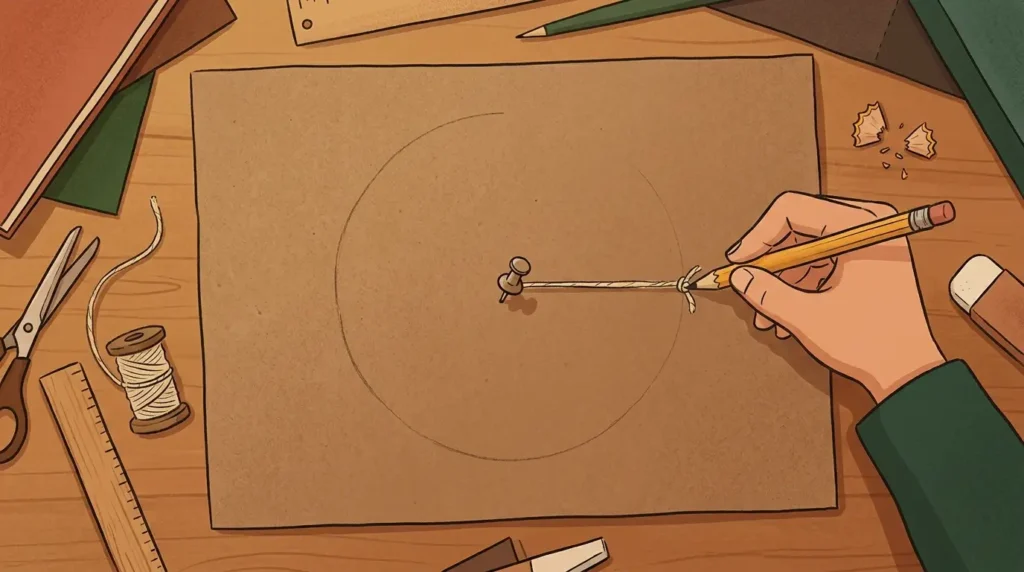
Here is an easy way to see it. Push a thumbtack into a piece of cardboard. Tie a string to the tack and tie a pencil to the other end of the string. Keep the string tight and swing the pencil all the way around. You just drew a circle, and the length of the string is the radius. Because the string never changes length, every point you draw is the same distance from the tack.
A radius has two ends. One end sits at the center. The other end touches the circle itself. The center is not part of the circle, only the edge is. That small detail matters when you draw one, because the line should start in the middle and stop right on the curve, not poke past it.
Radius vs Diameter vs Circumference
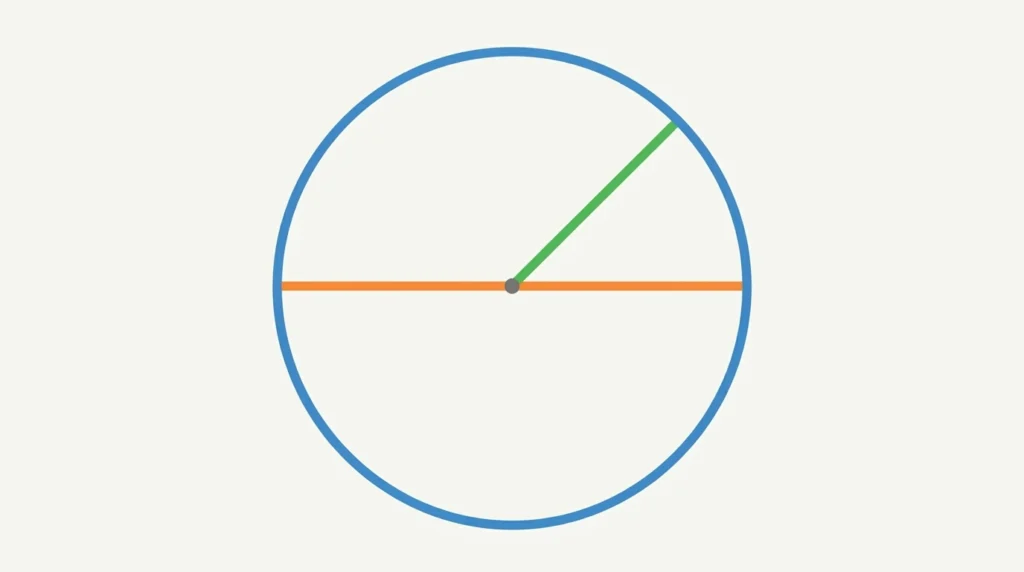
These words often get mixed up, so let us put them side by side. The diameter goes all the way across a circle and passes through the center. The radius only goes halfway, from the center to the edge. Two radii placed end to end in a straight line make one diameter.
| Term | What it means | Symbol | Simple fact |
| Radius | Distance from the center to the edge | r | Half of the diameter |
| Diameter | Distance across the circle through the center | d | Twice the radius |
| Circumference | Distance around the circle | C | Equals 2 × π × r |
| Area | Flat space inside the circle | A | Equals π × r × r |
| Chord | A straight line joining two points on the circle | none | The diameter is the longest chord |
The circumference is the distance around the circle, like the crust of a pizza. The area is the flat space inside, like the cheese and sauce. A chord is any straight line that joins two points on a circle. The diameter is the longest chord, which is a good fact to keep in your pocket.
Notice how the radius sits at the center of everything. If you know it, you can find every other measurement on this list.
Radius Formulas You Need to Know
Most circle formulas use the radius. The special number π (say pie) shows up in many of them. Pi is about 3.14, though its digits go on forever without a repeating pattern. Some people use 22/7 as a quick stand-in. In school, your teacher will tell you which one to use.
| What you want | Formula | Example (circle with r = 5, π ≈ 3.14) |
| Diameter | d = 2 × r | 10 |
| Circumference | C = 2 × π × r | 31.4 |
| Area | A = π × r × r | 78.5 |
| Radius from diameter | r = d ÷ 2 | 10 ÷ 2 = 5 |
| Radius from circumference | r = C ÷ (2 × π) | 31.4 ÷ 6.28 = 5 |
| Radius from area | r = √(A ÷ π) | √(78.5 ÷ 3.14) = √25 = 5 |
Look at the area formula again. The radius is multiplied by itself, which is why you will also see it written as πr². That little 2 is called a square. It does not mean multiply by two. Mixing these up is one of the top errors students make, and we will come back to it in the mistakes section.
The last three rows run the formulas backward. When you know the diameter, circumference, or area, you can work your way back to the radius. The next section shows exactly how.
How to Find the Radius: Step-by-Step Examples
Example one: you know the diameter. A round table is 120 centimeters across. Divide by 2. The radius is 60 centimeters. That is all there is to it.
Example two: you know the circumference. A circle has a circumference of 31.4 inches. Use r = C ÷ (2 × π). First, 2 × 3.14 is 6.28. Then 31.4 ÷ 6.28 is 5. The radius is 5 inches.
Example three: you know the area. A circle has an area of 50.24 square feet. Use r = √(A ÷ π). First divide 50.24 by 3.14, which gives 16. Then find the square root of 16, which is 4. The radius is 4 feet.
Example four: you have a real object and a ruler. Take a jar lid and lay the ruler across the widest part, making sure it passes through the middle. Say you read 8 centimeters. That is the diameter, so the radius is 4 centimeters. If you cannot find the center, slide the ruler around a little until you get the biggest number. That biggest reading is the diameter.
No matter which way you start, the goal is the same. Turn what you know into the radius, then use it to find whatever the problem asks for.
Radius Size Chart: See How a Circle Changes
Numbers can feel flat until you see them together. This chart uses π ≈ 3.14 and shows how a circle grows when the radius grows.
| Radius (r) | Diameter (d) | Circumference (C) | Area (A) |
| 1 | 2 | 6.28 | 3.14 |
| 2 | 4 | 12.56 | 12.56 |
| 3 | 6 | 18.84 | 28.26 |
| 5 | 10 | 31.40 | 78.50 |
| 10 | 20 | 62.80 | 314.00 |
Watch what happens when the radius doubles, going from 5 to 10. The diameter doubles from 10 to 20. The circumference doubles from 31.4 to 62.8. But the area jumps from 78.5 to 314, which is four times bigger. This is why a 20-inch pizza has four times the area of a 10-inch pizza, even though it is only twice as wide. The radius is squared in the area formula, so small changes make big differences.
Radius in 3D Shapes
The radius is not only for flat circles. It also shows up in shapes you can hold.
A sphere, like a ball, has a radius too. It is the distance from the very center of the ball to its surface. The volume of a sphere is 4/3 × π × r³, and its surface area is 4 × π × r². If a ball has a radius of 3 units, its volume is 4/3 × 3.14 × 27, which equals 113.04 cubic units.
A cylinder, like a soup can, has two circular ends. The radius is the radius of that circle. The volume is π × r² × h, where h is the height. For a can with a radius of 2 inches and a height of 5 inches, the volume is 3.14 × 4 × 5, or 62.8 cubic inches.
A cone has a circular base, and its radius is the radius of that base. The volume is 1/3 × π × r² × h. Think of an ice cream cone. A wider base means a bigger radius and more room for ice cream.
Here is a big one to try on for size. The average radius of the Earth is about 6,371 kilometers, or roughly 3,959 miles. That is a very long speech.
Radius on a Coordinate Grid
When circles are drawn on a graph, the radius hides inside an equation. A circle with its center at the point (h, k) and a radius of r follows this rule: (x − h)² + (y − k)² = r².
Let us read one. Take x² + y² = 25. There is no h or k to subtract, so the center is (0, 0). The right side is 25, which is r², so the radius is the square root of 25, or 5. You can test a point, too. The point (3, 4) is on this circle because 9 + 16 equals 25.
Now try (x − 2)² + (y + 3)² = 49. The center is (2, −3). Be careful here, because the signs flip. A plus sign inside the bracket means the center number is negative. The radius is the square root of 49, which is 7.
A good habit is to always take the square root at the end. The number on the right side is r², not r.
Where the Word Radius Comes From
The word radius comes from Latin. In Latin, it meant a ray of light, a rod, or the spoke of a wheel. That is a perfect picture, because a radius in a circle looks just like a spoke reaching from the hub to the rim. The same word family gave us radiate, which means to spread out from a center, and it is close to the everyday word ray.
Math books across the world agree on this Latin source. Exact dates for when mathematicians first used the word in this way are harder to pin down, so it is best to skip any claim about the year.
There is a fun twist. Radius is also the name of a bone in your forearm. It is a different meaning of the same word, and the bone name also comes from the Latin word for a rod or spoke. In math class, though, it always means the circle measurement.
Radius in Real Life
Once you start looking, you will spot radii everywhere. A pizza that is 14 inches across has a radius of 7 inches. The tip of the minute hand on a clock draws a circle as it moves, and the length of the hand is the radius of that circle. A garden sprinkler that shoots water 10 feet in every direction waters a circle with a radius of 10 feet.
Maps use the idea all the time. When a store says it delivers within a 5-mile radius, it means anywhere up to 5 miles from the shop in every direction. Cell towers, Wi-Fi routers, and radio stations also describe their reach as a radius. And when you drop a pebble in a pond, the ripples spread out in circles with a growing radius.
Engineers, builders, and designers use it too. Wheels, gears, pipes, round tables, and domes all depend on getting the radius right.
Common Mistakes to Avoid
The first big mistake is mixing up the radius and the diameter. Say a problem tells you a circle is 10 centimeters across. That is the diameter, so the radius is 5. If you use 10 in the area formula by accident, you get 314 instead of the right answer, 78.5. Always ask yourself, is this number across the whole circle or just to the edge?
The second mistake is forgetting what the little 2 means in πr². It means r times r, not r times 2. For a radius of 5, the right math is 5 × 5 = 25, then 25 × 3.14 = 78.5. Doing 5 × 2 gives 10 and a wrong answer.
The third mistake is mixing up units. Radius, diameter, and circumference are lengths, so they use units like centimeters or feet. The area uses square units, like square centimeters or square feet. Volume uses cubic units. Writing the right unit shows you understand what you found.
The fourth mistake is measuring from the wrong spot. A radius must start at the center. If you measure from a random point on the edge to another point, you might be measuring a chord and not a radius.
The last mistake is rounding up too early. If you cut pi short at the start, small errors can grow. Wait until the final step to round, unless your teacher says otherwise.
Tips to Remember the Radius
Tie the word to a picture. Radius starts with the same sounds as ray, and a ray starts at one point and goes outward. Picture a ray starting at the center of a circle and reaching the edge.
Use a simple rule: radius is half, diameter is double. If you know one, you can always find the other in one step.
Check your work with common sense. The radius should always be smaller than the diameter. If your answer for the radius is bigger than the distance across, something went wrong.
Draw a quick sketch for every problem. Mark the center, draw the radius, and label what you know. Pictures catch errors that numbers hide. If you can, grab a compass and draw a real circle. Hands-on practice makes the idea stick far better than just reading about it.
Finally, write the unit every time. It keeps your thinking clear and your answers complete.
FAQs
What is the radius of a circle in simple words?
It is the distance from the center of the circle to its edge. Imagine a spoke on a wheel. The length of that spoke is the radius.
How do you find the radius if you know the diameter?
Divide the diameter by 2. If the diameter is 14 inches, the radius is 7 inches.
How do you find the radius from the circumference?
Divide the circumference by 2 × π. With π as 3.14, you divide by 6.28. A circumference of 62.8 gives a radius of 10.
What is the plural of radius?
The usual plural is radii, said RAY-dee-eye. Some dictionaries also list radiuses as acceptable, but math books almost always use radii.
Can a radius be zero or negative?
A radius is a length, so it cannot be negative. A radius of zero would make the circle shrink to a single point, so in most problems the radius is a number greater than zero.
Is the radius used for shapes other than circles?
Yes. Spheres, cylinders, and cones all have a radius. Some advanced geometry lessons also use radius-like measurements for other shapes, but for most school math, think of circles and round 3D shapes.
Conclusion
Now you know the radius meaning in math: it is the distance from the center of a circle to its edge, and it is exactly half of the diameter. This one measurement unlocks the rest of the circle. With the radius, you can find the diameter, the circumference, and the area. With a little extra work, you can also find the volume of spheres, cylinders, and cones.
The best way to make it stick is to practice. Grab a cup, a plate, or a coin, measure across the middle, and cut that number in half. Then try the formulas from this guide and see if your answers make sense. Always ask yourself if the radius is the smaller number and if your units match. Small checks like these save you from most mistakes. Keep a sketch handy, take your time, and you will be solving circle problems with confidence.