
“Come hell or high water” means you will do something no matter what gets in your way. It shows strong promise and strong will. You may hear it at work, in sports, in movies, or around the dinner table.
People search for the come hell or high water meaning because the words sound dramatic. Hell and floods? It seems like a lot for a simple promise. But that is the point. The phrase paints a picture of the worst trouble you can imagine, then says, “I will still do it.”
In this guide, you will learn what the phrase means, how to use it, where it may have come from, and which mistakes to avoid.
Quick Answer
The meaning of “come hell or high water” is “no matter what happens” or “despite any problem or danger.” It is an idiom, which means the words together mean something different from the words alone. Nobody expects real fire or a real flood. The speaker is saying that nothing, not even the worst trouble, will stop them from keeping a promise or reaching a goal.
Come Hell or High Water Meaning in Simple Words

Think of a friend who says, “I will be at your wedding, come hell or high water.” Your friend is not talking about a flood.
The phrase has three main jobs.
The first job is to show a strong promise.
The second job is to show strong determination. It fits a person who refuses to quit.
The third job is to say something is certain.
The words “hell” and “high water” stand for two kinds of trouble. High water means a flood, which stands for a natural disaster that blocks your path. Put them together and you get “the worst that can happen.” The word “or” adds a simple message: it does not matter which kind of trouble shows up.
Other easy ways to say it are “no matter what,” “whatever happens,” and “at all costs.”
How the Phrase Works in a Sentence
Grammar for this idiom is easy once you know a few simple rules. The word “come” here is not about arriving. It works like the word “if.” So “come hell or high water” is a bit like saying “if hell comes or high water comes.” This older style of speech is called the subjunctive mood, and it explains why the verb sounds a little old-fashioned.
Here are the main patterns.
You can put the phrase at the end of a sentence: “I will finish this project, come hell or high water.”
You can also put it at the start: “Come hell or high water, we are leaving at six.”
Both are correct. Most people use a comma to set it apart from the rest of the sentence. When it comes first, you need a comma after “water.” When it comes last, you need a comma before “come.”
Here is a quick table to help you remember the patterns.
| Pattern | Example | Punctuation Tip |
| Phrase at the end | She will graduate, come hell or high water. | Comma before “come” |
| Phrase at the start | Come hell or high water, we will win. | Comma after “water” |
| Phrase in the middle | We will, come hell or high water, finish on time. | Commas on both sides |
| Shortened form | Hell or high water, I’m going. | Use in casual talk only |
Notice that the phrase does not change for different people or times. You do not say “came hell or high water” or “comes hell or high water.” It stays the same if you talk about the past, present, or future. That is true of many fixed phrases.
The phrase is not a full sentence. It always needs a main idea to go with it, like “I will call you” or “the team will finish.”
Where Did “Come Hell or High Water” Come From?
The honest answer is that no one knows the exact origin. Language experts have found the phrase in American writing from the late 1800s, and many believe it grew out of the American West. Beyond that, the story is not clear.
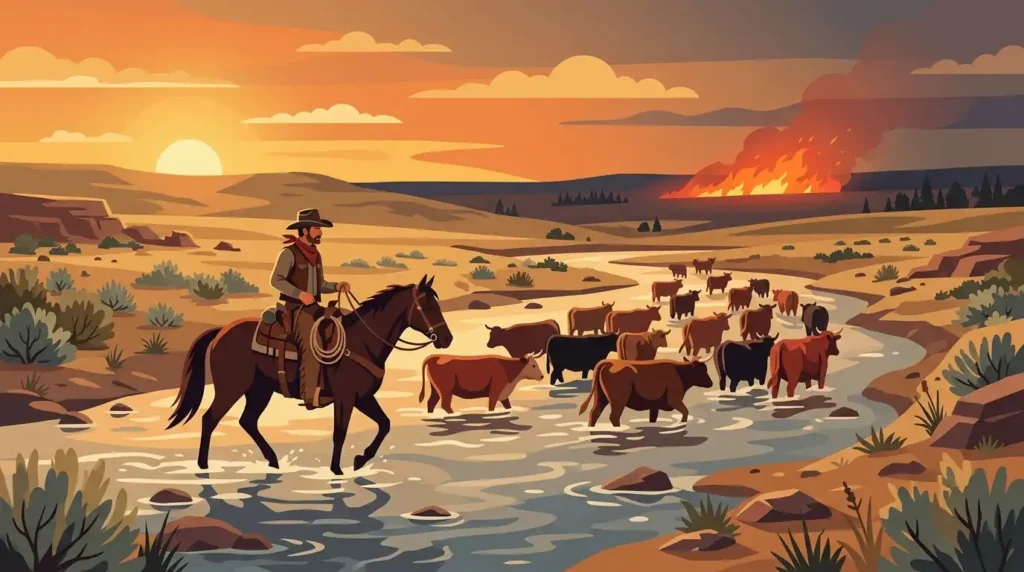
The most popular story links the phrase to cowboys in the old West. In this tale, cattle drivers had to move herds across long, rough land. Along the way, they faced fires on the prairie and flooded rivers. Hell might stand for the fire, and high water for the river. A cowboy who promised to deliver his cattle “come hell or high water” was promising to get through both. It is a fun story and it fits the words well.
There is a catch, though. It is a theory, not a proven fact. Some writers tell it as if it were certain, but reliable sources do not back that up. So the safest way to describe it is this: the phrase seems to have started in the United States, and the cowboy explanation is a popular guess.
There is another idea, too. Some people think “hell and high water” is an older way of naming any big trouble, and “come hell or high water” grew from that. This is also unproven.
What we can say with confidence is that the phrase has been around for well over a hundred years. It has stayed popular because the picture is so clear. Everyone understands that fire and floods are hard to fight, so the phrase carries power without needing much explanation.
If you ever write about this idiom, be honest about what is known. Say “may have come from” instead of “came from,” and you will stay accurate.
Real Life Examples of Come Hell or High Water
Seeing the phrase in action is the best way to learn it. Here are examples from different parts of life.
At home, a parent might say, “I will be at your recital, come hell or high water.” A child might say, “I am going to finish my homework tonight, come hell or high water.”
At work, a manager could say, “We will launch this product on Monday, come hell or high water.” A worker might promise, “I will send the report by noon, come hell or high water.”
The table below shows how the tone changes depending on the situation.
| Situation | Sample Sentence | What It Shows |
| Family promise | I will be at your game, come hell or high water. | Love and loyalty |
| Work deadline | The order ships Friday, come hell or high water. | Firm commitment |
| Personal goal | I will run this marathon, come hell or high water. | Strong willpower |
| Lighthearted joke | I am getting pizza tonight, come hell or high water. | Playful exaggeration |
| Warning | He will get what he wants, come hell or high water. | Stubborn certainty |
The last two rows show something useful. The phrase can be serious or silly. If you say you are getting pizza “come hell or high water,” everyone knows you are joking. The big words make the small goal funny.
Similar Phrases and Other Ways to Say It
English has many ways to say “no matter what.” Some are close to this idiom, and some are softer. Knowing them helps you choose the right one and avoid repeating yourself.
| Phrase | Strength | Best Used For |
| No matter what | Medium | Everyday promises |
| At all costs | Strong | Serious goals |
| Rain or shine | Light | Events and plans |
| Through thick and thin | Strong | Loyalty over time |
| Whatever it takes | Strong | Hard goals |
| Come what may | Strong | Formal or old-style writing |
| Hell or high water | Strong | Casual, shortened form |
“Rain or shine” is a gentle cousin of our phrase. It usually means an event will happen even if the weather is bad. “Come what may” is very close in meaning, but it sounds more formal and a bit poetic. “Through thick and thin” is about staying loyal across good and bad times, so it fits friendships better.
What makes “come hell or high water” special is its punch. The mention of hell and flood makes it sound bolder than most others. It says the speaker expects a big fight and plans to win it anyway.
Common Mistakes to Avoid
Even a simple idiom can trip people up. Here are the mistakes you will see most often.
Changing the words. Some people write “come hell and high water” or “come hell or high waters.” The standard form uses “or” and “water” in the singular. You may see “hell and high water” in some writing, and it is not wrong in every case, but for this exact idiom, “come hell or high water” is the form readers expect.
Using it for small things without meaning to be funny. Saying “I will water my plants, come hell or high water” can sound silly if you did not mean it as a joke. The phrase works best when a promise is big or when you are clearly exaggerating on purpose.
Forgetting the commas. Without commas, the sentence can look messy. Set the phrase apart at the start, middle, or end.
Taking it literally. Because the words are strong, a new English learner may worry that hell or floods are truly involved. Remind them it is only a figure of speech.
Mixing up the verb form. Do not say “comes hell or high water” or “came hell or high water.” Keep “come” exactly as it is.
Using it in very formal writing. In a legal paper or a science report, this idiom would look out of place. Save it for casual and creative writing, speeches, and conversation.
Is the Phrase Rude or Too Strong?
Many readers ask this, and it is a fair question. The word “hell” can feel rough to some people. So is the phrase rude?
Mostly, no. It is a very common idiom, and most people hear it as ordinary speech rather than a curse. You will find it in newspapers, books, and everyday talk. It is generally safe in casual and workplace settings.
Still, context matters. In places where people avoid the word “hell,” such as some religious groups, schools with strict language rules, or very formal events, you may want a softer choice. In those cases, “no matter what” or “whatever happens” does the same job without any risk.
A helpful rule is to think about your audience. With friends and coworkers, go ahead. With young children or in a formal speech, you might pick a gentler phrase. It is your call, and neither choice is wrong.
Come Hell or High Water in Modern Language
The phrase is far from old news. People still use it all the time, and you can spot it in many places.
News writers use it in headlines and stories when someone shows strong determination, such as a leader promising to pass a law or a team promising to win. Business writers use it to describe firm deadlines. Speakers use it to fire up a crowd.
It also shows up in entertainment. For example, “Hell or High Water” is the title of a well-known 2016 crime film. Writers and musicians borrow the words for titles because they sound bold and dramatic.
Online, people use the phrase in posts about goals and habits. You may see, “I am hitting the gym tomorrow, come hell or high water,” often with a wink.
One small trend is the shortened form “hell or high water,” used on its own, as in, “He will get there, hell or high water.” Some people like the shorter style for its speed. Others prefer the full phrase, which sounds more complete. Both are understood, so use the version that fits your voice.
Tips for Using the Phrase Well
Once you understand the idiom, a few habits will help you use it in a natural way.
Save it for moments that matter. The phrase hits harder when it is not overused. If you say it ten times a day, it loses its punch.
Match it to your tone. A serious promise needs a serious voice. A joke needs a playful one. Your listener should be able to tell which you mean.
Pair it with something you truly plan to do. Nothing weakens a promise like saying “come hell or high water” and then not showing up. The phrase makes a big claim, so keep your word.
Try swapping it with other phrases when you write a longer piece. Mixing in “no matter what” or “whatever it takes” keeps your writing fresh.
If you teach English, act it out. Let learners say the phrase with a big, bold voice. It helps them feel the meaning, not just memorize it.
FAQs
What does “come hell or high water” mean?
It means you will do something no matter what problems or dangers appear. It shows a strong promise or a firm decision.
Is “come hell or high water” an idiom?
Yes. An idiom is a group of words whose meaning is different from the words alone. Here, “hell” and “high water” stand for any big trouble, not real fire or floods.
Where did the phrase come from?
Nobody knows for sure. It appears in American writing from the late 1800s. A popular story ties it to cowboys crossing fires and rivers, but that story is a guess and not proven.
Is it okay to say “hell or high water” without “come”?
Yes, in casual talk. People say things like “I am going, hell or high water.” The full phrase is more common in writing, though.
Is the phrase rude to use?
Usually not. Most people see it as an ordinary expression. In very formal or strict settings, you may prefer a softer phrase such as “no matter what.”
What is a good example sentence?
“I will finish my degree, come hell or high water.” It tells the reader that no trouble will make the speaker quit.
Conclusion
The come hell or high water meaning is easy to remember: you will do it no matter what. The phrase uses the picture of fire and floods to show that no problem is too big to stop you. It works for promises, goals, and jokes, and it has stayed popular for well over a century.
Remember the main points. Keep the wording exactly as it is, use commas to set it off, and save it for moments that truly matter. Be careful when telling its origin, since the cowboy story is a theory and not a fact. And if a setting is very formal, pick a gentler phrase.
The best advice is simple. Use this idiom only when you mean it, and then follow through. After all, a promise made “come hell or high water” is only as strong as the person who keeps it.