Inter alia means “among other things.” In law, it tells the reader that a list is not complete. The writer names one or a few items and leaves the rest unsaid. That is the inter alia meaning in law in a nutshell.
You may have seen this odd Latin phrase in a contract, a court ruling, or a news story about a trial. It looks fancy, and it can feel confusing. Many people skip right over it. Others guess and hope for the best.
This guide clears things up. You will learn what the phrase means, how to say it, where it came from, and how judges and lawyers use it. You will also see real-life examples, common mistakes, and simple tips for using it the right way. No law degree needed.
Inter Alia Meaning in Law: The Quick Answer
Inter alia is a Latin phrase that means “among other things.” Lawyers, judges, and lawmakers use it when they mention one item from a longer list. The phrase works like a small flag. It says, “Here is an example, but there is more.”
Take this sentence: “The company, inter alia, broke the safety rules.” It tells you the company broke the safety rules. It also tells you the company did other wrong things that the writer did not list. Without the phrase, a reader might think the safety rules were the only problem.
So the phrase does two jobs at once. It points to a few key items, and it warns that the full picture is bigger. That is why you often see it in long legal papers where listing every single detail would take pages.
One small rule is worth remembering right away. Inter alia is used for things, like actions, terms, claims, and facts. It is not used for people. For people, there is a different phrase, which you will meet later in this guide.
How to Say and Spell Inter Alia
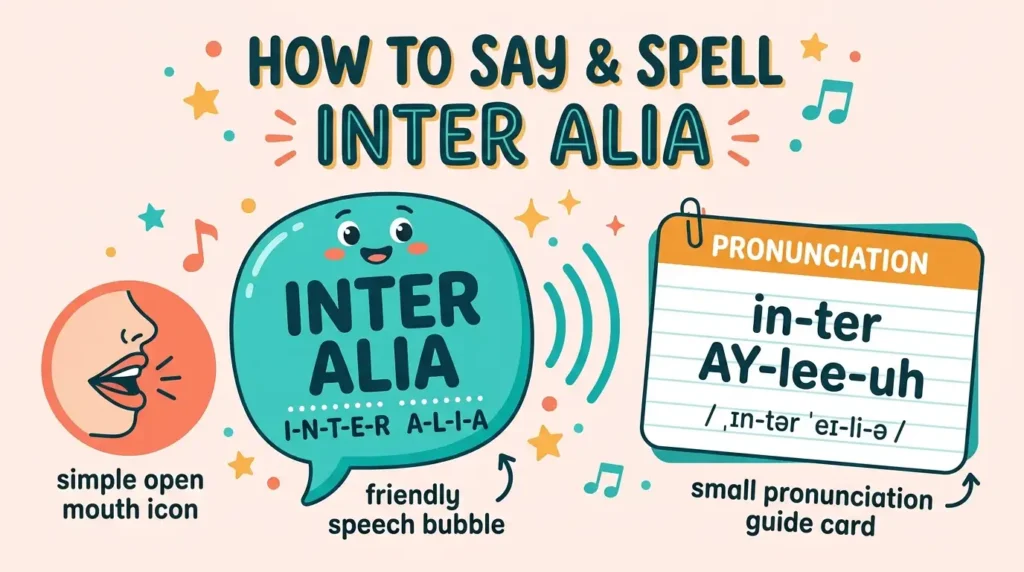
The spelling is simple: two words, both lowercase, written as “inter alia.” Some writers put the phrase in italics because it is Latin. Many modern style guides no longer ask for italics, since the phrase is common in English legal writing. Either choice is fine as long as you stay consistent in the same document.
Pronunciation is where people get nervous. In American English, you will hear “IN-ter AY-lee-uh” a lot. You will also hear “IN-ter AL-ee-uh,” which is closer to classical Latin. Some speakers say “IN-ter AH-lee-ah.” All of these are heard in real courtrooms and classrooms. Nobody will think less of you for picking one.
Here is a quick tip. If you are talking in a formal setting and want to sound sure, choose one pronunciation and say it with confidence. A steady voice matters more than the exact vowel sound.
A few related words use the same Latin root. “Alias” comes from the same family, and so does “alien.” In each case, the root idea is “other.” That can help you remember what “alia” means in the phrase.
Where the Phrase Comes From

The phrase is Latin, and it is very old. “Inter” means “among” or “between.” “Alia” is a form of the Latin word for “other,” and in this case it points to other things. Put the two together and you get “among other things.”
Latin was the main language of the law in much of Europe for hundreds of years. When English courts and lawyers wrote down their work, they borrowed many Latin phrases. Some stuck around long after people stopped speaking Latin every day. Inter alia is one of them. It traveled to the United States along with English common law, and it never left.
I will be honest about the limits here. It is hard to name the first person who used the exact phrase in a legal paper, and guessing would not help you. What we can say with confidence is that the words are plain Latin, the meaning has stayed steady, and the phrase is now a normal part of legal English in many countries.
That long life is part of why it sticks. Lawyers learn it in school, see it in old cases, and pass it along in new documents.
How Lawyers and Judges Use Inter Alia
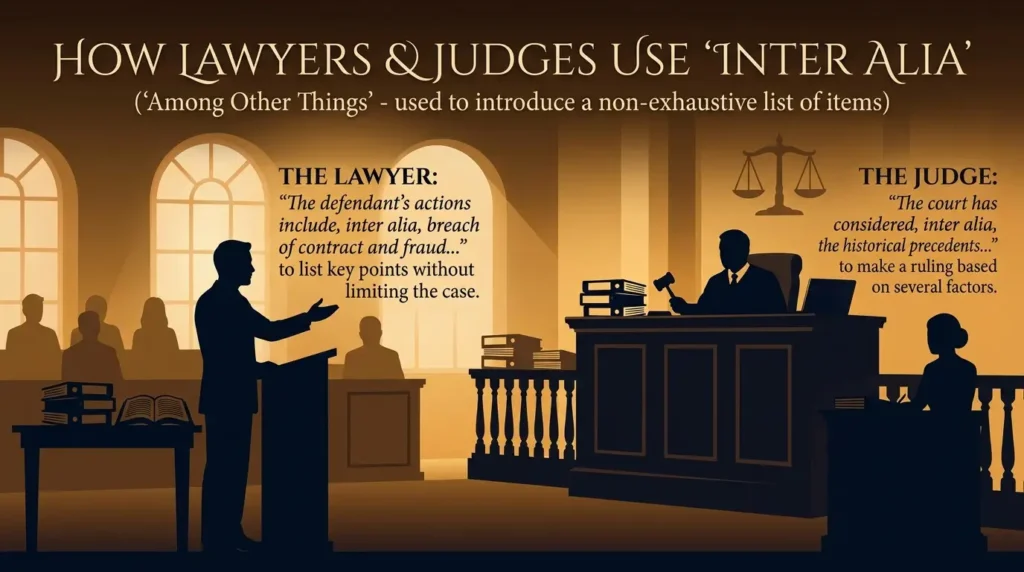
The phrase shows up in many places in the legal world. Each place uses it for a slightly different reason, but the core meaning stays the same: “among other things.”
| Where You See It | Why It Is Used | Simple Example |
| Contracts | To name key duties without listing every one | “The seller must, inter alia, deliver the goods by June 1.” |
| Court opinions | To mention one reason out of several | “The court relied, inter alia, on the witness report.” |
| Legal complaints | To show a few claims out of many | “The plaintiff alleges, inter alia, breach of contract.” |
| Laws and rules | To point to one power or duty of an agency | “The board shall, inter alia, review all permits.” |
| News reports | To keep a story short while hinting at more | “He was charged with, inter alia, fraud.” |
Think about why this helps. Legal writing can get long fast. A contract might have dozens of duties. A court opinion might rest on five or six reasons. Writers often want to highlight the most important item without pretending it is the only one.
The phrase also saves space in court filings. A lawyer can point to a few facts that matter most and signal that more facts exist in the record. The judge or reader can then look deeper if needed.
Still, the phrase is a shortcut, and shortcuts have costs. When a writer leaves items unnamed, the reader has to trust that the missing items are real and fair. That is one reason careful lawyers use the phrase with thought rather than by habit.
Real-Life Examples in Simple Sentences
Examples make the phrase easier to feel. Let us walk through a few in different settings.
First, a rental agreement. Imagine a sentence like this: “The tenant must, inter alia, pay rent on the first of each month.” Paying rent is one duty. The phrase tells you there are other duties too, such as keeping the home clean or following building rules. If you only read the rent part, you might miss the rest.
Second, a court case. A judge might write: “The defendant argued, inter alia, that the search was illegal.” The defendant made that argument, and also made other arguments that the judge is not repeating right now. The phrase keeps the sentence short without hiding the fact that more was said.
Third, a job contract. “The employee’s duties include, inter alia, managing the sales team.” Managing the team is one task. The employee may also write reports, train new hires, or attend meetings.
Fourth, a law. “The agency may, inter alia, set fees for licenses.” Setting fees is one power. The law may give the agency other powers too.
Notice the pattern in every example. First comes an action word, like “must,” “argued,” “include,” or “may.” Then comes the phrase between commas. Then comes the one item the writer chose to name. You can use the same pattern in your own writing when it fits.
Inter Alia vs. Similar Latin Phrases
Legal writing is full of Latin, and some phrases look alike. Mixing them up is easy, so here is a short comparison.
| Phrase | Meaning | Used For | Short Example |
| Inter alia | Among other things | Things, acts, terms | “The ruling covered, inter alia, unpaid wages.” |
| Inter alios | Among other people | People or parties | “The letter was sent to, inter Alios, the mayor.” |
| Et cetera (etc.) | And the rest | Lists that trail off | “Chairs, tables, desks, etc.” |
| Inter se | Among themselves | Dealings between the same group | “The partners agreed to settle matters inter se.” |
| Inter vivos | Between living people | Gifts or trusts made while alive | “He set up an inter vivos trust.” |
The most common mix-up is between inter alia and inter Alios. They differ by one letter, but they point to different things. “Alia” is about things. “Alios” is about people. If your list holds names, use inter Alios. If your list holds actions, rules, or facts, use inter alia.
Another common question is how inter alia differs from “etc.” The short answer is placement. Etc. comes at the end of a list that has already started. Inter alia comes before the item you choose to name and tells the reader that the item is only part of a larger group. Etc. says, “and more like these.” Inter alia says, “this one, and others besides.”
Does Inter Alia Change the Legal Effect of a Sentence?
This is a smart question, and the honest answer is: it depends on the document and the situation. Here is a general way to think about it. The phrase tells the reader the list is not complete. In many cases, that is exactly what the writer wants.
In a contract, though, the details can matter a lot. If a sentence says a party must do something “inter alia,” it signals that other duties may exist. Those duties usually need to be found somewhere else in the agreement. The phrase does not create new duties by itself. It simply tells the reader to look for more.
That is why careful drafters often ask a simple question before using it: “Are the other items stated clearly somewhere else?” If yes, the phrase can be a handy pointer. If no, the phrase may leave a gap. Gaps can lead to arguments later about what the contract really covers.
In a court opinion, the situation is different. The phrase usually just tells you the judge had more than one reason or looked at more than one fact. It is a way of summarizing, not a way of adding new rules.
A fair note: how a court reads a specific phrase in a specific contract depends on the full text, the law in that state, and the facts. This article explains general meaning and is not legal advice. If a real contract or case depends on the phrase, a licensed attorney can read the whole document and give advice that fits.
Grammar and Correct Usage
Using inter alia correctly is mostly about placement and punctuation. The good news is that the rules are few and simple.
The phrase usually goes in the middle of a sentence, right before the item it introduces or right after the main verb. Most writers set it off with commas. For example: “The report covers, inter alia, the cost of repairs.” The commas let the reader take a small breath and see that the phrase is a side note.
You can also place it earlier in a sentence: “Inter alia, the court examined the bank records.” This works too, and it can sound a bit more formal. Both forms are common in legal papers.
Be careful about word order when you pair the phrase with a list. If you write, “The rules cover, inter alia, parking, noise, and trash,” the phrase tells readers that parking, noise, and trash are examples from a longer set. You do not need to add “etc.” at the end. Doing so would say the same thing twice.
Also, keep the phrase in the singular form. Inter alia does not change for plural or past tense. It stays the same no matter how many items you name or when the action took place.
One last point on style. You do not need to capitalize it unless it starts a sentence. Treat it like any normal English phrase in your writing.
Common Mistakes to Avoid
Even skilled writers slip up with this phrase. Here are the mistakes that show up most often.
The first mistake is using it for people. As you saw earlier, inter alia is for things. If you are naming people, the correct phrase is inter Alios. Saying “The letter went to, inter alia, the mayor” is a small error. Saying it with inter Alios is the better choice.
The second mistake is using it when there is only one item. If a contract has just one duty, writing “inter alia” makes the reader hunt for duties that do not exist. That can cause confusion or even a dispute. Use the phrase only when more items truly exist.
The third mistake is using it with a full list that is already complete. If you list every item, there is nothing “other” left. The phrase would be misleading.
The fourth mistake is overuse. Some writers sprinkle the phrase through a document to sound smart. This usually makes the writing harder to read. A paragraph with three of them in a row feels like a puzzle.
The fifth mistake is leaving the “other things” unclear. In a contract or formal paper, readers should be able to find the rest of the items somewhere. If they cannot, the phrase may hide something important.
A quick self-check helps. Before you type inter alia, ask yourself: “Are there really other items? Are they things, not people? Could a reader find them if they looked?” If the answer to all three is yes, you are on solid ground.
British vs. American English
Both British and American writers use inter alia, and the meaning is identical on both sides of the Atlantic. You will see it in courts in the United States, the United Kingdom, India, Australia, Canada, and many other places that follow common law traditions.
There are small style differences. British legal writing has traditionally leaned a little more toward Latin phrases, and you may spot the phrase more often in older British documents. American legal writing has moved toward plainer language in recent decades. The federal government even passed the Plain Writing Act of 2010, which asks federal agencies to write in clear, simple terms the public can understand.
That does not mean Americans have stopped using the phrase. It still appears in court opinions, legal briefs, and contracts across the country. It just means that many writers now stop and ask if “among other things” would work as well.
Punctuation habits can differ a bit too. Some British writers skip the commas around the phrase, while many American writers keep them. Neither is wrong. Pick one style and keep it steady throughout your document.
Should You Use Inter Alia or Plain English?
Here is a practical question for anyone writing a letter, a contract, or an essay. Should you reach for the Latin phrase, or just say “among other things”?
For most everyday writing, plain English wins. “Among other things” is clear, short, and understood by everyone. If your reader is a regular person and not a lawyer, the plain version is kinder and safer.
For formal legal writing, the choice is a bit more open. Many lawyers still prefer inter alia because it is short, familiar in their field, and fits the tone of legal papers. If you are writing for a court or for other lawyers, using it is normal and expected.
Here are a few tips that work in either setting. Use the phrase only when you are sure more items exist. Make sure the other items can be found if they matter. Keep your sentences short around it, so the phrase does not get lost. And avoid using it more than once or twice in a single page.
Another good habit is to read your sentences out loud. If it sounds stiff, swap in “among other things.” If it sounds smooth and natural in a legal setting, keep the Latin. Your ear is a handy editor.
Finally, if you are reading a document with the phrase in it, treat it as a signal. It is a nudge to look for the rest of the story. Check other sections, ask questions, and do not assume the named item is the whole picture.
FAQs
What does inter alia mean in simple words?
It means “among other things.” The writer names one or a few items and signals that there are more that are not listed.
How do you pronounce inter alia?
Most Americans say “IN-ter AY-lee-uh” or “IN-ter AL-ee-uh.” Both are common, and either one is accepted in everyday and legal speech.
Can I use inter alia for people?
No. Inter alia is for things, like duties, claims, and facts. For people, the correct Latin phrase is inter alios, which means “among other people.”
Do I need to put inter alia in italics?
It is up to you. Some style guides still ask for italics because it is Latin, but many writers skip them now. Just stay consistent in the same document.
Is inter alia the same as etc.?
Not quite. Etc. goes at the end of a list and means “and more like these.” Inter alia goes before the item you name and means that item is one of several.
Does inter alia create new legal duties in a contract?
Not by itself. It simply tells the reader that other items exist. If those items matter depends on the full contract and the law, so a licensed attorney is the right person to ask about a specific document.
Conclusion
Now you know the inter alia meaning in law: it means “among other things,” and it tells readers that a list is not complete. It is used for things, not people, and it appears in contracts, court opinions, laws, and legal news. For people, the matching phrase is inter Alios.
Remember the key points. Use the phrase only when more items truly exist. Make sure those other items can be found if they matter. Watch out for common slips, like using it for people or using it with just one item. And when in doubt, “among other things” is always a safe and clear choice.
The next time you spot this Latin phrase in a document, you will not need to feel stuck. Pause, look for the missing pieces, and read with confidence. If a real contract or case depends on it, ask a licensed attorney for help.