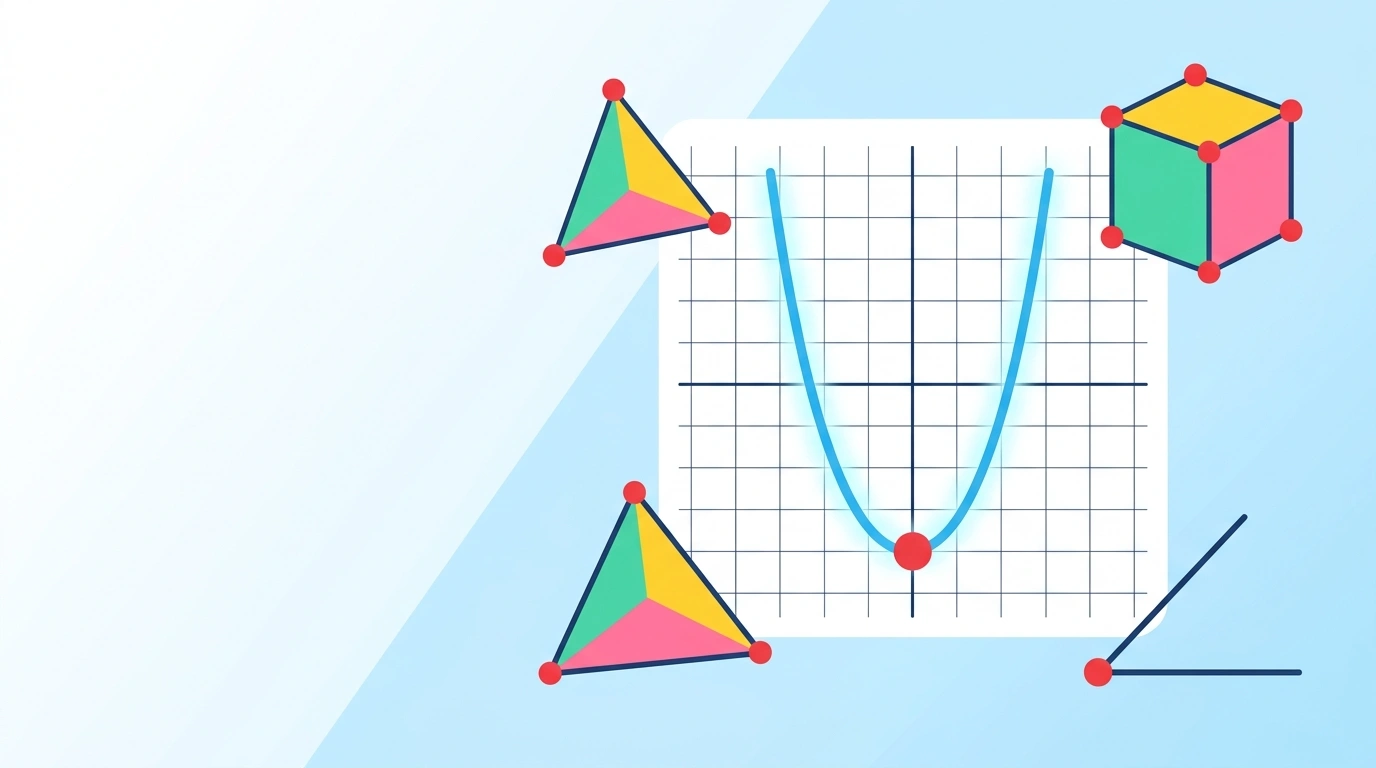
Have you ever looked at a triangle and wondered what to call its corners? Or seen a U-shaped graph and been asked to find its “vertex”? You are not alone. Many students search for vertex meaning in math because the word shows up in so many places.
In short, a vertex is a special point. It is where two or more lines, line segments, or edges meet. On a parabola, it is the turning point of the curve.
In this guide, you will learn what a vertex is in angles, flat shapes, solid shapes, graphs, and networks. You will also see easy examples, a step-by-step method, common mistakes to avoid, and answers to frequently asked questions.
Quick Answer: Vertex Meaning in Math
The vertex meaning in math depends on the kind of shape or graph you are looking at, but the big idea stays the same. A vertex is a key point where things join or change direction.
Here is how the word is used in the main topics:
| Topic | What the Vertex Is | Simple Example |
| Angle | The point where two rays meet | The tip of a “V” shape |
| Polygon | A corner where two sides meet | A triangle has 3 vertices |
| 3D shape | A corner where edges meet | A cube has 8 vertices |
| Parabola | The highest or lowest point | The bottom of a U-shaped graph |
| Graph theory | A dot, also called a node | A city on a road map |
The plural of vertex is vertex. You may also see “vertexes,” but “vertices” is the form most teachers and textbooks use.
Where the Word Vertex Comes From
The word “vertex” comes from Latin. In Latin, it meant the top, the peak, or the highest point of something. It is linked to a Latin verb that means “to turn.” That makes sense when you think about math. A vertex is often a point where a line turns, a corner turns, or a curve turns around.
This history is a nice memory trick. When you see the word vertex, think of a point on top or a point where things turn. Not every vertex is at the top, of course. But the idea of a special “turning” or “meeting” point fits nearly every use of the word.
Vertex of an Angle
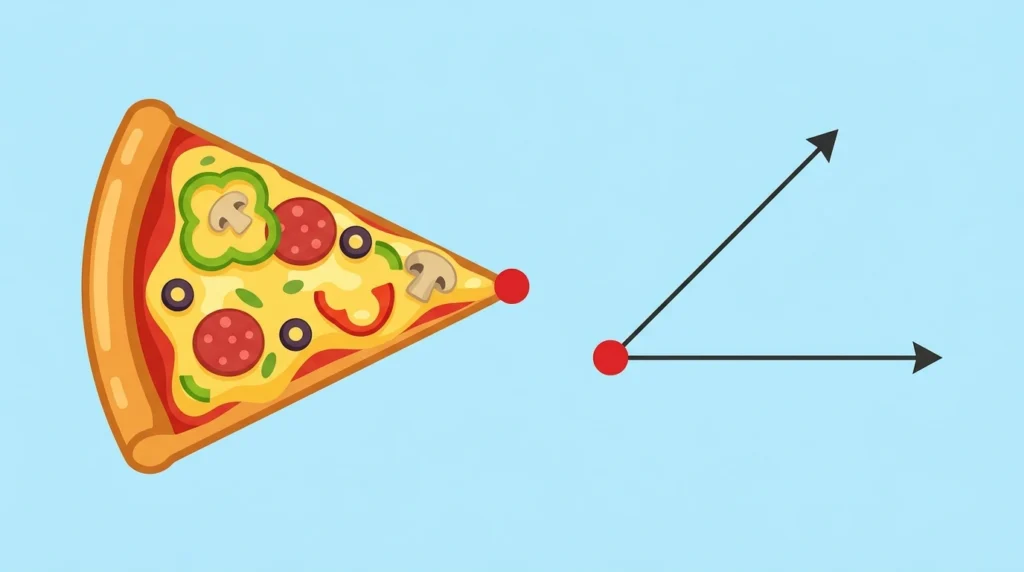
Let’s start with the simplest case. An angle is made when two rays start from the same point. That shared starting point is the vertex of the angle.
Picture a slice of pizza. The pointy tip of the slice is the vertex. The two straight edges going out from the tip are the rays, sometimes called the sides or arms of the angle.
When you name an angle with three letters, the vertex always goes in the middle. For example, in angle ABC, point B is the vertex. Points A and C sit on the two rays. You could also write this angle as angle B if there is no chance of mixing it up with other angles.
This rule is worth remembering. Students often lose points on tests because they put the vertex letter first or last instead of in the middle.
Here is a quick example. Say you draw two lines that start at point P. One goes to point Q, and the other goes to point R. The angle is called angle QPR, and P is the vertex. Simple as that.
Vertex of a Polygon

A polygon is a flat, closed shape made of straight sides. Triangles, squares, rectangles, and pentagons are all polygons. In each of these shapes, a vertex is a corner. It is the point where two sides meet.
Here is something helpful to know. In any polygon, the number of vertices always equals the number of sides. A triangle has 3 sides and 3 vertices. A square has 4 sides and 4 vertices. A hexagon has 6 sides and 6 vertices. If you can count one, you can count the other.
Each vertex of a polygon also forms an angle. In a square, every vertex makes a right angle, which measures 90 degrees. In an equilateral triangle, every vertex makes a 60-degree angle. So when you hear “the angle at vertex A,” it just means the angle made by the two sides that meet at that corner.
When you name a polygon, you usually list its vertices in order around the shape. A triangle with corners A, B, and C is called triangle ABC. A rectangle with corners W, X, Y, and Z is called a rectangle WXYZ. Going around in order, either clockwise or counterclockwise, keeps everything clear.
Vertex of a 3D Shape

Solid shapes have vertices too. In a three-dimensional shape with flat faces, a vertex is a corner where three or more edges meet. Think about the corner of a cardboard box. That sharp point you can poke your finger on is a vertex.
Solid shapes also have edges and faces. An edge is a line where two faces meet. A face is a flat surface. Many students mix these words up, so a side-by-side look helps.
| Shape | Vertices | Edges | Faces |
| Cube | 8 | 12 | 6 |
| Rectangular prism | 8 | 12 | 6 |
| Triangular prism | 6 | 9 | 5 |
| Square pyramid | 5 | 8 | 5 |
| Tetrahedron | 4 | 6 | 4 |
| Sphere | 0 | 0 | 0 flat faces |
Notice that a sphere has no vertices at all. It is smooth all the way around, with no corners. A cylinder also has no vertices, since its edges are curved circles rather than sharp corners. A cone is a little different. It has one pointed tip, and that tip is usually called the vertex, or sometimes the apex.
There is also a famous pattern hiding in this table. For many solid shapes with flat faces, if you add the vertices and faces, then subtract the edges, you get 2. For a cube, that is 8 + 6 − 12 = 2. This idea is called Euler’s formula, and it works for convex polyhedra, which are solid shapes without dents or holes. It is a fun way to check your counting.
Vertex of a Parabola
Now we move from shapes to graphs. This is the meaning that shows up most often in algebra class.
A parabola is the U-shaped curve you get when you graph a quadratic equation, such as y = x² or y = 2x² − 4x + 1. The vertex of a parabola is the point where the curve turns around. If the parabola opens upward, the vertex is the lowest point on the graph. This is called the minimum. If the parabola opens downward, like an upside-down U, the vertex is the highest point. This is called the maximum.
The vertex is also on the parabola’s line of symmetry. That is an imaginary vertical line that cuts the parabola into two matching halves. The vertex sits right on that line, at the very center of the curve.
Why does this matter? The vertex tells you the best or worst outcome in a problem. If a quadratic equation describes profit, the vertex can show the highest profit. If it describes the height of a thrown ball, the vertex shows the highest point the ball reaches.
We write a vertex as an ordered pair, like (h, k). The first number is the x-coordinate. The second number is the y-coordinate.
How to Find the Vertex of a Parabola
There are two common ways to find a vertex. The right one depends on how your equation is written.
Method 1: Use vertex form. Vertex form looks like this: y = a(x − h)² + k. When an equation is in this form, the vertex is simply (h, k). Just read it off.
For example, take y = 2(x − 3)² + 5. Here, h is 3 and k is 5, so the vertex is (3, 5). Because a = 2 is positive, the parabola opens upward, and (3, 5) is the lowest point.
Be careful with signs. In y = −2(x + 1)² + 8, the part inside the parentheses is x + 1, which is the same as x − (−1). So h is −1, not 1. The vertex is (−1, 8). Since a = −2 is negative, the parabola opens downward, and this vertex is the highest point.
Method 2: Use standard form. The standard form looks like y = ax² + bx + c. To find the vertex here, first find the x-coordinate using this formula: x = −b ÷ (2a). Then plug that x-value back into the equation to find y.
Let’s try y = x² − 6x + 5. Here, a = 1, b = −6, and c = 5.
First, find x: x = −(−6) ÷ (2 × 1) = 6 ÷ 2 = 3.
Next, put 3 back into the equation: y = 3² − 6(3) + 5 = 9 − 18 + 5 = −4.
So the vertex is (3, −4). Since a is positive, this is the lowest point of the graph.
You can double-check by rewriting the equation in vertex form. The equation y = x² − 6x + 5 can be written as y = (x − 3)² − 4. That gives the same vertex, (3, −4). When two methods agree, you can feel confident in your answer.
Vertex in Graph Theory
There is one more place you may meet this word. In a branch of math called graph theory, a “graph” does not mean a chart with an x-axis and y-axis. Instead, it means a picture made of dots and lines that connect the dots.
In this field, each dot is called a vertex, and each line joining two dots is called an edge. Many people also call the dots “nodes.”
Think of a map of a few cities joined by roads. Each city is a vertex. Each road is an edge. Or picture a group of friends on a social network. Each person is a vertex, and each friendship is an edge.
Graph theory helps solve real problems, like finding the shortest route between two places or working out how information travels through a network. Even though this use of “vertex” looks different from a corner of a square, the core idea still fits. A vertex is a point where things connect.
Vertex and Similar Words: What’s the Difference?
Math has a lot of words that sound alike, and it is easy to mix them up. This table can help you keep them straight.
| Word | Meaning | Where You See It |
| Vertex | A point where lines, edges, or sides meet | Angles, shapes, graphs |
| Edge | A line where two faces of a solid meet | 3D shapes |
| Side | A line segment forming part of a flat shape | Polygons |
| Face | A flat surface of a solid | 3D shapes |
| Apex | The top point of a cone or pyramid | Cones, pyramids |
| Node | Another name for a vertex | Graph theory |
One helpful tip is to remember that “vertex” is about a point, while “side,” “edge,” and “face” are about lines or surfaces. A vertex has no length or width. It is just a location.
Common Mistakes to Avoid
Even strong students slip up with this topic. Here are the mistakes that come up most often.
The first mistake is mixing up “vertex” and “vertices.” Use vertex when you mean one point and vertices when you mean more than one. Saying “the triangle has three vertices” is not correct.
Another common error is forgetting the sign change in vertex form. In y = (x − 4)² + 2, the vertex is (4, 2). In y = (x + 4)² + 2, it is (−4, 2). The sign inside the parentheses is flipped, and the sign outside is not.
Some students also forget the negative sign in the formula x = −b ÷ (2a). If b is already negative, you end up with a positive number on top. Take your time with this step.
A fourth mistake is finding only the x-coordinate and stopping there. A vertex has two parts. After you find x, you must plug it back in to get y.
Finally, some learners call every point on a shape a vertex. Only the corners or turning points count. A point in the middle of a side is not a vertex.
Real-Life Examples of Vertices
Vertices are all around you, even when you are not thinking about math.
Look at a stop sign. It has eight sides, so it has eight vertices. The corners of your phone screen, a slice of pizza, a picture frame, and a book are all easy examples too. Each corner is a vertex.
In three dimensions, the corners of a dice, a tissue box, or a shipping carton are vertices. Buildings have them as well. Architects think carefully about where corners meet so a structure stays strong.
Parabolas show up in real life too. When you toss a basketball, its path through the air is shaped like a parabola. The vertex is the highest point of the flight. The cables on some bridges hang in curves related to parabolas. Satellite dishes and car headlights use parabola shapes to focus signals and light, and the vertex sits at the center of the curve.
Businesses use vertices of parabolas as well. If a company knows that its profit follows a quadratic equation, finding the vertex tells it what price or amount will bring the highest profit.
Tips for Remembering the Vertex
A few small tricks can make this idea stick.
First, connect the word to a corner or a peak. If you picture the tip of a mountain or the point of a star, you will remember that a vertex is a special point.
Second, sketch it out. Drawing a quick angle, triangle, or parabola and circling the vertex helps your brain store the idea much better than just reading it.
Third, ask yourself which kind of vertex the problem wants.
Fourth, practice with real numbers. Try finding the vertex of three or four different parabolas using both methods. When you get the same answer each way, you will know you understand it.
Last, say the plural out loud a few times: vertex, vertices. It sounds a little like “VER-tuh-seez.” Saying it helps you remember the right form when you write.
FAQs
What is the vertex meaning in math in simple words?
A vertex is a corner or turning point. In shapes, it is where sides or edges meet. On a parabola, it is where the curve turns around.
What is the plural of vertex?
The plural is “vertices.” Some people write “vertexes,” but “vertices” is the standard choice in math class.
How many vertices does a cube have?
A cube has 8 vertices. It also has 12 edges and 6 faces.
How do you find the vertex of a parabola?
If the equation is in vertex form, y = a(x − h)² + k, the vertex is (h, k). If it is in standard form, find x with x = −b ÷ (2a), then plug that value into the equation to get y.
Is the vertex always the highest point of a graph?
No. On a parabola that opens upward, the vertex is the lowest point. On one that opens downward, it is the highest point. Its position depends on the sign of “a.”
Does a circle have a vertex?
No. A circle is smooth and has no corners, so it has no vertices. The same is true for a sphere and a cylinder.
Conclusion
Now you know the vertex meaning in math and how it changes a little from topic to topic. In an angle, it is the point where two rays meet. In a polygon or solid, it is a corner. On a parabola, it is the highest or lowest point of the curve. In graph theory, it is a dot that connects to other dots.
The big idea never changes: a vertex is an important point where lines meet or a curve turns. If you keep that in mind, the different uses will feel much less confusing.
For practical advice, always sketch the problem first, check your signs in vertex form, and remember that a vertex has both an x-value and a y-value on a graph. With a little practice, finding a vertex will become one of the easiest steps in your math work.